Opening: $200
Estimate: $300 - $400
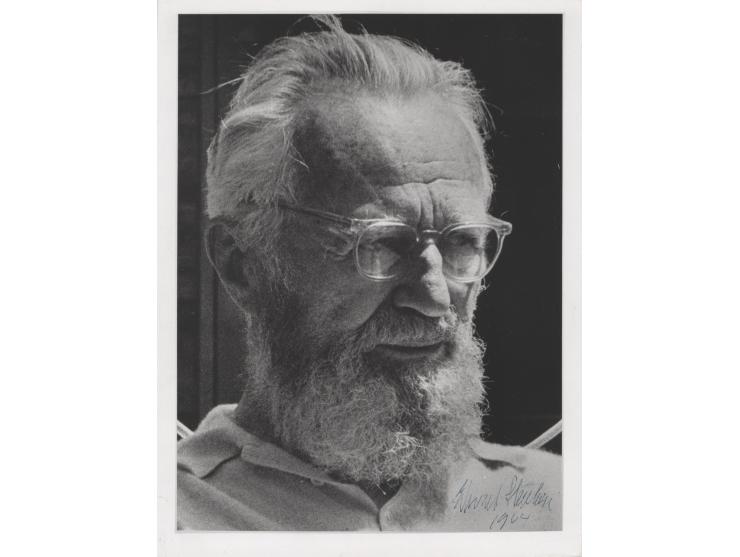
Vintage semi-glossy 7.25 x 9.5 head-and-shoulders photo of the famed photographer, signed in ballpoint, "Edward Steichen, 1964." In fine condition.
Opening: $200
Estimate: $200 - $300
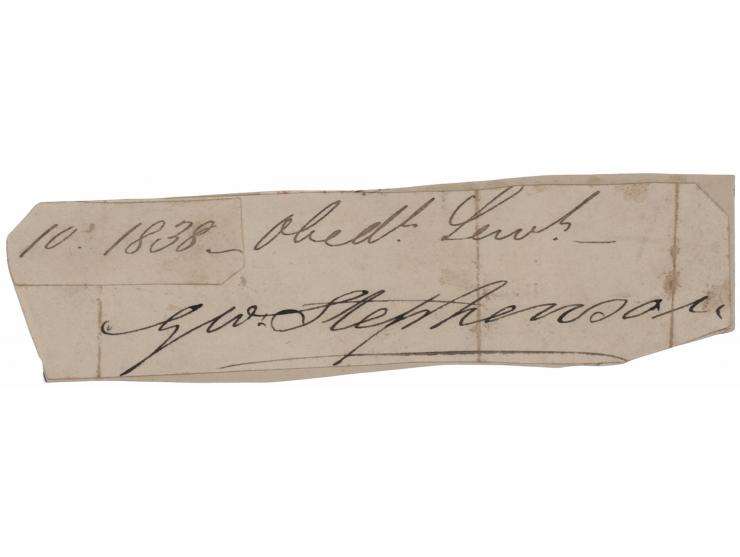
Ink signature, "Geo: Stephenson,” on an off-white 4.5 x 1 slip bearing an affixed date tab of "1838." Applied to a slightly larger cardstock mount and in very good to fine condition, with irregular trimming and several vertical folds.
Opening: $200
Estimate: $500 - $700
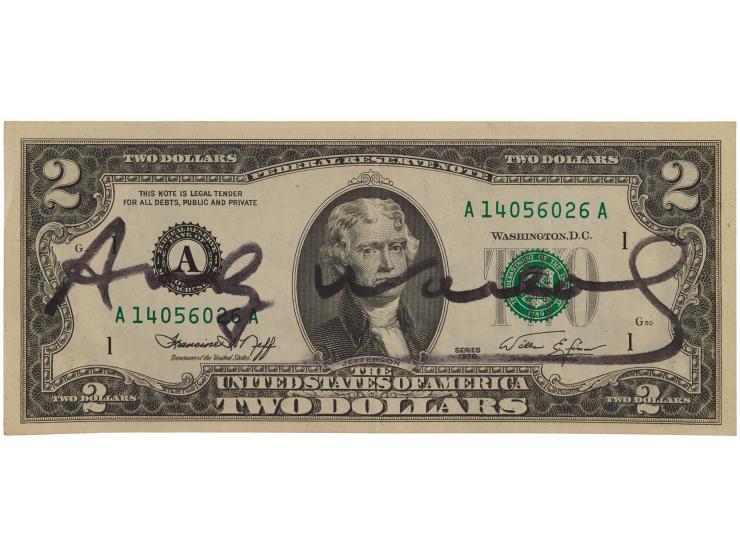
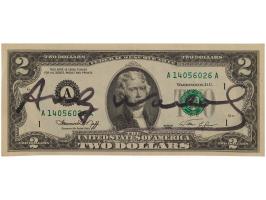
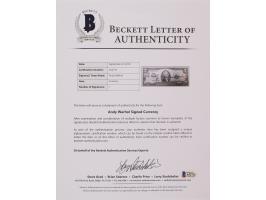
Series 1976 two-dollar bill, prominently signed on the portrait side in black felt tip by Andy Warhol. In fine condition. Accompanied by a full letter of authenticity from Beckett Authentication Services. Consignor notes that this was signed at an event in New York City, circa 1984.
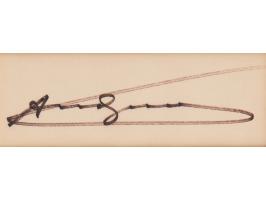
Opening: $200
Estimate: $500 - $600
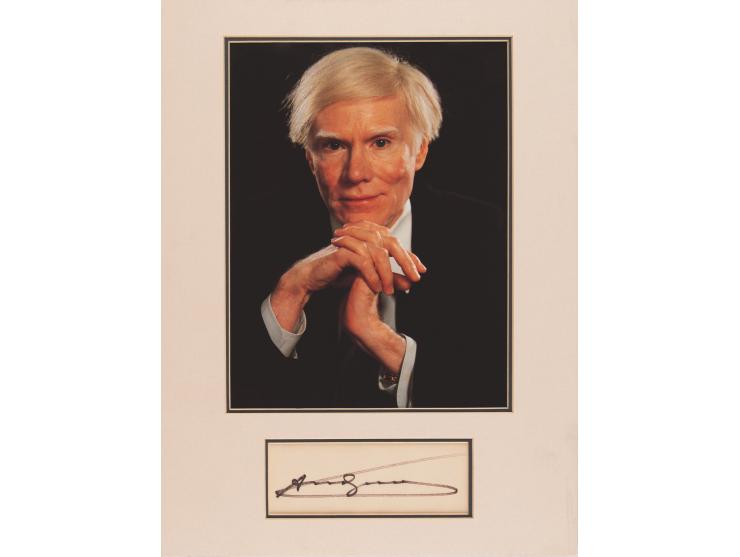
Felt tip signature, "Andy Warhol,” on an off-white 5.5 x 2 card, double-matted with a portrait to an overall size of 12 x 15.75. In fine condition.
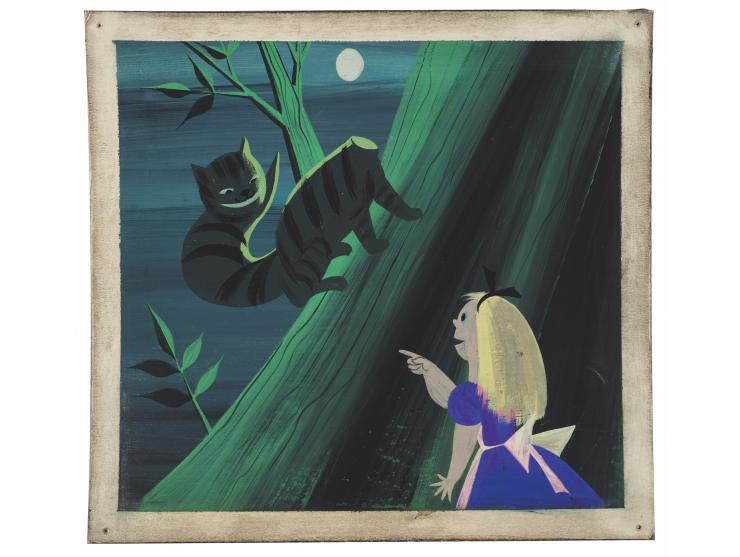
Opening: $1,000
Estimate: $15,000 - $20,000
(Walt Disney Studios, 1951) Incredible original concept painting by Mary Blair for Alice in Wonderland, showing Alice talking with the Cheshire Cat in his tree in the Tulgey Wood; the cat offers his trademark mischievous grin while he balances his disembodied head on his wide striped tail. Rendered in surreal shades of green, blue, and black, the moonlit scene is a superb example of Blair's artistic style—the composition dominated by striking contrasts of dark and light, as Alice and the Cat meet at the boundary between the commonplace and the supernatural. Accomplished in tempera on 9.25 x 8.5 artist's board. In fine condition, with tack holes at corners.
Blair was a concept artist for Disney during the 1940s and early 1950s, working on designs for such films as Peter Pan, Cinderella, and Alice in Wonderland. She also created designs for several Disney attractions (including It's a Small World), and her largest work ever, the multi-story mosaic in Disney World's Contemporary Hotel concourse. A marvelous, fantastical example of Blair's original artwork, boasting two of Disney's most desirable characters in a well-composed scene.
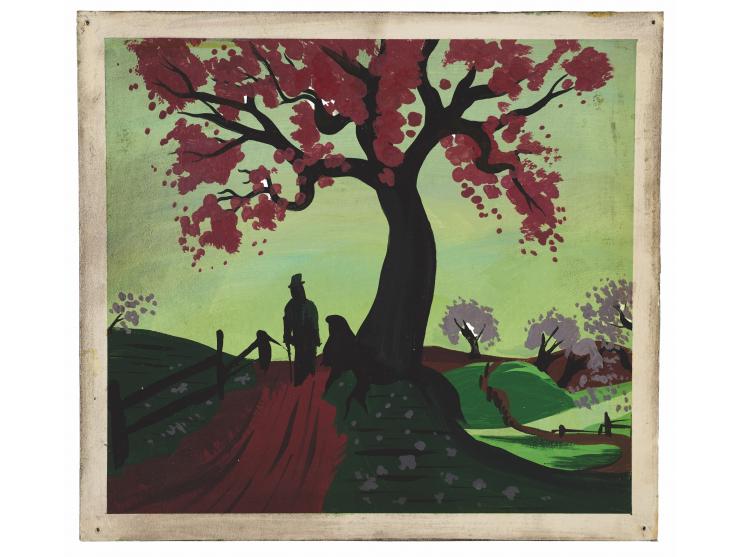
Opening: $1,000
Estimate: $12,000 - $15,000
(Walt Disney Studios, 1946) Nice original concept painting by Mary Blair for Song of the South, showing Uncle Remus passing by the Tar Baby on the road while singing 'Zip-a-Dee-Doo-Dah.' Inspired by a classic folktale as told by Joel Chandler Harris in his 'Uncle Remus' stories, Blair expertly executes the Southern scene, stylishly rendering the blooming magnolia trees and fence along the road, with the subjects silhouetted against the green-hued sky. Accomplished in tempera on 9.75 x 9 artist's board. In fine condition, with tack holes at corners.
Blair was a concept artist for Disney during the 1940s and early 1950s, working on designs for such films as Peter Pan, Cinderella, and Alice in Wonderland. She also created designs for several Disney attractions (including It's a Small World), and her largest work ever, the multi-story mosaic in Disney World's Contemporary Hotel concourse. A superb conception of an Academy Award–winning scene by one of Disney's great artists—'Zip-a-Dee-Doo-Dah' would go on to win the Oscar for Best Original Song.
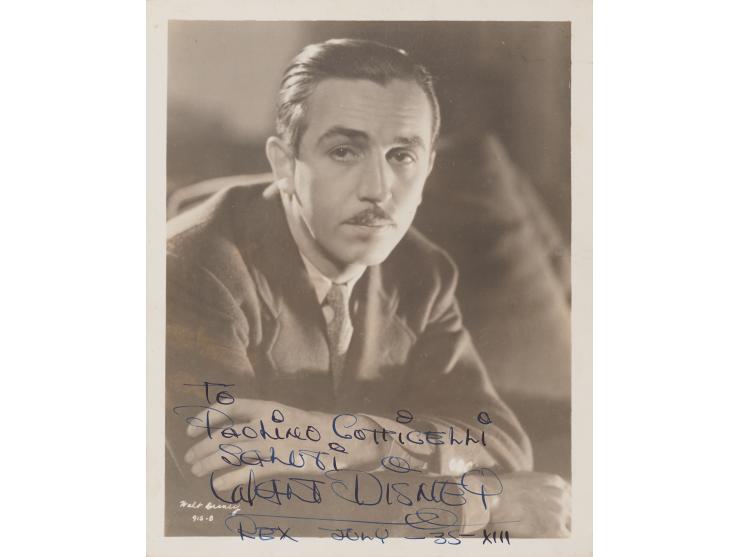
Opening: $500
Estimate: $3,000 - $5,000
Spectacular vintage matte-finish 8 x 10 photo of the youthful Walt Disney, signed and inscribed in fountain pen, "To Paolino Cotticelli, Saluti, Walt Disney, Rex July—35—XIII.” In very fine condition.
In 1935, Walt Disney traveled to Italy as part of a broader European trip following the international success of Mickey Mouse and the Silly Symphonies. During his visit, Disney was warmly received by fans and cultural figures, and he met with Italian publisher Arnoldo Mondadori, whose company played a key role in producing Disney comics for the Italian market—helping to cement Mickey Mouse’s immense popularity there, where he is known as 'Topolino.'
Opening: $200
Estimate: $1,000 - $1,500
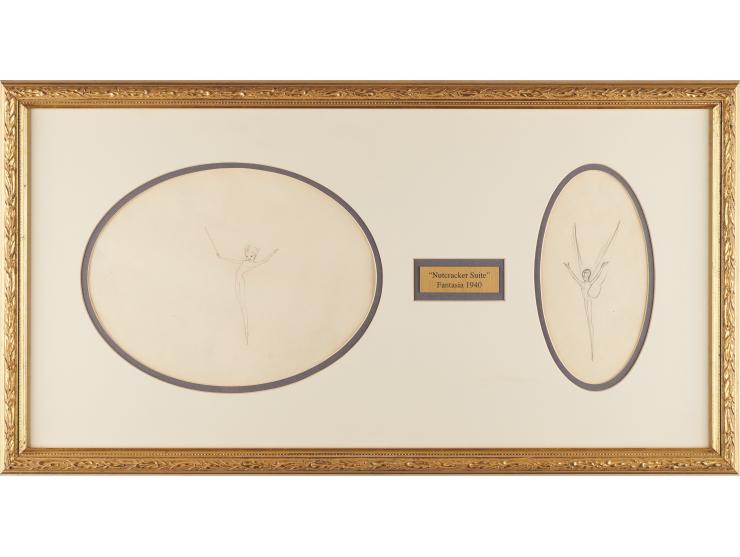
(Walt Disney Studios, 1940) Original production drawings of two fairies from Fantasia, depicting the sprites in full-figure poses as they appeared in the film's gorgeous Nutcracker Suite, one holding a wand and the other with arms raised and wings spread. Both are accomplished in graphite on sheets of animation paper measuring 4 x 8 and 11 x 8. Double-matted and framed together to an overall size of 28.5 x 15. In overall fine condition, with a crease to the larger sheet.
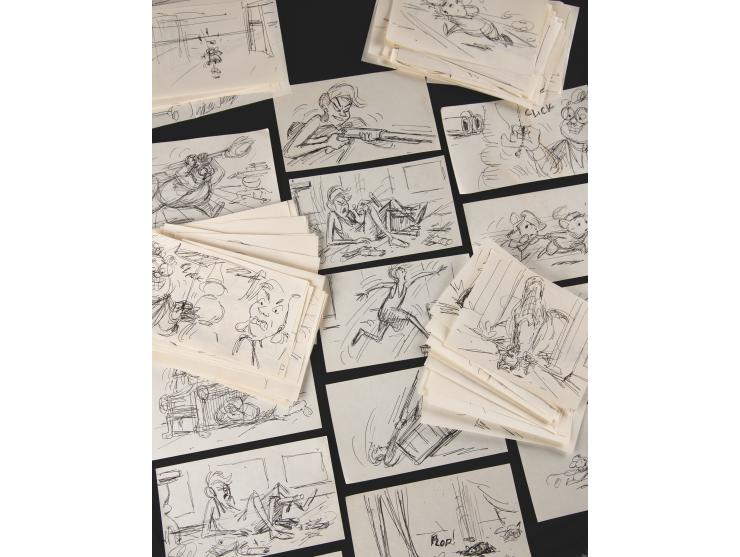
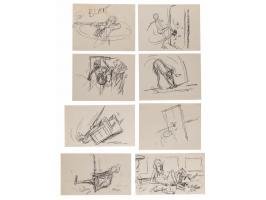
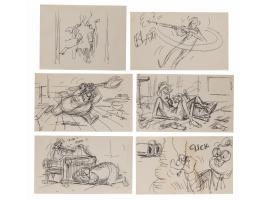
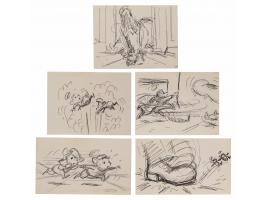
Bernard, Miss Bianca, Madame Medusa, Mr. Snoops, and Brutus and Nero collection of (113) preliminary storyboard drawings from The Rescuers
Opening: $200
Estimate: $2,000 - $2,500
(Walt Disney, 1977). Collection of 113 original preliminary storyboard drawings by Ted Berman for The Rescuers, which features characters like the mouse heroes Bernard and Miss Bianca, as well as the villains Mr. Snoops, the alligators Brutus and Nero, and Madame Medusa, the latter of whom is featured most prominently. The majority of the drawings occur around the 48:54 mark of The Rescuers, when Madame Medusa gets startled by Bernard and Bianca and, without hesitation, starts shooting her shotgun to get rid of the poor mice. The drawings are accomplished in graphite, ink, and felt tip on off-white studio bond paper ranging in size from 6 x 4.5 to 9 x 5. In overall fine condition.
From the collection of legendary Disney storyboard artist Ted Berman.
Opening: $200
Estimate: $600 - $800
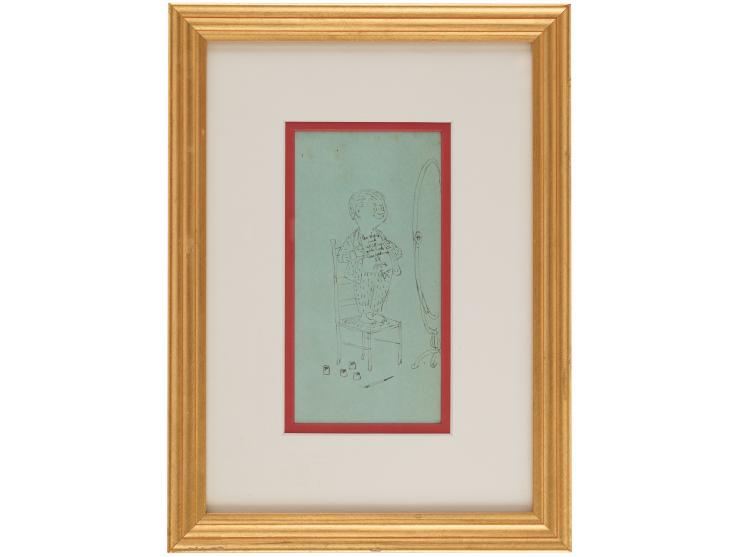
Highly desirable ink sketch of Pugsley from The Addams Family drawn by Charles Addams on a green 3.75 x 7.5 sheet, signed and inscribed on the character's chest, "For Middy and Whitney, with love, Chas. Addams." Attractively double-matted and framed to an overall size of 10.5 x 14. In fine condition.
Opening: $200
Estimate: $200 - $400
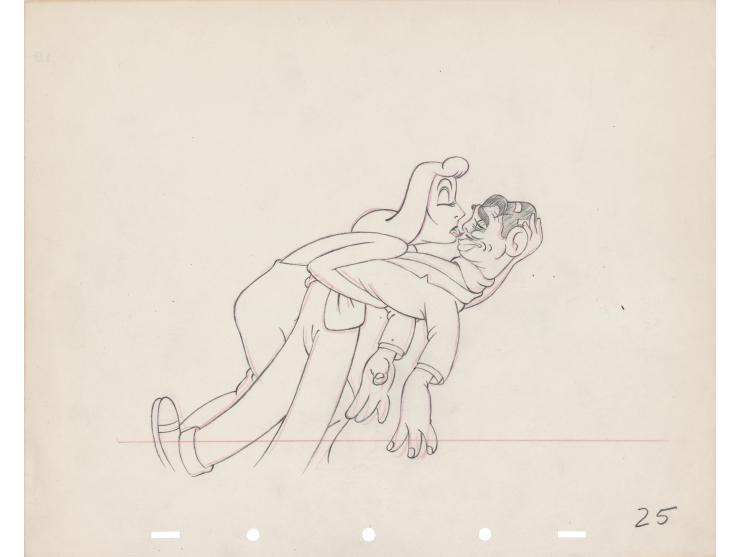
(Walt Disney Studios, 1939) Original production drawing of Greta Garbo and Clark Gable from The Autograph Hound, showing the Hollywood icons in a dramatic embrace. Accomplished in graphite and colored pencil on untrimmed 12 x 10 animation paper marked "25" in the lower right corner. Image measures 7 x 5.5. In fine condition.
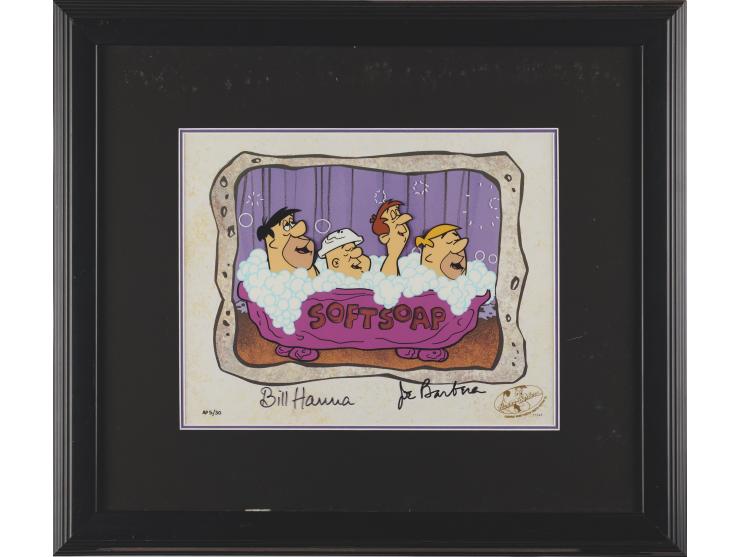
Fred Flintstone and Barney Rubble limited edition cel for The Flintstones entitled 'Soft Soap'
Opening: $200
Estimate: $300 - $400
(Hanna-Barbera Studios, 1994) Original limited edition cel for The Flintstones, numbered AP 5/30, featuring Fred Flintstone, Barney Rubble, and two construction workers singing in a bathtub for a ‘Soft Soap’ commercial. The cel, which is comprised of the bathtub, its occupants, and floating and popping bubbles, is placed on a matching production background. The total character image measures 8.5 x 5.25, with a mat opening of 12 x 9.5. Double-matted and framed to an overall size of 21 x 18.5. The lower right corner bears a Hanna-Barbera seal numbered "24547." In fine condition, some wear to the frame.
The famous ‘Soft Soap’ jingle was featured in the episode, ‘The Flintstone Canaries,’ the sixth episode of the fourth season of the original series, which aired on October 24, 1963. The song was sung by Barney Rubble and the Flintstone Canaries for a ‘Soft Soap’ commercial during the fictional program, Hum-Along with Herman Show.
Opening: $200
Estimate: $300 - $500
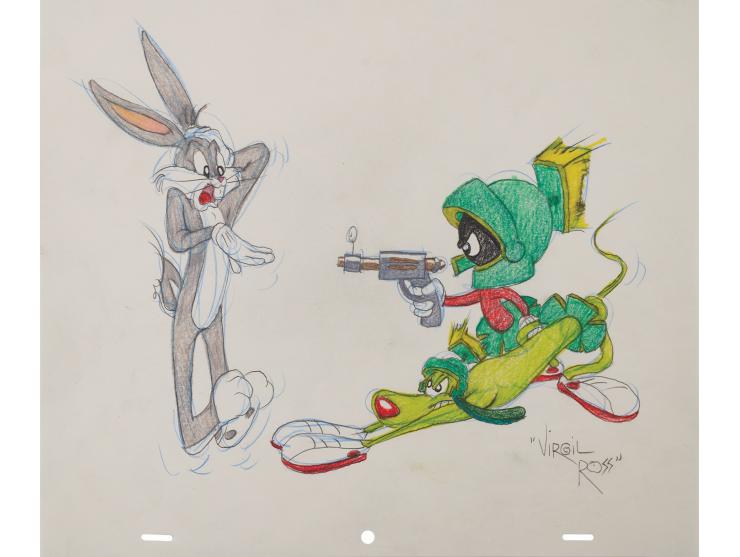
(Warner Bros. Studios, 1990s) Original drawing by Virgil Ross showing Marvin the Martian, with his dog, K-9, pointing a space gun at a distraught Bugs Bunny. Accomplished in graphite and colored pencil on untrimmed 12.5 x 10.5 animation paper, signed at the bottom in pencil, "Virgil Ross." In fine condition. This drawing was done to be sold in the Warner Bros. Studio stores in the 1990s.
Opening: $200
Estimate: $800 - $1,000
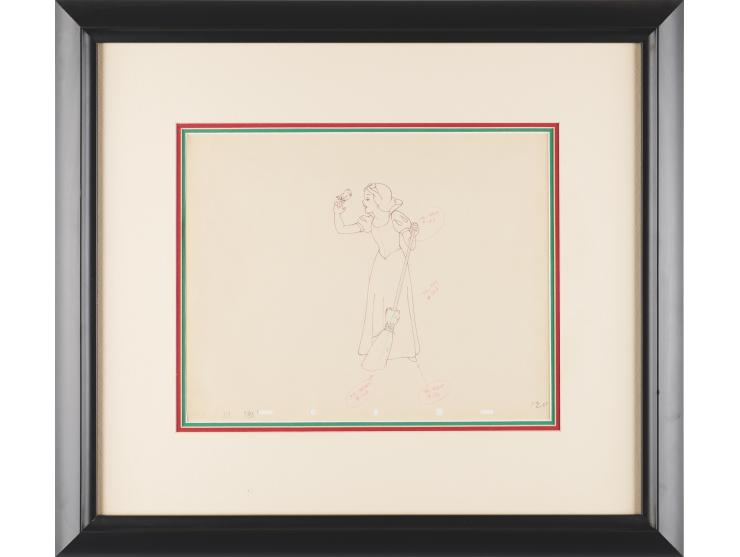
(Walt Disney Studios, 1937) Lovely original production drawing of the title character from Snow White and the Seven Dwarfs, depicting Disney’s original princess in a wonderful full-figure pose holding a broom and speaking to a small bird perched on her finger, with the character image measuring 3.5 x 5.75. Accomplished in graphite and colored pencil on 11.5 x 9 animation paper marked "124" in the lower right corner, and stamped "2001, 3D, 18A" in the lower left corner. Triple-matted and framed to an overall size of 20 x 17.5. In fine condition. An exemplary piece of original hand-drawn production art from Disney’s first animated feature film.
Opening: $300
Estimate: $3,000 - $5,000
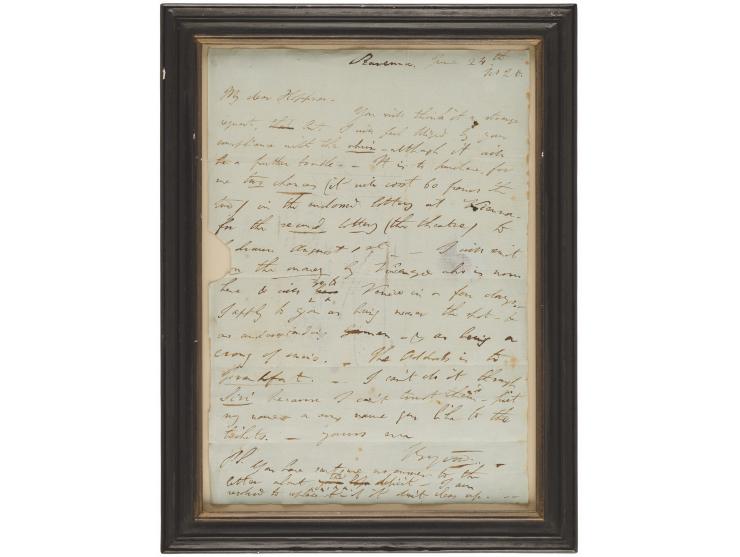
ALS signed “Byron,” one page, 7.75 x 11, June 24, 1820. Handwritten letter from Ravenna to Richard Belgrave Hoppner, the English Consul at Venice and Byron's friend. In part: "You will think it a strange request, but I will feel obliged by your compliance with the whim—although it will be a further trouble—It is to procure for me two chances (it will cost 60 francs the two) in the enclosed lottery at Vienna for the second lottery (the theatre) to be drawn August 1st. I will send the money by Vincenzo who is now here & will go to Venice in a few days. I apply to you as being one near that spot & as an outstanding man & as being a crony of mine…Put my name or any name you like to the tickets." Mounted and framed to an overall size of 10 x 13.5. In fine condition, with seal-related paper loss to the left edge.
Byron lived in Ravenna from 1819 to 1821, one of the most productive and politically turbulent periods of his life, during which he became involved with the Carbonari revolutionary movement. While residing there he continued work on Don Juan and completed several major dramatic works, including Marino Faliero, Sardanapalus, and The Two Foscari. A casually humorous and highly personal letter from this important Italian period.
Opening: $200
Estimate: $1,500 - $2,000
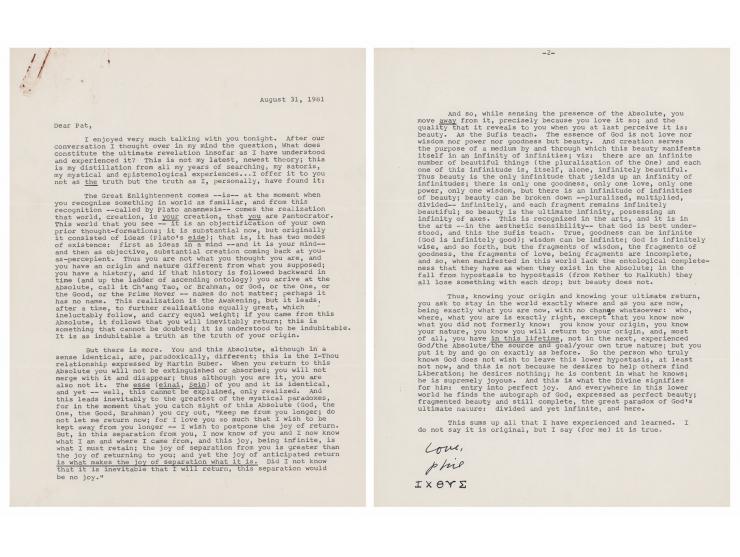
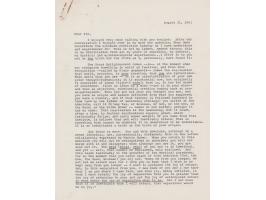
TLS signed “Love, Phil," who adds Greek characters below, "ΙΧΘΥΣ,” two pages, 8.5 x 11, August 31, 1981. Letter to science fiction author Patricia Warrick, in full: “I enjoyed very much talking with you tonight. After our conversation I thought over in my mind the question, What does constitute the ultimate revelation insofar as I have understood and experienced it? This is not my latest, newest theory; this is my distillation from all my years of searching, my satoris, my mystical and epistemological experiences…I offer it to you not as the truth but the truth as I, personally, have found it:
The Great Enlightenment comes—is—at the moment when you recognize something in world as familiar, and from this recognition—called by Plato anamnesis—comes the realization that world, creation, is your creation, that you are Pantocrator. This world that you see it is an objectification of your own prior thought-formations; it is substantial now, but originally it consisted of ideas (Plato's eide); that is, it has two modes of existence: first as ideas in a mind—and it is your mind—and then as objective, substantial creation coming back at you- as-percepient. Thus you are not what you thought you are, and you have an origin and nature different from what you supposed; you have a history, and if that history is followed backward in time (and up the ladder of ascending ontology) you arrive at the Absolute, call it Ch'ang Tao, or Brahman, or God, or the one, or the Good, or the Prime Mover—names do not matter; perhaps it has no name. This realization is the Awakening, but it leads, after a time, to further realizations equally great, which ineluctably follow, and carry equal weight; if you came from this Absolute, it follows that you will inevitably return; this is something that cannot be doubted; it is understood to be indubitable. It is as indubitable a truth as the truth of your origin.
But there is more. You and this Absolute, although in a sense identical, are, paradoxically, different; this is the I-Thou relationship expressed by Martin Buber. When you return to this Absolute you will not be extinguished or absorbed; you will not merge with it and disappear; thus although you are it, you are also not it. The esse (einai, Sein) of you and it is identical, and yet—well this cannot be explained, only realized. And this leads inevitably to the greatest of the mystical paradoxes, for in the moment that you catch sight of this Absolute (God, the One, the Good, Brahman) you cry out, ‘Keep me from you longer; do not let me return now; for I love you so much that I wish to be kept away from you longer—I wish to postpone the joy of return. But, in this separation from you, I now know of you and I now know what I am and where I came from, and this joy, being infinite, is what I must retain; the joy of separation from you is greater than the joy of returning to you; and yet the joy of anticipated return is what makes the joy of separation what it is. Did I not know that it is inevitable that I will return, this separation would be no joy.’
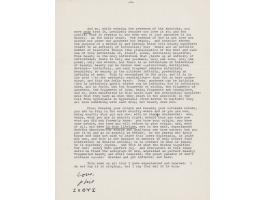
And so, while sensing the presence of the Absolute, you move away from it, precisely because you love it so; and the quality that it reveals to you when you at last perceive it is: beauty. As the Sufis teach. The essence of God is not love nor wisdom nor power nor goodness but beauty. And creation serves the purpose of a medium by and through which this beauty manifests itself in an infinity of infinities; viz: there are an infinite number of beautiful things (the pluralization of the One) and each one of this infinitude is, itself, alone, infinitely beautiful. Thus beauty is the only infinitude that yields up an infinity of infinitudes; there is only one goodness, only one love, only one power, only one wisdom, but there is an infinitude of infinities of beauty; beauty can be broken down—pluralized, multiplied, divided—infinitely, and each fragment remains infinitely beautiful; so beauty is the ultimate infinity, possessing an infinity of axes. This is recognized in the arts, and it is in the arts in the aesthetic sensibility—that God is best understood, and this the Sufis teach. True, goodness can be infinite (God is infinitely good); wisdom can be infinite; God is infinitely wise, and so forth, but the fragments of wisdom, the fragments of goodness, the fragments of love, being fragments are incomplete, and so, when manifested in this world lack the ontological completeness that they have as when they exist in the Absolute; in the fall from hypostasis to hypostasis (from Kether to Malkuth) they all lose something with each drop; but beauty does not.
Thus, knowing your origin and knowing your ultimate return, you ask to stay in the world exactly where and as you are now, being exactly what you are now, with no change whatsoever: who, where, what you are is exactly right, except that you know now what you did not formerly know: you know your origin, you know your nature, you know you will return to your origin, and, most of all, you have in this lifetime, not in the next, experienced God/the Absolute/the source and goal/your own true nature; but you put it by and go on exactly as before. So the person who truly knows God does not wish to leave this lower hypostasis, at least not now, and this is not because he desires to help others find Liberation; he desires nothing; he is content in what he knows; he is supremely joyous. And this is what the Divine signifies for him: entry into perfect joy. And everywhere in this lower world he finds the autograph of God, expressed as perfect beauty; fragmented beauty and still complete, the great paradox of God's ultimate nature: divided and yet infinite, and here. This sums up all that I have experienced and learned. I do not say it is original, but I say (for me) it is true.” In fine condition, with a rusty paperclip impression to the upper left corner. Accompanied by the original mailing envelope.
Opening: $200
Estimate: $1,500 - $2,000
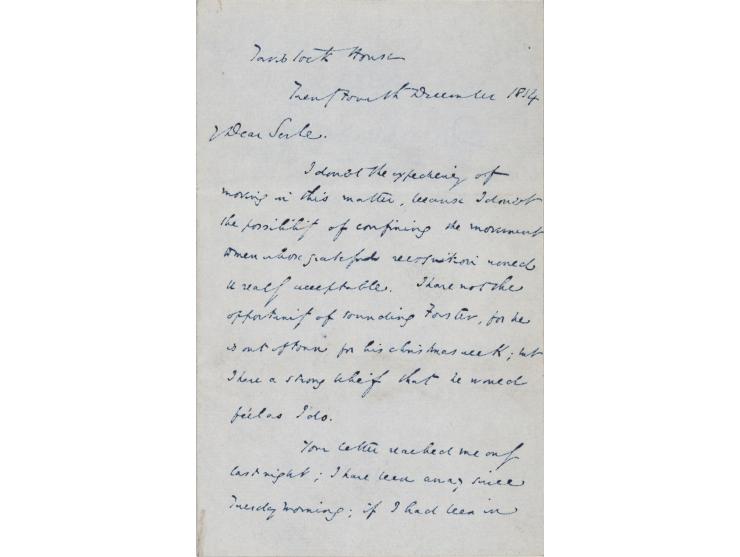
ALS, two pages on two adjoining sheets, 4.5 x 7, December 24, 1854. Handwritten letter to T. J. Serle, sent from "Tavistock House." In part: "I doubt expediency of moving in this matter, because I doubt the possibility of confining the movement to men whose gratified recognition would be really acceptable. I have not the opportunity of sounding Forster, for he is out of town for his Christmas week; but I have a strong belief that he would feel as I do." In fine condition.
Published in The Letters of Charles Dickens: 1847-1857, edited by Walter Dexter.
Opening: $200
Estimate: $1,000 - $1,500
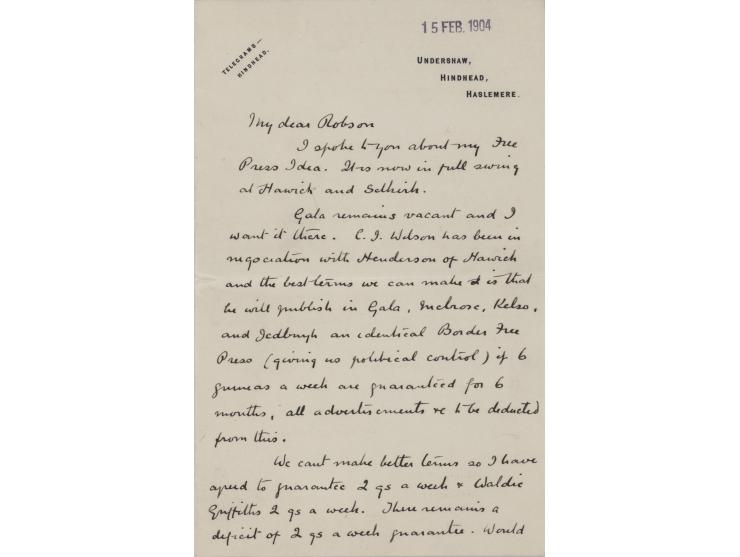
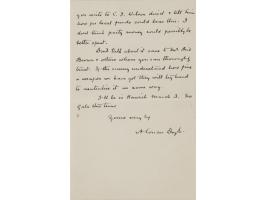
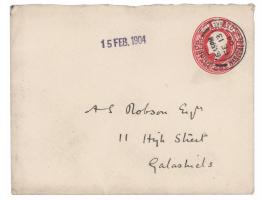
ALS signed “A. Conan Doyle,” two pages on two adjoining sheets, 4.25 x 7, Undershaw letterhead, February 15, 1904. Handwritten letter to A. S. Robson, in part: "I spoke to you about my Free Press Idea. It is now in full swing at Hawich and Selkirk. Gala remains vacant and I want it there. C. J. Wilson has been in negotiation with Henderson of Hawich and the best terms we can make it is that he will publish in Gala, Melrose, Kelso, and Jedburgh an identical Border Free Press (giving us political control) if 6 guineas a week are guaranteed for 6 months, all advertisements &c to be deducted from this. We can't make better terms so I have agreed to guarantee 2 gs a week…Would you write to C. J. Wilson direct & tell him how far local funds could bear this. I don't think party money could possibly be better spent." In very fine condition. Accompanied by the original mailing envelope, addressed in Doyle's own hand.
Opening: $1,000
Estimate: $8,000 - $10,000
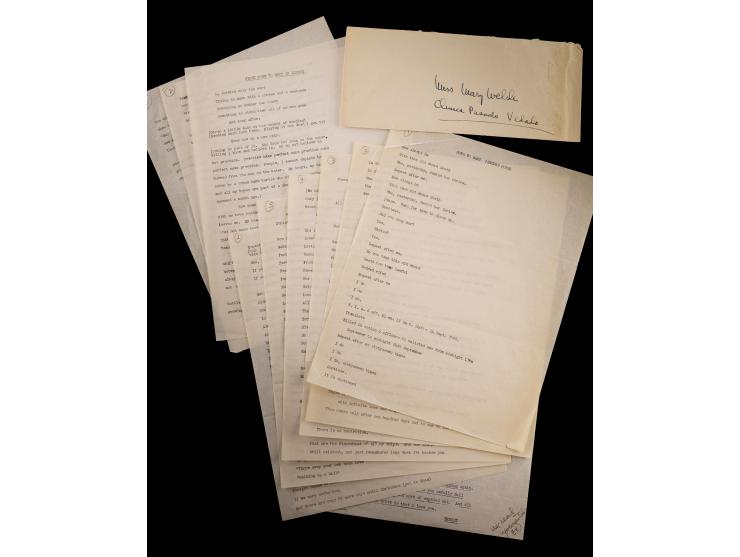
Two typewritten poetical manuscripts by Ernest Hemingway, totaling ten pages, 8.5 x 11, Ritz Hotel, Paris, September 1944. The second poem is signed in pencil on page 7, "un-read, un-corrected, E.H.," and bears additions written by Hemingway on pages 2 and 6.
The first is headed "First Poem to Mary in London," and begins: "I, loveing only the word / Trying to make with a phrase and a sentence / Something no bomber can reach / Something to stand when all of us are gone / And long after: / (Given a little luck at the moment of wording) / (Needing much luck then. Playing it out when I get it) / Come now to a new city."
The second is headed "Poem to Mary (Second Poem)," and begins: "Now sleeps he / With that old whore Death / Who, yesterday, denied her thrice. / Repeat after me / Now sleeps he / With that old whore Death / Who, yesterday, denied her thrice." On the last page, Hemingway closes with a typed letter: "So, Mary, now I love you straight and true and send you this to let you know that we had a rather sticky day today in the forest. Casualties were fairly heavy, and a certain amount of battle fatigue. Many more than there should be. But there are many contributing factors. I'm getting sort of mixed up on a lot of things again. But much clearer on others. Very hard to write about this stuff. It is different from the boat. In the boat we were always waiting for it. Here it is the happening all the time and who it happens to. I do not think about me at all any more. Bragging again. I think about you and that brings me in. I write you awfully dull letters darling, because I get tired and sort of emptied out. And all I have to tell you that I can write is that I love you."
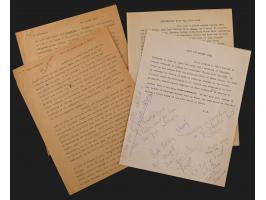
Includes the original envelope, addressed in Hemingway's hand to "Miss Mary Welsh." Also includes three of Mary Hemingway's explanations of the poems (original photocopies and carbon typescript with her handwritten revisions), totaling four pages, evidently prepared as part of the creation of the LP 'Ernest Hemingway – Reading,' released by Caedmon Records in 1965. On it, Hemingway reads 'Second Poem To Mary.'
Mrs. Hemingway relates: "After joining in the landings in Normandy on June 6, 1944, his head still wreathed in bandages, Ernest returned to London and continued flying with the RAF. On D-Day he had landed with the First Division at Omaha Beach, but when he returned to France in July he attached himself to the Fourth Division under Major-General R. O. Barton and especially to that division's Twenty-Second Regiment of Foot commanded by Gen. Charles T. Lanham, then a Colonel. He was with Col. Lanham in the battle of Huertgen Forest when he began the poem which he finished during a brief leave at the Ritz Hotel in Paris."
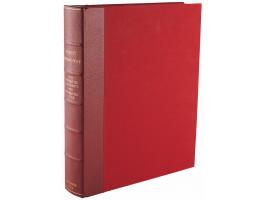
Housed in a handsome custom-made quarter-leather clamshell case. In overall very good to fine condition.
These wartime poems—written during one of the most intense periods of Hemingway’s life as a correspondent accompanying Allied troops in Europe—offer a rare and deeply personal glimpse into his emotional and psychological state in the closing months of World War II in Europe. The first poem blends reflections on language, war, and displacement, juxtaposing the permanence of words with the destruction of modern warfare. It continues with commentary on his anti-submarine patrols off the Cuban coast with Winston Guest ("Wolfie") amid meditations on fatigue, comradeship, and the dislocation of a man removed from the sea.
The second poem is darker and experimental in structure, incorporating liturgical repetition and military language to confront the realities of death in combat. Referencing casualties and the bureaucratic language of wartime reporting, Hemingway constructs a grim, ironic meditation on mortality and sacrifice. Throughout both works, moments of tenderness and longing for Mary Welsh appear amid the brutal imagery of war—an emotional anchor for him during a turbulent period.
Mary Hemingway’s accompanying notes place the poems within the context of Hemingway’s wartime activities, capturing Hemingway at the intersection of love and violence. Manuscript material relating to Hemingway’s wartime experiences is exceedingly scarce, and literary manuscripts of his poetry are rarer still. The present group, combining two substantial poems, minor autograph corrections, a signed notation, a heartfelt letter, and contextual material from Mary Hemingway herself, represents an exceptional and intimate survival from a dramatic chapter of Hemingway’s life.
Opening: $500
Estimate: $8,000 - $10,000
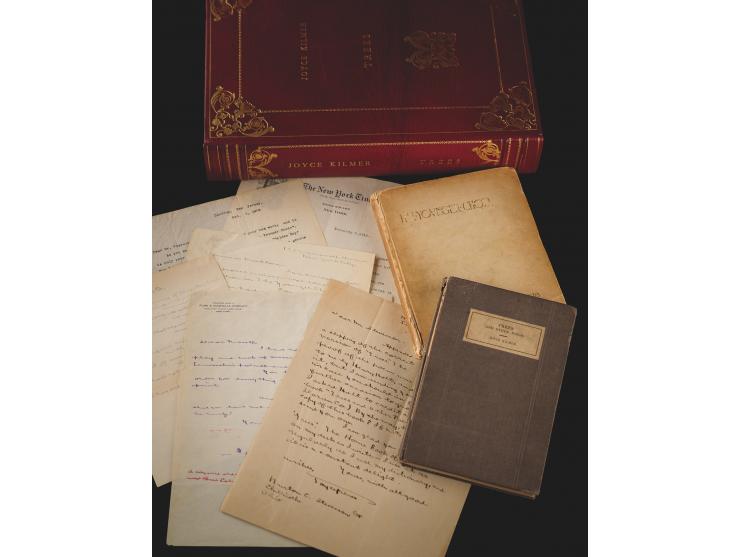
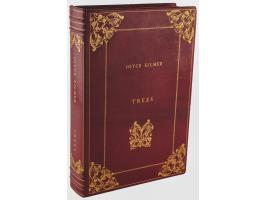
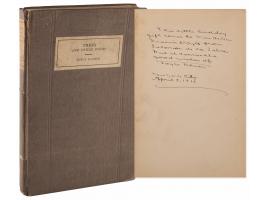
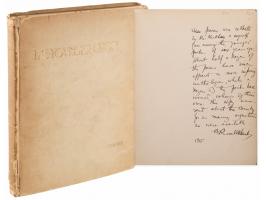
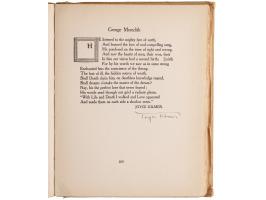
Remarkable archive comprising two books signed by Joyce Kilmer—an inscribed first edition of Trees and Other Poems and the multi-signed limited edition of The Younger Choir—plus correspondence related to their publication, and an autograph manuscript of Kilmer's "Poets."
- Signed book: Trees and Other Poems. First edition. NY: George H. Doran Company, 1914. Hardcover, 5.5 x 8, 75 pages. Signed and inscribed on the first free end page in ink, "This little birthday gift comes to Miss Helen Francis Doyle from Salomon de la Selva, But it carries the good wishes of Joyce Kilmer, New York City, April 5, 1915." Autographic condition: fine, with light soiling to the margin of the signed page. Book condition: VG-/None, with wear to the spine's paper label, chips to the bottom of the spine, and a partially cracked front hinge.
- Signed book: The Younger Choir. First edition, limited issue, numbered 14/500 [with only the first 50 autographed]. NY: Moods Publishing Company, 1910. Signed throughout by the editor, Edwin Markham, and more than twenty contributors. including Joyce Kilmer, Louis Untermeyer, Elsa Barker, George W. Cronyn, Herbert Everett, Adelaide Wood Guthrie, B. Russell Herts, Reginald Wright Kauffman, Ludwig Lewisohn, Otto S. Mayer, Philip Moeller, James Oppenheim, Seumas O'Sheel, Muriel Rice, Jessie E. Sampter, Herman Scheffauer, Edwin Davies Schoonmaker, Charles Hanson Towne, George Sylvester Viereck, Thomas Walsh, and Carlos S. Wuppermann. Also signed on the first free end page with a lengthy presentation inscription, "These poems were collected by Mr. Markham & myself from among the youngest poets of six years ago. About half a dozen of the poems have since appeared in more imposing anthologies, while a dozen of the poets have issued volumes of their own. This copy was sent about the country for as many signatures as were available. B. Russell Herts, 1915." Autographic condition: fine. Book condition: VG-/None, with edgewear, bumped corners, toning, and scuffing to boards.
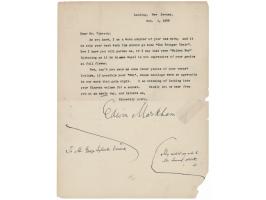
- TLS signed "Edwin Markham," one page, October 5, 1909, to George Sylvester Viereck. In part: "As you know, I am a warm admirer of your best work; and it is only your best work that should go into 'The Younger Choir.' Now I know you will pardon me, if I say that your 'Golden Boy' (pleasing as it is in some ways) is not expressive of your genius at full flower. Now, can't you send me some other pieces of your verse? Include, if possible, your 'Owl,' whose hootings were so agreeable to our ears that gala night." Viereck's poems 'Ode to a Parrot' and 'Iron Passion' would ultimately appear in the anthology.
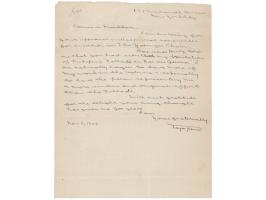
- ALS signed "Joyce Kilmer," one page, November 5, 1909, to Edwin Markham. In part: "I am enclosing for your approval or disapproval or disapproval some verses for insertion in The Younger Choir. Comrade Hertz told me that you had selected my imitation of Richepin's 'Ballade du Roi des Gueux.' I am naturally eager to have more of my work in the volume—especially to have the poem representing me a more sincere and original effort than the Ballade." Kilmer's poems 'Ballade of My Lady's Beauty' and 'George Meredith' were chosen for publication in The Younger Choir.
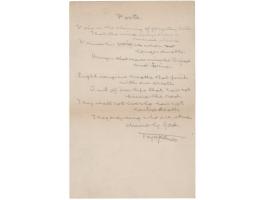
- AMS in pencil, Signed "Joyce Kilmer," one page, no date. Kilmer's handwritten manuscript for "Poets," in full: "Vain is the chiming of forgotten bells / That the wind sways above a ruined shrine / Vainer his voice in whom no longer dwells / Hunger that craves immortal bread and wine. / Light songs we breathe that perish with our own breath / Out of our lips that have not kissed the rod, / They shall not live who have not tasted death / They only sing who are struck dumb by God."
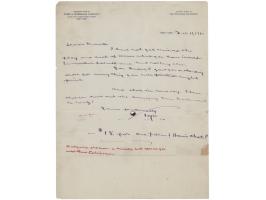
- ALS signed "Joyce," one page, Funk & Wagnalls Company letterhead, February 11, 1910, to "Russell." In part: "I have not yet received the play and book of verses which you have issued. Lewissohn's poems came but nothing else. You know, I gave you a standing order for everything you ever might print…$18 for one poem! How's that?"
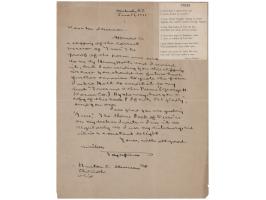
- ALS signed "Joyce Kilmer," one page, June 13, 1915, to "Mr. Stevenson." In part: "Appended is a clipping of the correct version of 'Trees.' The proof of the poem was sent to me by Henry Holt, and I revised it, but I am sending you this clipping in case you should in future have further occasion to quote the poem. I asked Holt to credit it to my book 'Trees and Other Poems' (Geroge H. Doran Co.) By the way, have you a copy of this book? If not, I'll gladly send you one. I am glad you are quoting 'Trees.' The Home Book of Verse is on my desk as I write—I use it as regularly as I use my dictionary, and it is a constant delight." The corrected poem clipping is affixed in the upper right corner.
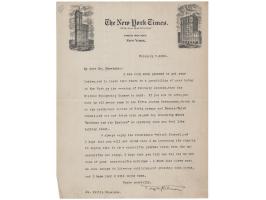
- TLS signed "Joyce Kilmer," one page, New York Times letterhead, February 5, 1916, to "Dr. Skrainka." In part: "If you are in town, you must by all means come to the Fifth Avenue Restaurant…and eat and drink with us, and say something about 'Dickens and the Doctors' or anything else you feel like talking about. I always enjoy the Interstate Medical Journal, and I hope that you will not think that I am lessening its dignity in saying that it is a scientific journal which even the unscientific can enjoy."
All are housed in a handsome custom-made full morocco clamshell case. The letters are in overall fine condition.
Opening: $300
Estimate: $3,000 - $5,000
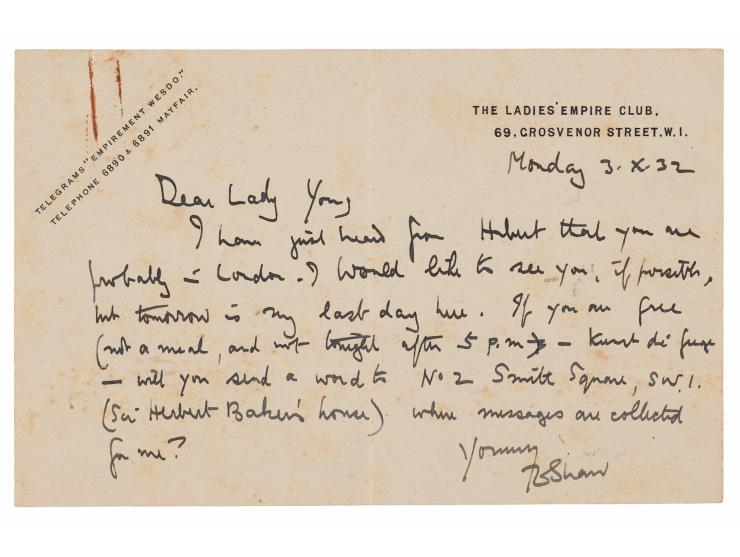
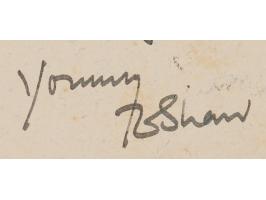
ALS signed “T. E. Shaw,” one page, 7 x 4.5, The Ladies' Empire Club letterhead, October 3, 1932. Handwritten letter to "Lady Young," the wife of English soldier and colonial administrator Hubert Young, author of The Independent Arab, a part-memoir, part-travelogue detailing his diplomatic and military time in the Middle East. In full: "I have just heard from Hubert that you are probably in London. I would like to see you, if possible, but tomorrow is my last day here. If you are free (not a meal, and not tonight after 5 p.m.)—kunst di fuge—will you send a word to No. 2 Smith Square, S.W.1. (Sir Herbert Baker's house) where messages are collected for me." In very good to fine condition, with scattered light foxing, and a rusty paperclip impression to the upper left corner.
This letter dates to the final chapter of T. E. Lawrence’s life, when the famed 'Lawrence of Arabia' was living quietly following his celebrated—and controversial—role in the Arab Revolt. Having retreated from public life into the ranks of the Royal Air Force under the name T. E. Shaw, Lawrence carefully guarded his privacy while maintaining select friendships within Britain’s political and diplomatic circles.
Opening: $200
Estimate: $1,500 - $2,000
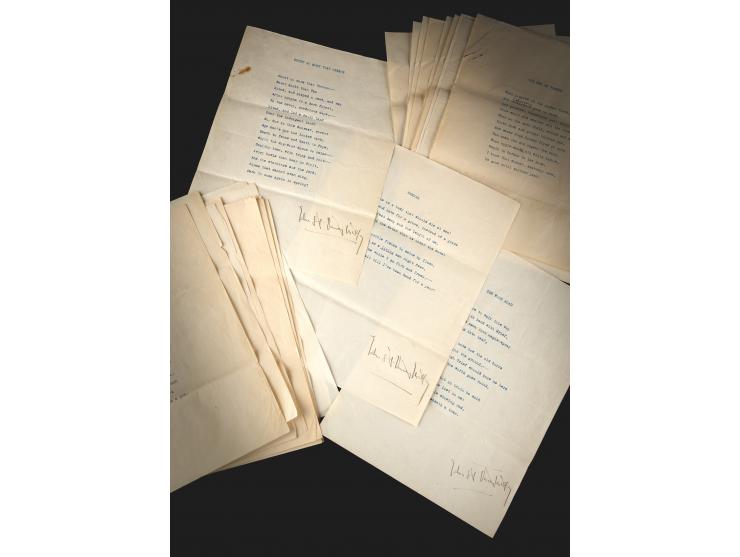
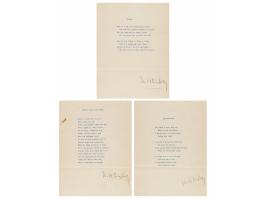
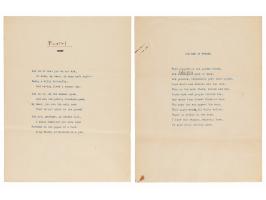
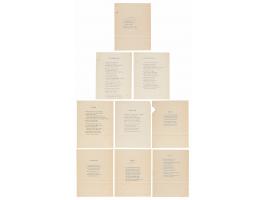
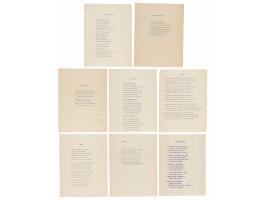
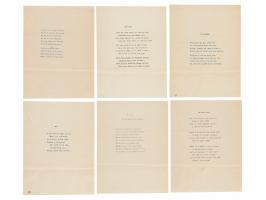
Collection of 26 typewritten manuscripts of poems by renowned lyrical poet and playwright Edna St. Vincent Millay, 28 total pages on 8.5 x 11 sheets, compiled by her mother, Cora Lounella Buzelle, and forwarded to Charles Hapgood, the son of writers Hutchins Hapgood and Neith Boyce, on September 24, 1920. Of the collection, three of the poems are signed at the bottom in fountain pen by the author, “Edna St. Vincent Millay.” These are: ‘Burial,’ ‘Doubt No More That Oberon’ [both published in 1920], and ‘The Wood Road’ [published in 1923]. The full list of unsigned poems includes:
‘Pastel’
‘The End of Summer’
‘Bereavement’
‘The Merry Spinner’
‘Progress’
‘The Poet’s Request’
‘A Blessing (To R. R.)’
‘The Two Loves’
‘To the Poison Ivy’
‘She Is Overheard Singing’ - 2 pages
‘The Pear Tree’
‘The Penitent’
‘Nocturne’
‘Wraith’ - 2 pages
‘The Little Hill’
‘That Which Is Love’s’
‘No Matter What I Say’
‘The Merry Maid’
‘Low-Tide’
‘To Kathleen’
‘Ebb’
‘To S. M. (If he should lie a-dying)’
[Untitled]
The following manuscripts are unpublished according to Yost's bibliography in Collected Poems (1956) and Collected Lyrics (1939): ‘Bereavement,’ ‘The Merry Spinner,’ ‘Progress,’ ‘The Poet's Request,’ and ‘A Blessing.’ Also included is an untitled poem beginning, “A poem is not a thing that grows.” The remaining manuscripts were later published: ‘That Which is Love’s’ (1919); ‘She is Overheard Singing,’ ‘The Penitent,’ ‘Nocturne’ [later titled ‘MacDougal Street’], ‘The Merry Maid,’ ‘To Kathleen,’ ‘To S. M., If he should lie a-dying’ (1920); ‘Wraith,’ ‘The Little Hill,’ ‘No Matter What I Say’ [later titled ‘Eel Grass’], ‘Low-Tide,’ ‘Ebb’ (1921); and ‘The Pear Tree’ (1956).
The collection features a few handwritten amendments: Millay changes the name of a poem from ‘Song’ to “Pastel,” and, in the poem ‘The End of Summer,’ Millay strikes through the word “calliopsis” and writes above, “Coreopsis.” Below, in the same poem, she pluralizes the word “appleseed” and adds a comma. ‘The End of Summer’ was published in The Melody of Earth, ca. 1920, and ‘Pastel,’ to the best of our knowledge, was unpublished. In overall fine condition, with some creases, paper loss, and rust stains from paperclips.
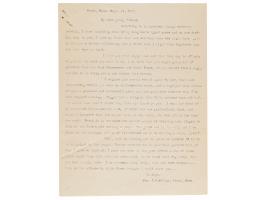
Accompanied by a typed letter from Millay’s mother, dated September 24, 1920, addressed from Truro, Massachusetts, and sent to Hapgood. It reads, in part: “I have looked up some of my daughter's typed poems and am now sending them to you. I have no doubt that had she been here she might have gotten for you a better collection, but I chose what I might from duplicate copies that were at hand. I hope that you will enjoy them and that they may be of help to you in the work you want to do. I am sure that you might get a lot of pleasure from her book Renascence and Other Poems, if you should find a copy, and she is to bring out a new volume this Autumn.” Includes the original mailing envelope.
Edna St. Vincent Millay graduated from Vassar in 1917, having already achieved widespread recognition with the publication of her first volume, Renascence and Other Poems. Her next collection, A Few Figs from Thistles (1920), helped establish her as one of the leading poetic voices of her generation. Dating from this same early period in Millay’s career, the present archive preserves a substantial group of her poems in manuscript form, including several that remain unpublished according to standard bibliographies. Groups of Millay manuscripts of this scale are seldom encountered, and the survival of more than two dozen poems—some with authorial revisions and three signed by the poet—offers a revealing glimpse into the working manuscripts of one of the twentieth century’s most celebrated American lyric poets.
Opening: $200
Estimate: $1,000 - $2,000
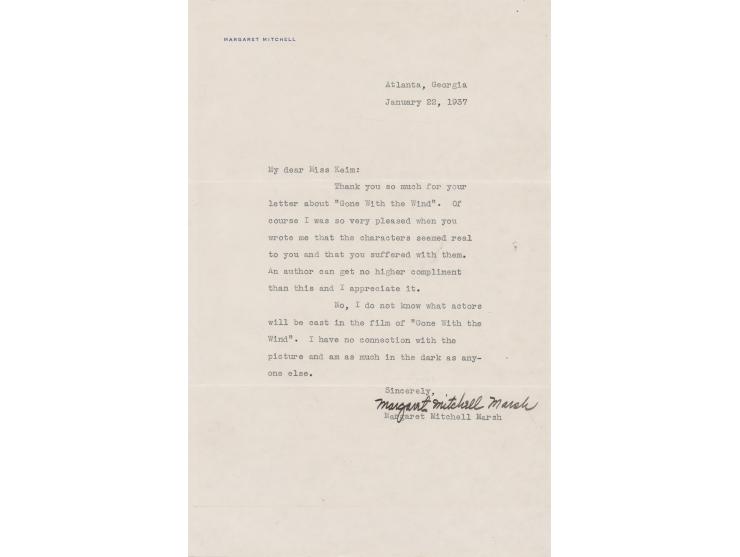
TLS signed "Margaret Mitchell Marsh," one page, 7 x 11, personal letterhead, January 22, 1937. Letter to "Miss Keim," in full: "Thank you so much for your letter about 'Gone with the Wind.' Of course I was so very pleased when you wrote me that the characters seemed real to you and that you suffered with them. An author can get no higher compliment than this and I appreciate it. No, I do not know what actors will be cast in the film of 'Gone with the Wind.' I have no connection with the picture and am as much in the dark as anyone else." In fine condition.
Only a month after Mitchell published her bestseller in 1936, David O. Selznick of Selznick International Pictures purchased the film rights for $50,000. Casting took two years and filming finally began on January 26, 1939, with Clark Gable and Vivien Leigh as the film's two main characters, Rhett Butler and Scarlett O'Hara.
Mitchell, for her part, did not want an active role in the production of the film, but did enjoy receiving updates from the set. The film premiered on December 15, 1939, in Atlanta, Georgia, with local crowds showing Mitchell and her film overwhelming amounts of support. In addition to a three-day parade, the Georgia governor declared December 15th a state holiday.
Opening: $200
Estimate: $1,000 - $2,000
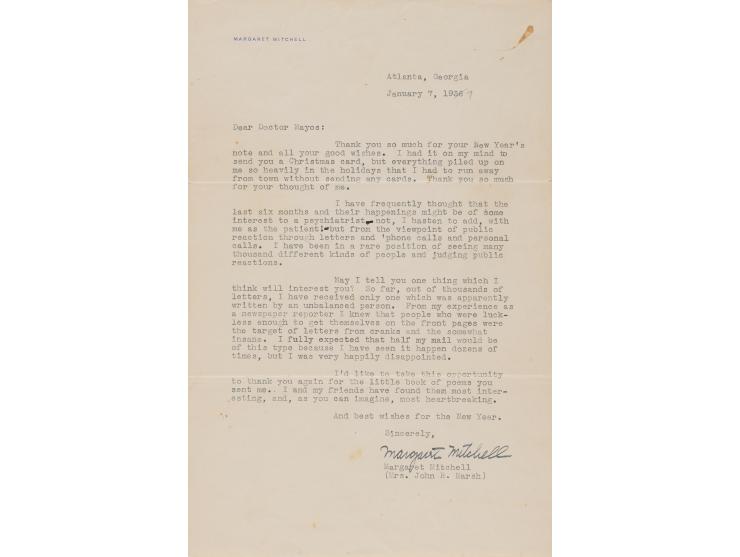
TLS, one page, 7.25 x 11, personal letterhead, January 7, 193[7]. Letter to "Doctor Mayos," in part: "I have frequently thought that the last six months and their happenings might be of some interest to a psychiatrist—not, I hasten to add, with me as the patient!—but from the viewpoint of public reaction through letters and 'phone calls and personal calls. I have been in a rare position of seeing many thousand different kinds of people and judging public reactions.
May I tell you one thing which I think will interest you? So far, out of thousands of letters, I have received only one which was apparently written by an unbalanced person. From my experience as a newspaper reporter I knew that people who were luckless enough to get themselves on the front pages were the target of letters from cranks and the somewhat insane. I fully expected that half my mail would be of this type because I have seen it happen dozens of times, but I was very happily disappointed.
I'd like to take this opportunity to thank you again for the little book of poems you sent me. I and my friends have found them most interesting, and, as you can imagine, most heartbreaking." In fine condition, with a few small stains.
Upon its release in the summer of 1936, Gone With the Wind swiftly captured the hearts and imaginations of readers, garnering widespread acclaim for its sweeping narrative and vivid characters. Margaret Mitchell's depiction of the antebellum South amidst the turmoil of the Civil War resonated deeply with audiences, propelling the novel to unparalleled success. Critics hailed Mitchell's storytelling prowess and her ability to evoke a sense of place and time with remarkable detail. It became an instant bestseller, selling over 1,000,000 copies within the first six months of its publication, and she was besieged with fan mail, invitations, and autograph requests—fortunately, few from 'unbalanced cranks.'
Opening: $200
Estimate: $1,000 - $1,500
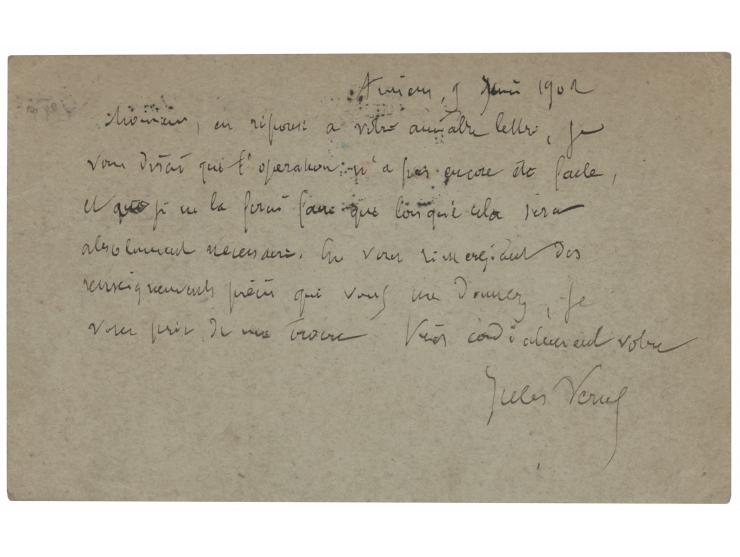
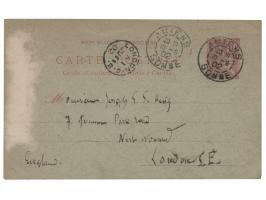
ALS in French, signed "Jules Verne," one page on a 5.5 x 3.5 postcard, June 9, 1902. Handwritten letter to a friend, sending thanks for his message and commenting on a needed surgery. Addressed on the reverse in Verne's hand. In fine condition, with some paper residue along the left edge of the address side.