Abraham Lincoln
Opening: $10,000
Estimate: $100,000 - $150,000
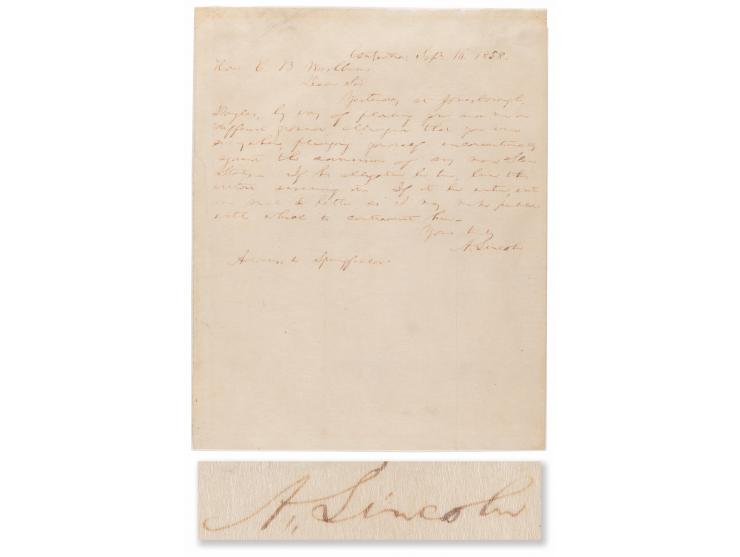
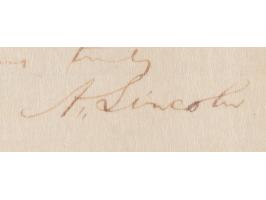
Historic ALS signed “A. Lincoln,” one page, 7.75 x 9.75, September 16, 1858. Handwritten letter to Congressman Elihu B. Washburne, concerning an allegation made by Stephen Douglas against Washburne at the preceding Lincoln-Douglas debate in Jonesboro, Illinois. Lincoln addressed the letter from Centralia, Illinois, a city about 80 miles north of Jonesboro and about 100 miles southwest of Charleston, Illinois, the site of Lincoln's next debate with Douglas two days later. Lincoln took the evening northbound train from Centralia on his way to Charleston.
The letter, in full: “Yesterday at Jonesborough, Douglas, by way of placing you and me on different ground, alledged that you were everywhere, pledging yourself unconditionally against the admission of any more Slave States. If his allegation be true, burn this without answering it. If it be untrue, write me such a letter as I may make public with which to contradict him.” To the lower left, Lincoln adds, “Address to Springfield.” Elihu B. Washburne was elected as a Whig to the 33rd Congress in 1852 and was reelected as a Republican in 1854 and 1856. By this time, he was seeking his fourth term in Congress and had been present at the second Lincoln-Douglas debate held in his congressional district of Freeport on August 27, 1858. Includes a handsome presentation folder with quarter-bound slipcase. Professionally cleaned, rice paper-backed, and restored to near-fine condition. An astounding Lincoln letter that mentions both his pivotal debates with Douglas and the admission of slave states to the Union, the issue that divided the nation and led to the Civil War.
The day before, in their third debate held at Jonesboro, Illinois, on September 15, 1858, Sen. Stephen A. Douglas said, in part, ‘But Mr. Lincoln does not want to be held responsible for the Black Republican doctrine of no more slave States…Washburne, the Black Republican candidate for Congress in the Galena district, is making speeches in favor of this same abolition platform declaring no more slave States. Why are men running for Congress in the northern districts, and taking that abolition platform for their guide, when Mr. Lincoln does not want to be held to it down here in Egypt and in the centre of the State, and objects to it so as to get votes here.’
In the Freeport debates on August 27, 1858, Lincoln affirmed that he was not against the admission of new slave states, stating: ‘I do not now, nor ever did, stand pledged against the admission of any more slave states into the Union.’ Lincoln’s stance seemed clear, but Douglas, a shrewd politician, called into doubt his sincerity by referencing fellow party members like Washburne while emphasizing Lincoln’s adherence to his party's abolitionist platform and advocacy of social equality between the races, a radical position guaranteed to cause Lincoln to lose.
In Jonesboro, Lincoln stayed firm by challenging the implications of the Dred Scott decision, stating that the Supreme Court had ruled ‘any Congressional prohibition of slavery in the Territories is unconstitutional.’ He then asked his audience: ‘What would be the first thing you would have to do before entering upon your duties? Swear to support the Constitution of the United States.’ Lincoln emphasized that failing to support such rights, while claiming to uphold the Constitution, would be a contradiction, and concluded that if he accepted the Dred Scott decision as a correct interpretation of the Constitution, then refusing to support slavery in the territories would make him ‘a perjured man.’ Lincoln’s counter made it clear that he would be violating his duty to support the Constitution if he were against the admission of any more Slave States.
Over the next two debates, held in Charleston and Galesburg, Douglas continued to accuse Lincoln and the Republican Party of hypocrisy, arguing that Republicans said one thing in the North and another in the South, all while mocking Lincoln for supposedly distancing himself from a position his supporters openly embraced. He questioned Lincoln’s leadership and accused him of political evasiveness: ‘Why cannot Abraham Lincoln… speak out their principles so that they may be understood?’
Douglas defeated Lincoln for the Senate seat, but Lincoln's popularity was boosted by the debates, setting the stage for his presidential election in 1860. After that election, Washburne and William Seward were appointed to meet and escort the newly elected president to his hotel upon his first arrival in Washington in 1861. Washburne later served as President Grant's Secretary of State.
The Lincoln letter here offered is published in Roy P. Basler's ‘The Complete Works of Abraham Lincoln’ (Rutgers University Press, 1953). Basler notes, ‘Apparently, Washburne did not reply to this letter, for in the Lincoln Papers there are no Washburne letters between May 31, 1858 and May 20, 1860.’ It is possible that Washburne did reply, addressing his letter “to Springfield” as requested by Lincoln, but Lincoln would not have received it until he returned home on October 16th after the final debate with Douglas. If he did receive Washburne's reply, the issue was now moot, so Lincoln may have destroyed it. According to The Collected Works, after Elihu Washburne died, this letter was owned by his son, Hempstead Washburne.
Opening: $1,000
Estimate: $10,000 - $15,000
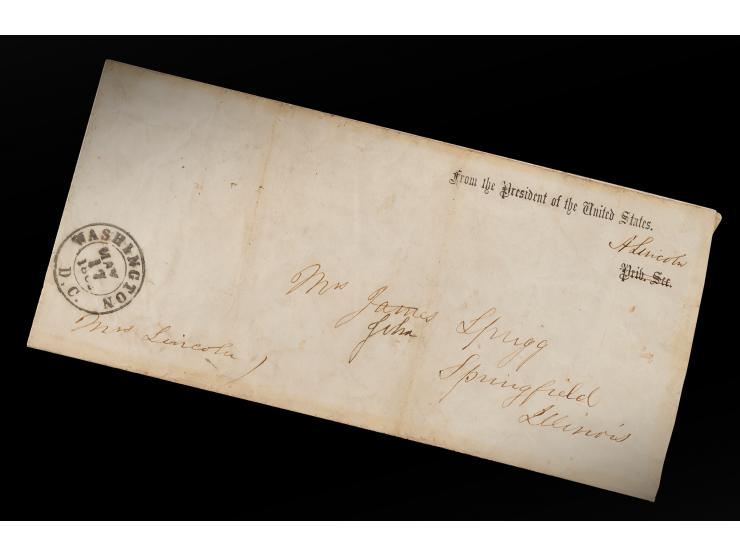
Franking signature as president, "A. Lincoln," on a 9.25 x 4.25 "From the President of the United States" mailing envelope, postmarked at Washington, May 17, 1862. The envelope has been addressed in Mary Lincoln's hand to "Mrs. James [struck out] John Sprigg, Springfield, Illinois," and signed by her at lower left "Mrs. Lincoln." In very good condition, with light creasing, several vertical folds, and overall soiling; both signatures are clear, dark, and well contrasted.
The addressee is evidently Mrs. Julia Sprigg, a widow who purchased a home next to the Lincolns' in Springfield in 1853. Sprigg and Mary Lincoln became close friends, and Sprigg's daughter sometimes babysat the younger Lincoln boys. An exceedingly scarce and desirable president-and-first-lady combination.
Opening: $1,000
Estimate: $4,000 - $6,000
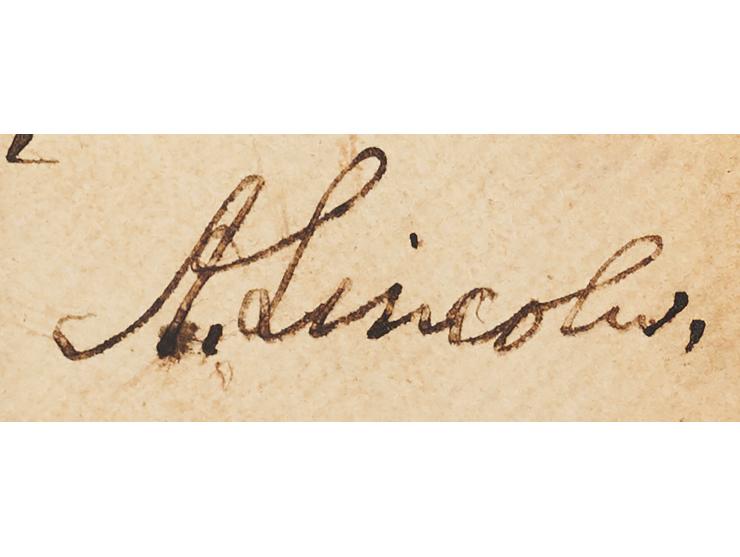
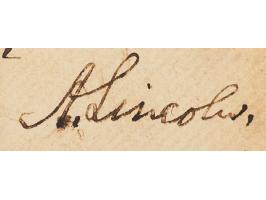
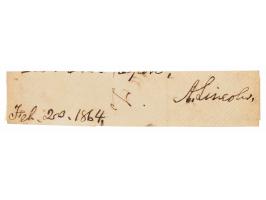
Civil War-dated ink signature as president, “A. Lincoln, Feb. 20, 1864,” on an off-white 3.75 x .75 slip. In fine condition. Accompanied by an engraving of Abraham Lincoln with a facsimile signature. According to ‘Lincoln Day By Day: A Chronology, 1809-1865,’ on February 20, 1864, the ‘President attends Mrs. Lincoln's regular Saturday afternoon reception,’ and, as noted in the ‘Collected Works of Abraham Lincoln,’ on this date Lincoln forwarded an endorsement to Edwin Stanton, his Secretary of War, on a letter from Edward Cooper and Judge Henry Cooper of Tennessee, regarding a prisoner of war, ill with tuberculosis, at Camp Morton, Indiana. Lincoln wrote: ‘I specifically request that you will see Judge Cooper and allow him to take his brother home with him.’
Opening: $200
Estimate: $1,000 - $1,500
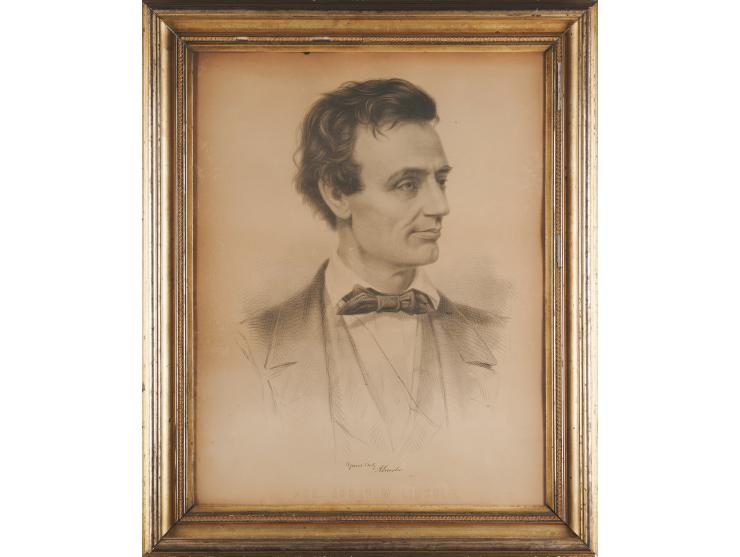
Original circa 1860 preliminary proof of a campaign lithograph depicting Abraham Lincoln, 19.5 x 25.5, featuring his printed facsimile signature in the lower border, "Yours truly, A. Lincoln," with "Hon. Abraham Lincoln," printed in block letters below. The portrait of Lincoln is based on one done by artist Thomas Hicks, the first to come west to paint the new Republican candidate in June 1860. Lincoln is said to have joked to Hicks: 'It will give the people of the East a correct idea how I look at home, and, in fact, how I look in my office. I think the picture has a somewhat pleasanter expression than I usually have, but that, perhaps, is not an objection' (see: Reminiscences of Abraham Lincoln, edited by C. Allen Thorndike Rice, p. 602).
This example appears to be a preliminary first state of the more common campaign poster, lacking the plate signature of lithographer Leopold Grozelier, the imprint line, the complete title, and some extra linework in the margins. Later examples feature the complete block-letter caption: "Hon. Abraham Lincoln, Republican Candidate for the Presidency, 1860." Other examples of this scarce printing reside in the collections of the Library of Congress and the Library Company of Philadelphia, while another was sold at Swann's in 2018.
Framed to an overall size of 25.5 x 31. In very good condition, with light toning and scattered small surface scuffs.
Opening: $200
Estimate: $1,000 - $2,000
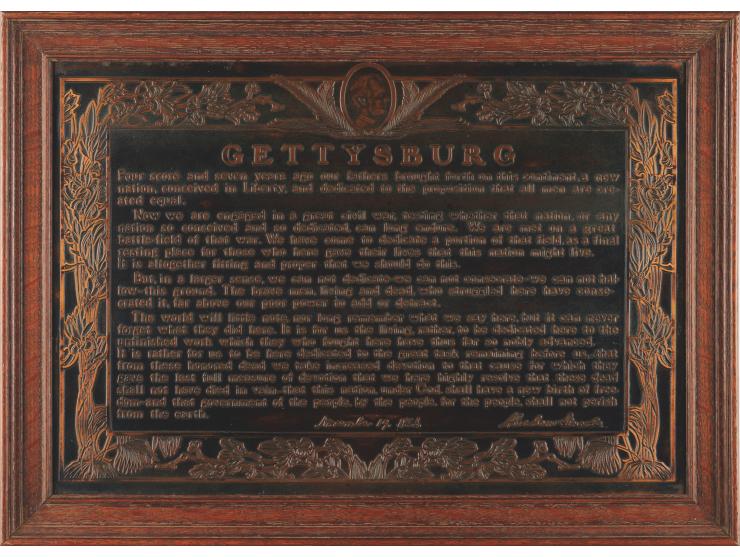
Mid-century bronzed plaque commemorating the Gettysburg Address made by President Abraham Lincoln on November 19, 1863. The plaque, 19 x 13, features the full text of the iconic Civil War speech in raised text with Lincoln’s facsimile signature and date below. A floral border wraps the plaque, which is surmounted by the president’s likeness in profile. Framed to an overall size of 22 x 16. In fine condition, with some surface wear.
Opening: $1,000
Estimate: $10,000 - $15,000
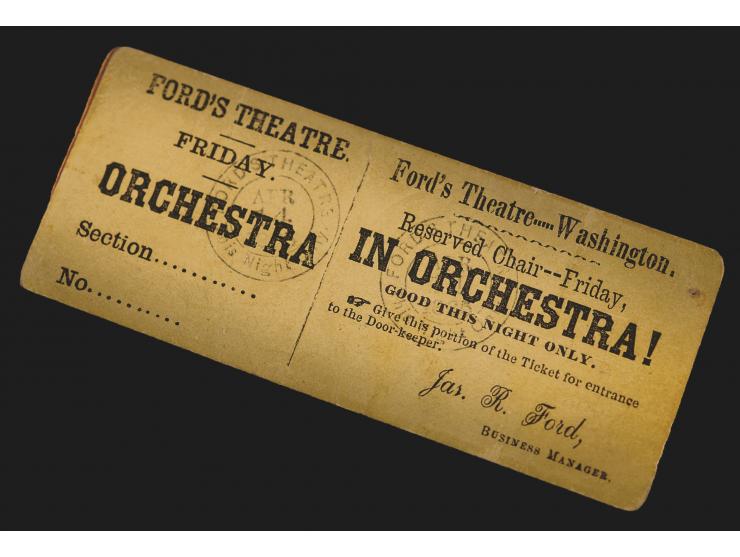
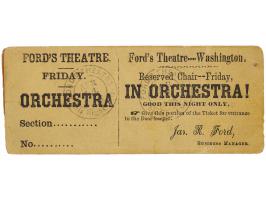
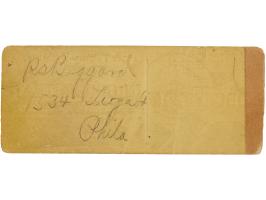
Rare original unissued 'Orchestra' level ticket from Ford's Theatre in Washington, D.C., bearing two circular date stamps, "Ford's Theatre, APR 14, 1865, This Night Only," the date of the performance of Our American Cousin when assassin John Wilkes Booth shot President Abraham Lincoln. The yellow ticket, 4.25˝ x 1.75˝, is imprinted on the left side, "Ford's Theatre., Friday., Orchestra," with the lower "Section" and "No." fields left blank. The right side carries the printed signature of "Jas. R. Ford, Business Manager," below the following text: "Ford's Theatre …. Washington. / Reserved Chair – Friday, In Orchestra! Good This Night Only. / Give this portion of the Ticket for entrance to the Door-keeper." The reverse is annotated in a contemporary hand: "R.S. Biggard, 1534 Tioga St., Phila." In fine condition, with a light vertical fold.
The circular April 14th date stamps match those seen on both known, authentic used tickets as well as on unissued examples, including a similar unused yellow 'Orchestra' level ticket held by the Shapell Manuscript Foundation, whose reverse bears a handwritten certification, signed by John M. Haseltine and dated July 14, 1865, stating that the ticket is an original from the evening of Lincoln's assassination and was presented to him personally by James R. Ford.
That notation is significant: Ford was barred from accessing Ford's Theatre — including its box office — following the federal government's seizure of the building after the assassination. He did not regain entry until July 1865. At that point, he was able to retrieve surviving box office stock and, as the Haseltine inscription confirms, present examples to acquaintances as mementos.
Also consistent with this history are the unissued tickets published in the Restoration of Ford's Theatre Historic Structures Report. This ticket almost certainly shares that provenance. The blank "Section" and "No." fields indicate it was never issued to a patron; it survived intact in the box office because Ford had no access to distribute it until three months after the performance for which it was printed.
Interested parties are encouraged to read the following RR Auction blog post from September 2023, which covers in detail the various types of Ford’s Theatre tickets known to exist.
Opening: $200
Estimate: $1,000 - $2,000
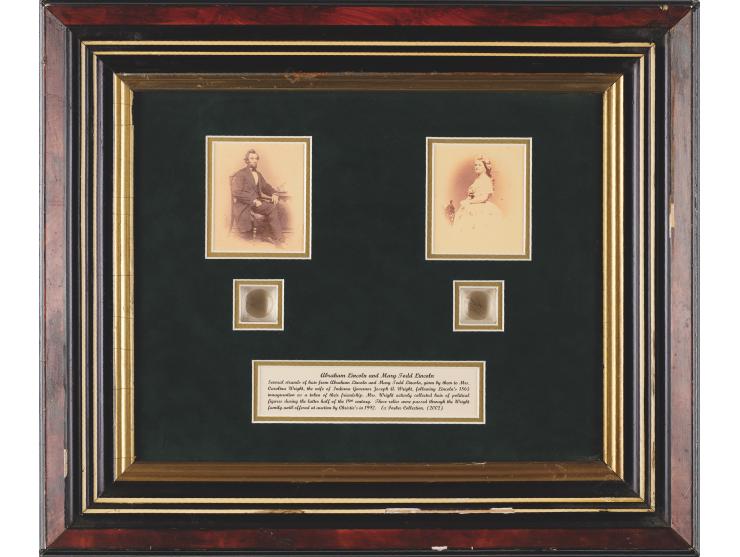
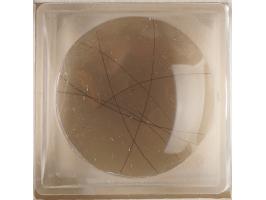
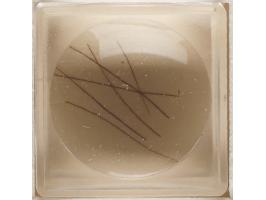
Several strands of hair from both Abraham and Mary Todd Lincoln, housed in small magnified plastic cases and double-suede-matted and framed with images of the Lincolns and a descriptive caption to an overall size of 18.5 x 16. In fine condition, with light damage only to the frame. The hair was originally collected by Caroline Wright, wife of Indiana governor Joseph Wright. The Wrights were close friends of Lincoln and the hair was presented to Mrs. Wright after Lincoln’s 1865 inauguration. Accompanied by a certificate of authenticity from Cary J. Delery, stating the hair was in the possession of the Wright family until 1992, when it was sold at Christie’s. The hair was sold again by Christie’s in 2002, as part of the Forbes Collection.
Opening: $200
Estimate: $1,500 - $2,000
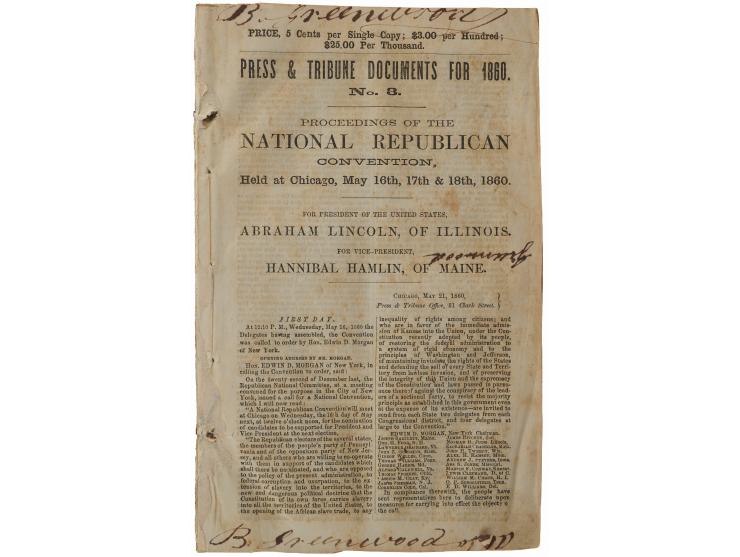
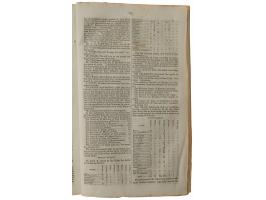
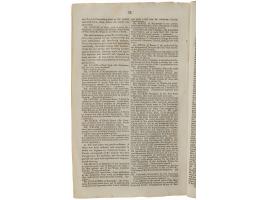
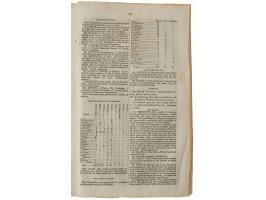
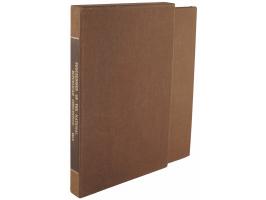
String-bound pamphlet entitled “Proceedings of the Republican National Convention Held at Chicago, May 16th, 17th & 18th, 1860. For President of the United States, Abraham Lincoln, of Illinois. For Vice-President, Hannibal Hamlin, of Maine.” Published by the Chicago Press & Tribune newspaper, the pamphlet, 44 pages, 5.5 x 8.75, issued as “Press & Tribune Documents for 1860. No. 3.,” contains a detailed synopsis of the convention’s three busy days, culminating in the dramatic events that secured Lincoln’s rise to national prominence.
Day 3, May 18, 1860, was the decisive and dramatic climax of the Republican National Convention in Chicago, when Abraham Lincoln secured the presidential nomination after three intense ballots. Entering the day, William H. Seward led but lacked a majority; on the first ballot, he held a strong advantage, yet Lincoln surged on the second as delegates from key states shifted their support to the more broadly acceptable Illinois candidate. On the third ballot, Lincoln reached 231½ votes—just shy of the required majority—before several delegates switched their votes, pushing him over the threshold and igniting an eruption of cheers, shouting, and celebration. The nomination was then made unanimous, and later that day, Hannibal Hamlin of Maine was chosen as the vice-presidential candidate, completing the ticket that would win the 1860 election and alter the course of American history. The first page bears ink ownership notations. Housed in a custom-bound slipcase with matching chemise. In very good to fine condition, with scattered light foxing and staining, and trimming to the top and bottom edges.
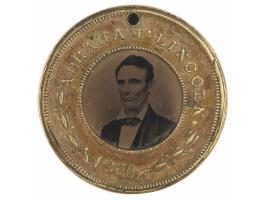
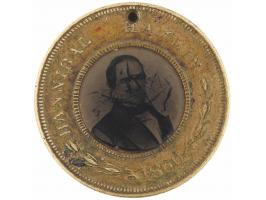
Opening: $200
Estimate: $1,000 - $1,500
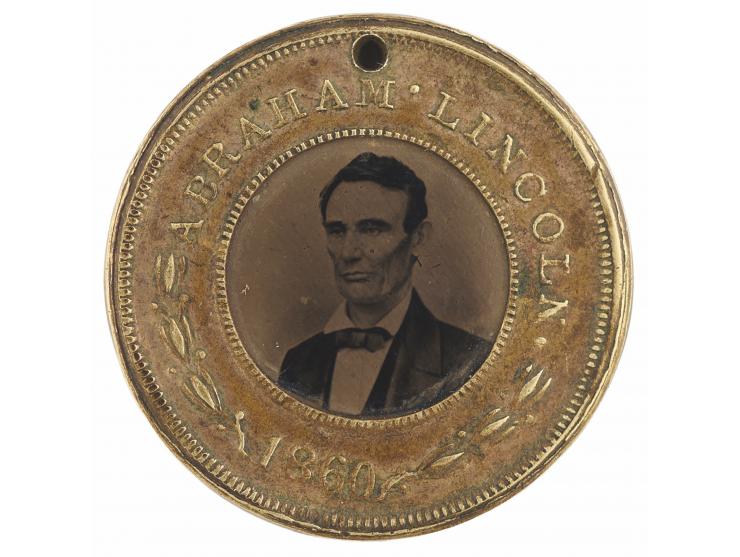
Extremely desirable ferrotype button from the 1860 presidential campaign, 1˝ in diameter, featuring a portrait of the beardless Abraham Lincoln on one side, with his vice presidential running mate Hannibal Hamlin on the other. Their portraits are encircled with raised text, "Abraham Lincoln, 1860" and "Hannibal Hamlin, 1860." In fine condition, with marks to the Hamlin image; Lincoln's image is uncommonly sharp.
Opening: $200
Estimate: $400 - $600
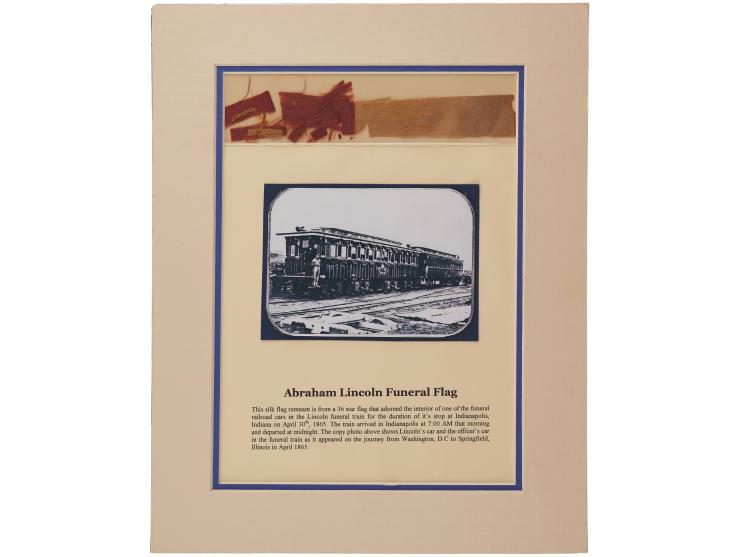
Red-and-white silk flag fragments, 7˝ x 1˝, removed from a 36-star flag that adorned one of the cars in the Lincoln funeral train while in Indianapolis. Encapsulated in plastic and affixed to a descriptive mount, double-matted and framed to an overall size of 11 x 14. Flags were made locally for the train's stops while on its journey from Washington to Springfield, Illinois. It arrived in Indianapolis at 7:00 AM on April 30, 1865, and departed at midnight. Following the departure, the flags were given to prominent Indianapolis families.
Opening: $200
Estimate: $400 - $600
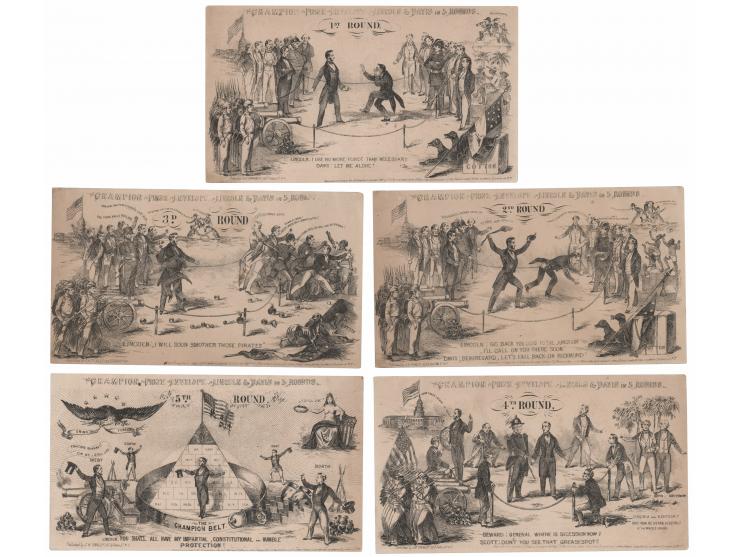
Complete set of five pictorial postal covers entitled "Champion Prize Envelope – Lincoln & Davis in 5 Rounds," published by J. H. Tingley of New York City in 1861. The cartoons depict U.S. President Abraham Lincoln and Confederate President Jefferson Davis as boxers fighting in a five-round prize match, symbolizing the conflict between the Union and the Confederacy during the Civil War. Across the sequence of envelopes, Lincoln defeats Davis, serving as pro-Union political satire meant to encourage support for the Union cause. In overall fine condition, with uniform light toning.
Opening: $200
Estimate: $300 - $500
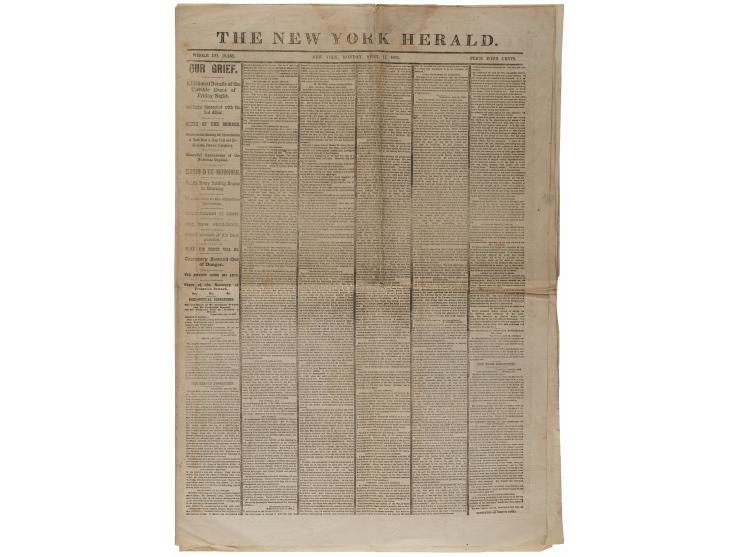
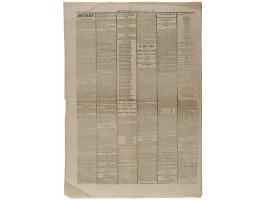
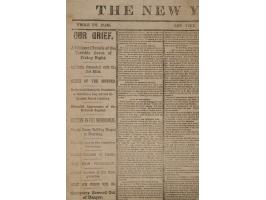
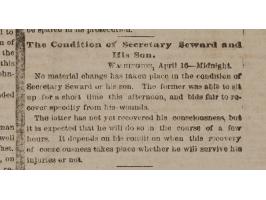
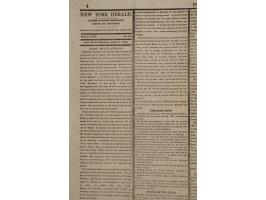
Complete issue of the New York Herald from April 17, 1865, eight pages, 15.5 x 22.5, reporting on the assassination of President Abraham Lincoln, outlined with black mourning rules throughout the entire paper. The first column begins with a series of large headlines covering the tragedy: "Our Grief. Additional Details of the Terrible Event of Friday Night. Incidents Connected with the Sad Affair. Scene of the Murder. Developments Showing the Assassination to Have Been a Deep Laid and Deliberately Planned Conspiracy. Mournful Appearance of the National Capital. Sorrow in the Metropolis. Nearly Every Building Draped in Mourning." These are followed by coverage of more positive developments, including: the inauguration of President Andrew Johnson; the recovery of Secretary of State William Seward, who was also attacked as part of the conspiracy; and the manhunt for the assassin and his accomplices. In fine condition.
By 1845, the New York Herald was the most popular and profitable daily newspaper in the United States. In 1861 it circulated 84,000 copies and called itself 'the most largely circulated journal in the world.' A well-preserved example of an important paper, carrying detailed information on Lincoln's assassination and its aftermath.
Opening: $200
Estimate: $300 - $400
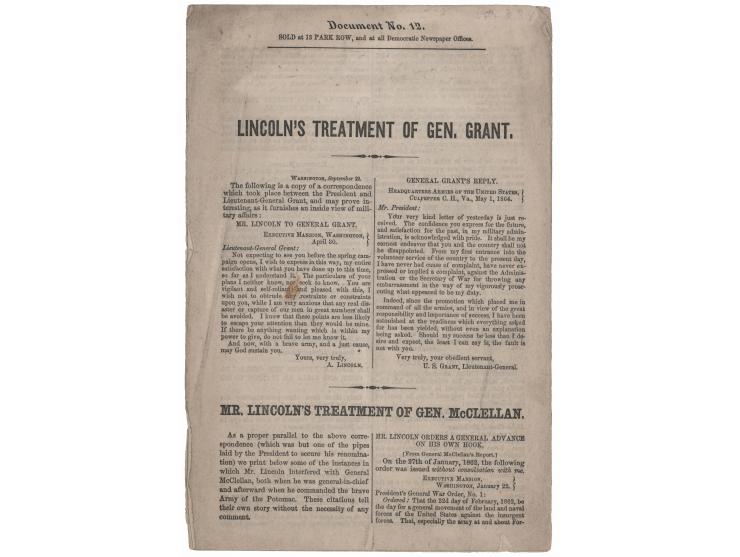
Civil War-era political pamphlet issued by the Democratic Newspaper Offices, printed in 1864 during the presidential election campaign when Republican incumbent Abraham Lincoln was running for reelection against Democratic candidate George B. McClellan. Designed as anti-Lincoln propaganda, the pamphlet, issued as “Document No. 12,” eight pages, 5.75 x 8.75, frames Lincoln as an incompetent military leader and contains various examples of orders and printed letters from Lincoln to Union Generals U. S. Grant and George B. McClellan, all intended to cast the president in a negative light. In very good to fine condition, with light soiling, and a small stain.
Opening: $200
Estimate: $300 - $400
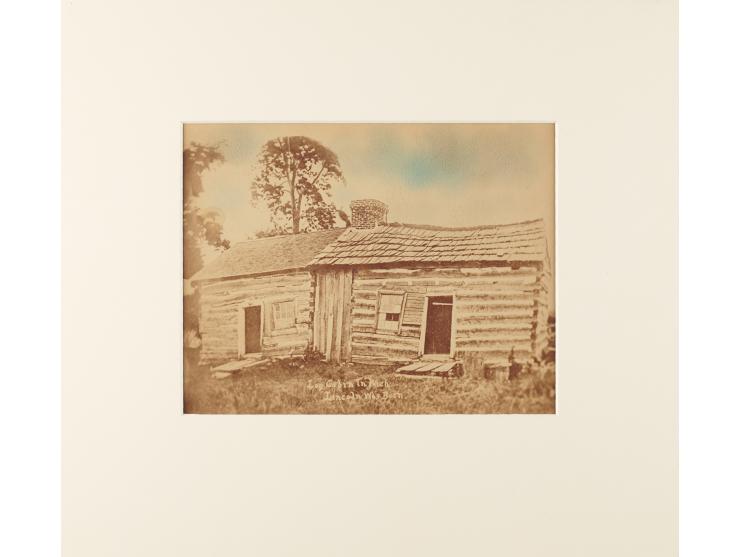
Original 9 x 7 mounted albumen photograph of the "Log Cabin in Wich Lincoln Was Born," affixed to a slightly larger mount. Matted to an overall size of 15 x 13.5. In very good to fine condition, with wear to the edges of the mount.
This cabin was in fact built by Abraham Lincoln and his father on Goose Nest Prairie, near Farmington, Illinois, in 1831; Lincoln had been born in Kentucky in 1809. Located near Charleston, Illinois, the log cabin was the home of Lincoln's father and stepmother, Thomas Lincoln and Sarah Bush Lincoln, and where the former died in 1851. While traveling the circuit as a lawyer, Lincoln would visit them at this home and was involved with later purchasing some of the land for his parents to remain living there. In 1893, the log cabin was removed to Chicago for exhibition at the Chicago World's Columbian Exposition but was unfortunately lost after the Exposition and possibly even used as firewood.
Opening: $200
Estimate: $300 - $400
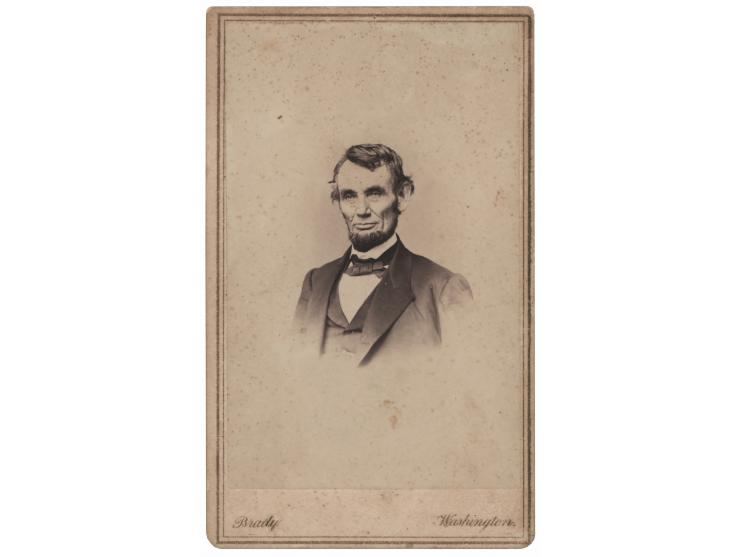
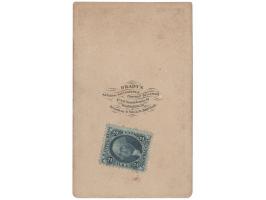
Uncommon 2.5 x 4 carte-de-visite portrait photograph of President Abraham Lincoln made on February 9, 1864, by Anthony Berger at Mathew Brady's Washington, D.C., gallery. The reverse bears a Brady's National Photographic Portrait Galleries mark and an affixed 2-cent postage stamp. In fine condition, with some light soiling.
On February 9, 1864, portrait painter Francis B. Carpenter arranged for President Lincoln to sit for a series of photographs at Matthew Brady’s Washington, D.C., gallery. Carpenter, the President, and Lincoln’s youngest son, Tad, walked to Brady’s studio at 3 p.m. Since Brady’s eyesight was beginning to fail, he asked his superintendent, Anthony Berger, to photograph Lincoln. Berger took at least seven poses of the President, both alone and with ten-year-old Tad. The images taken that day have formed the basis for Lincoln’s image on the penny and both the old and new $5 bills.
Lincoln sat for over fifty official portraits from his lawyering days on the court circuit until his assassination; he understood the importance of creating a dignified public profile. Lincoln joked after his first photo shoot with Brady in 1860 that the photographer’s portrait helped secure his Republican nomination as president. Brady's images of Lincoln are among the most iconic.
Mathew Brady became one of the most recognized photographers of the Civil War era, known both for documenting the realities of war and for creating iconic portraits of figures such as Abraham Lincoln and Robert E. Lee. At the start of the war, his business flourished as soldiers commissioned carte-de-visite portraits before heading to the front. In 1861, Lincoln authorized Brady to travel to battlefields and military camps to photograph the conflict firsthand. Investing roughly $100,000 of his own money, Brady and his team produced around 10,000 war-related negatives. However, when the federal government declined to purchase his collection after the war, Brady faced financial ruin, and the massive personal investment ultimately led to his bankruptcy.
Opening: $200
Estimate: $400 - $600
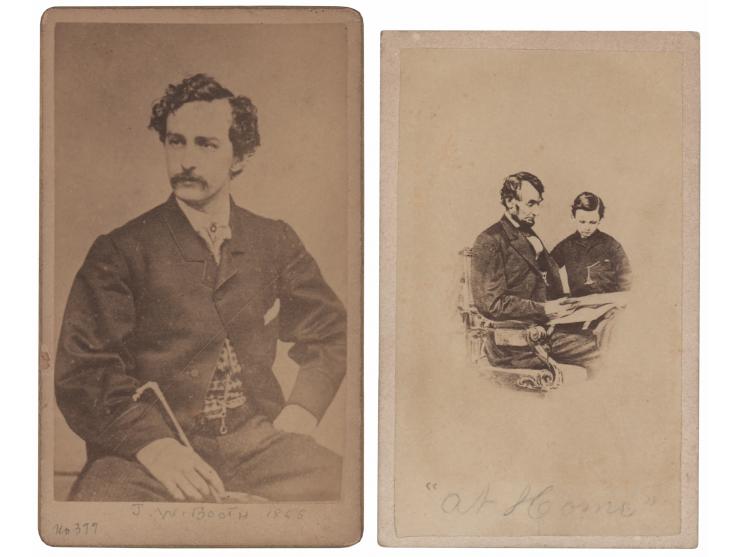
Two uncommon carte-de-visite photos, including: a 2.5 x 4 portrait of Abraham Lincoln reading with his son Tad, after a photograph taken by Anthony Berger; and a 2.5 x 4 portrait of Lincoln assassin John Wilkes Booth, after a photograph taken by Alexander Gardner. In overall fine condition, with old pencil notations to the bottom of each photo.
On February 9, 1864, portrait painter Francis B. Carpenter arranged for President Lincoln to sit for a series of photographs at Matthew Brady’s Washington D.C. gallery. Carpenter, the President, and Lincoln’s youngest son Tad walked to Brady’s studio at 3 p.m.
Since Brady’s eyesight was beginning to fail, he asked his superintendent, Anthony Berger, to photograph Lincoln. Berger took at least seven poses of the President, both alone and with ten-year-old Tad. The images taken that day have formed the basis for Lincoln’s image on the penny and both the old and new $5 bills.
In this image, Lincoln holds 'a big photograph album which the photographer, posing the father and son, had hit upon as a good device to use in this way to bring the two sitters together.' Lincoln later feared that the public would view this pose as 'a species of false pretense' because most viewers would assume the book was a large clasped Bible. When they learned that it was a photograph album, they might think Lincoln was 'making believe read the Bible to Tad.' Just as Lincoln feared, after his death, some versions were carefully retouched to make the album appear like a large Bible.
In the second half of 1863, the twenty-five-year-old actor John Wilkes Booth visited Alexander Gardner's photographic studio in Washington, D.C. The young Scottish photographer had worked for Matthew Brady from 1856 to 1862, learning the photographer's art. After opening his own studio in Washington, D.C., in May 1863, Gardner photographed both President Abraham Lincoln and his future assassin, along with thousands of Civil War officers and enlisted men.
Opening: $200
Estimate: $400 - $600
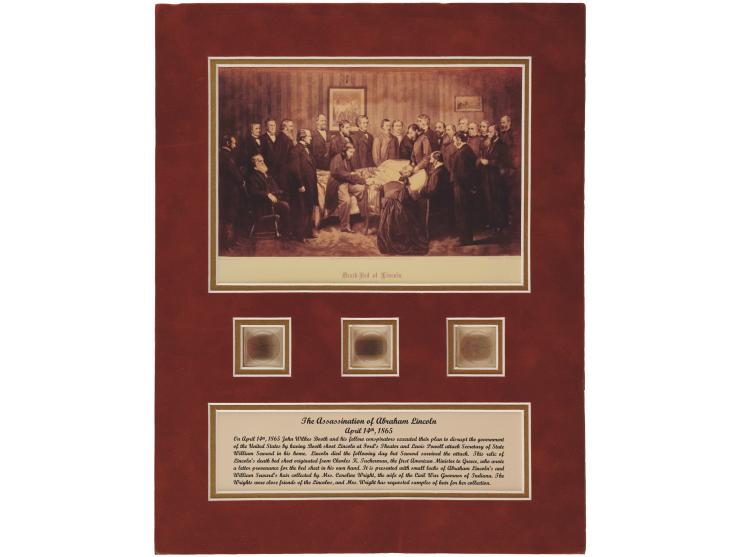
Several short strands of Lincoln’s hair encapsulated in a plastic cube and displayed alongside a similar cube containing strands of Seward’s hair, as well as one with a swatch of Lincoln's deathbed sheet, double-matted together with a descriptive passage to an overall size of 10.75 x 14. In fine condition. Accompanied by a certificate of authenticity from the Historical Shop, stating that the hair came from collected by Mrs. Caroline Wright which were sold by Christie’s as part of the Forbes collection in 2002; the death bed sheet relic originated from the effects of Charles K. Tuckerman, who was the first American ambassador to Greece.
Opening: $200
Estimate: $800 - $1,200
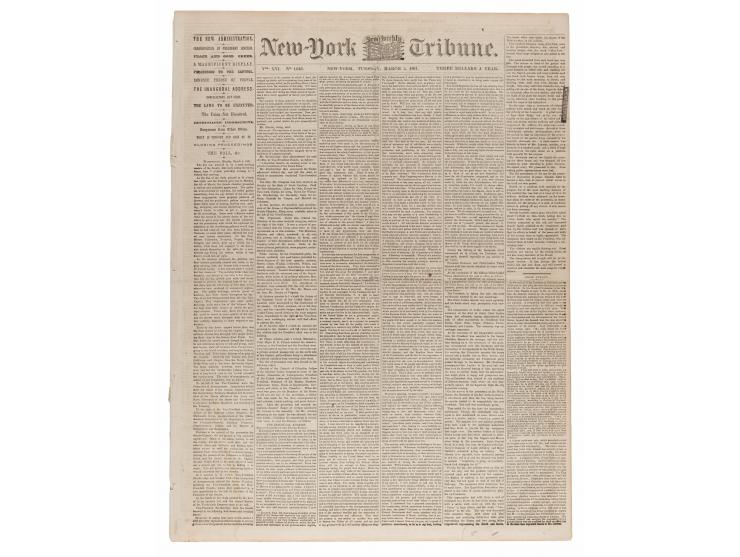
Complete issue of the New-York Tribune from March 5, 1861, eight pages, 16 x 21.5, being the first reporting on the inauguration of Abraham Lincoln, who addressed the nation the day before in his memorable inaugural address on the cusp of Civil War. The paper offers a detailed account of the day’s events and contains the entirety of his inaugural address. Headlines include: "The New Administration"; "Inauguration of President Lincoln"; "A Magnificent Display"; "Procession to the Capitol"; "Immense Throng of People"; "The Inaugural Address"; "The Laws to be Executed"; and "The Union Not Dissolved."
Lincoln’s famous address is spread over four columns on the first page, in part: “It is seventy-two years since the first inauguration of a President under our National Constitution. During that period fifteen different and very distinguished citizens have in succession have administered the Executive branch of the Government. They have conducted it through many perils, and generally with great success…I now enter upon the same task for the brief Constitutional term of four years, under great and peculiar difficulty. A disruption of the Federal Union, heretofore only menaced , is now formidably attempted. I hold that in contemplation of universal law of the Constitution, the Union of these States is perpetual….In your hands my dissatisfied fellow countrymen, and not in mine, is the momentous issue of civil war. The government will not assail you. You can have no conflict without being yourselves the aggressors. You have no oath registered in Heaven to destroy the Government, while I shall have the most solemn one to preserve, protect, and defend it. I am left to close. We are not enemies, but friends. We must not be enemies. Though passion may have strained, it must not break our bonds of affection. The mystic chords of memory stretching from every battlefield and patriot grave to every living heart and heart stone all over this broad land, will yet swell the chorus of the Union, when again touched as surely they will be, by the better angels of our nature.” In very fine condition.
Opening: $200
Estimate: $400 - $600
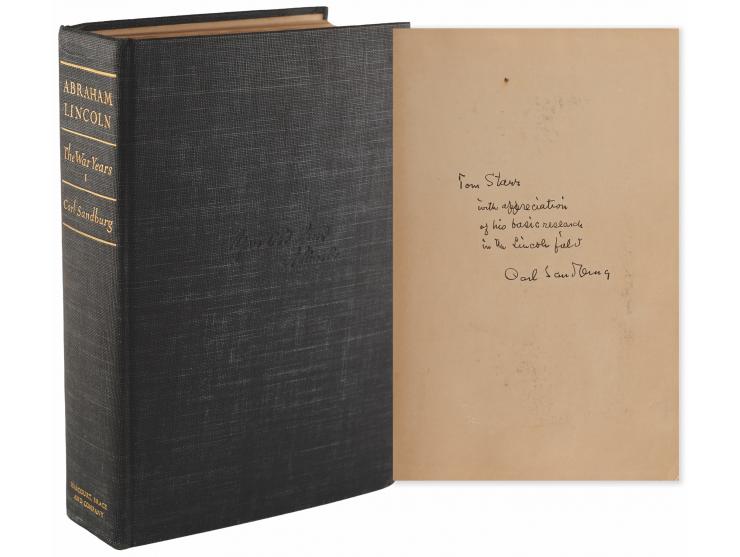
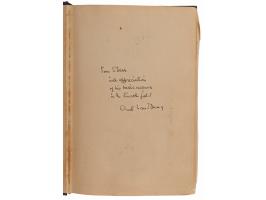
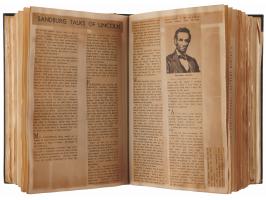
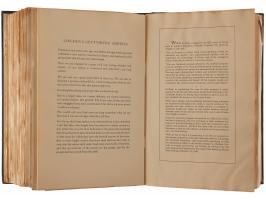
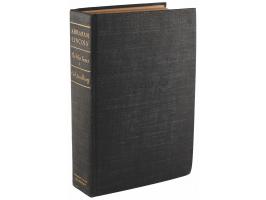
Signed book: Abraham Lincoln: The War Years, Vol. 1 by Carl Sandburg. NY: Harcourt, Brace & Company, 1939. Hardcover with gilt-titling to the spine, 6.5 x 9.5. Signed and inscribed on the opening page in black ink, "Tom Starr, with appreciation of his basic research in the Lincoln field, Carl Sandburg." Except for the book’s opening pages and first chapter, the original textblock has been removed and refitted as a scrapbook of sorts, with pages comprised of sundry clippings, advertisements, and photographs, all related to Sandburg and Lincoln. In fine condition, with wear to the inner binding.
Thomas Irwin Starr (1903–1965), an editorial director for publications at the Michigan Bell Telephone Company, was a noted Abraham Lincoln scholar and collector of Lincolniana. He began collecting Lincoln-related materials after attending an auction in 1929, a pursuit that developed into a lifelong scholarly interest. In 1930, Starr discovered a long-lost newspaper printing of Abraham Lincoln’s 1856 Kalamazoo speech while researching in the Detroit Public Library, an important find that helped preserve the text of the address. He later wrote and annotated several books and articles on the 16th President and assembled a significant collection of Lincoln materials.
Opening: $200
Estimate: $1,000 - $1,500
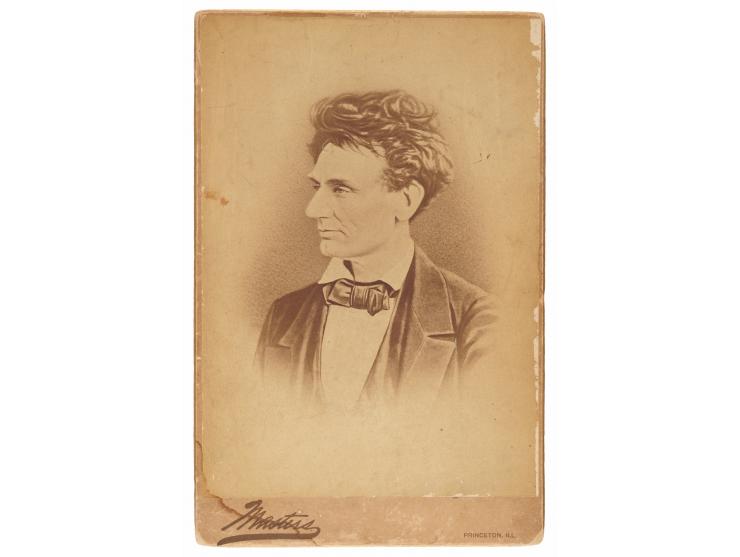
Scarce oversized 8.5 x 13 cabinet-style mounted albumen portrait of the beardless, pre-presidential Abraham Lincoln, being an artistically enhanced version of the 'tousled hair' portrait taken by Alexander Hesler in Chicago, February 28, 1857 (catalogued by Lloyd Ostendorf as O-2). Imprinted on the mount: "Masters, Princeton, Ill." A blurb affixed on the reverse carries a spurious attribution: "Mr. Masters, had a reputation of being one of the best photographers of his day…and developed what is believed to be the best picture ever taken of Abraham Lincoln. The Lincoln picture was taken here upon occasion when Lincoln came to deliver a Fourth of July speech at a picnic in Bryant's woods on July 4, 1856." In very good to fine condition, with dampstaining to the lower left corner of the mount, overall scuffing, and some surface loss to the image edges.
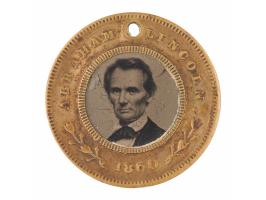
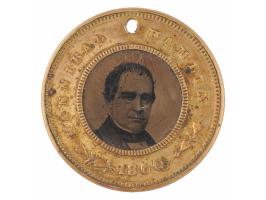
Opening: $200
Estimate: $1,000 - $1,500
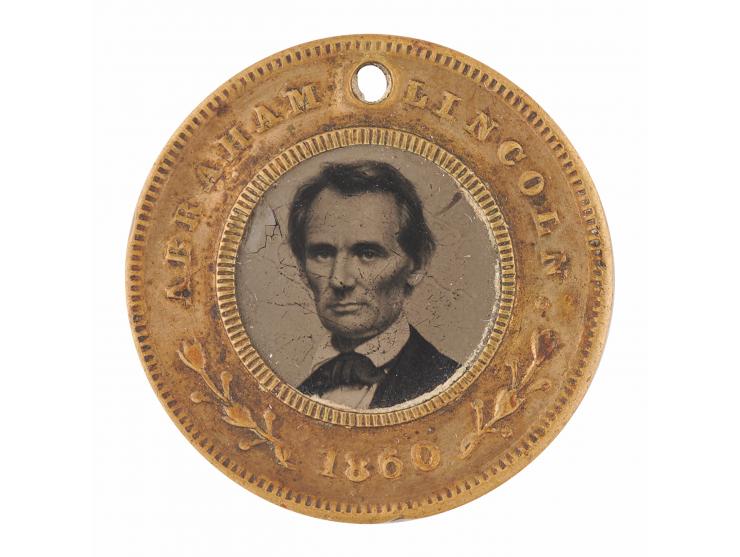
Extremely desirable ferrotype token from the 1860 presidential campaign, 1″ in diameter, featuring a portrait of the beardless Abraham Lincoln on one side (based on Mathew Brady’s iconic Cooper Union photograph), with his vice presidential running mate Hannibal Hamlin on the other. Their portraits are encircled with raised text, "Abraham Lincoln, 1860" and "Hannibal Hamlin, 1860." In fine condition, with minor crazing to the portraits.
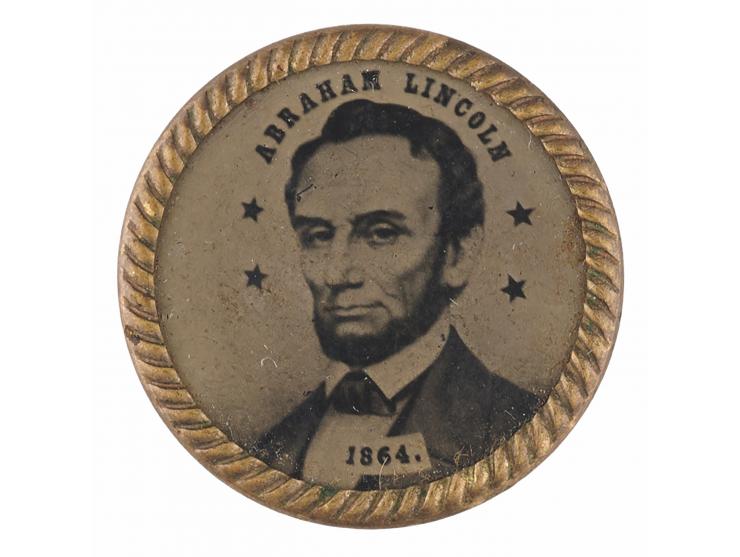
Opening: $200
Estimate: $800 - $1,000
Extremely scarce ferrotype token from the 1864 presidential campaign, .75″ in diameter, featuring a portrait of the bearded Abraham Lincoln within a thin metal frame, with text in the image reading: "Abraham Lincoln, 1864." The reverse is blank. In fine condition.
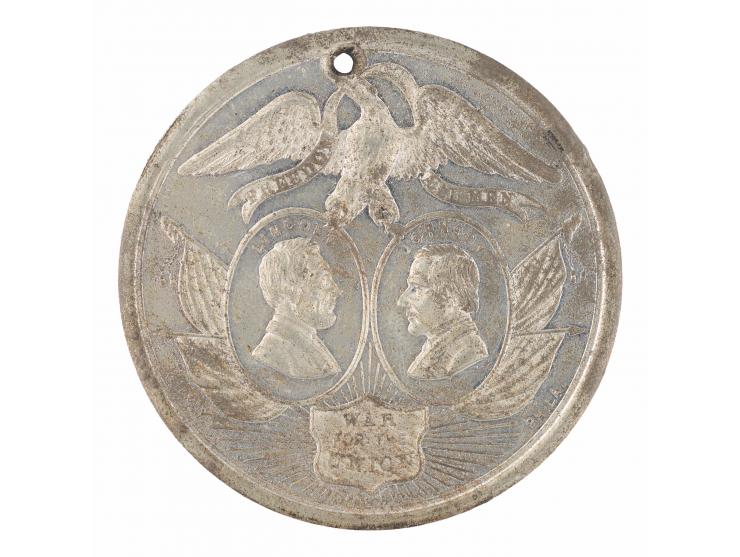
Opening: $200
Estimate: $400 - $600
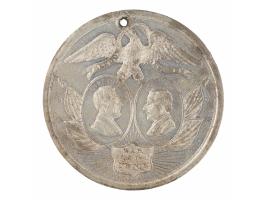
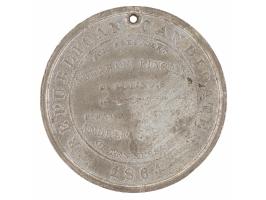
Desirable silver-tone medallion the 1864 presidential campaign, approximately 1.5˝ in diameter, featuring oval profile likenesses of Abraham Lincoln and Andrew Johnson grasped by eagle in flight and flanked by flags, two bearing liberty caps, with legends reading: "Freedom to All Men" and "War for the Union." The outer band on the reverse reads, "Republican Candidates 1864," with a central legend: "For President Abraham Lincoln of Illinois, For Vice President Andrew Johnson of Tennessee." In very good to fine condition, with scattered surface wear and tarnishing, and a hole drilled at the 12-o'clock position.
Opening: $200
Estimate: $300 - $400
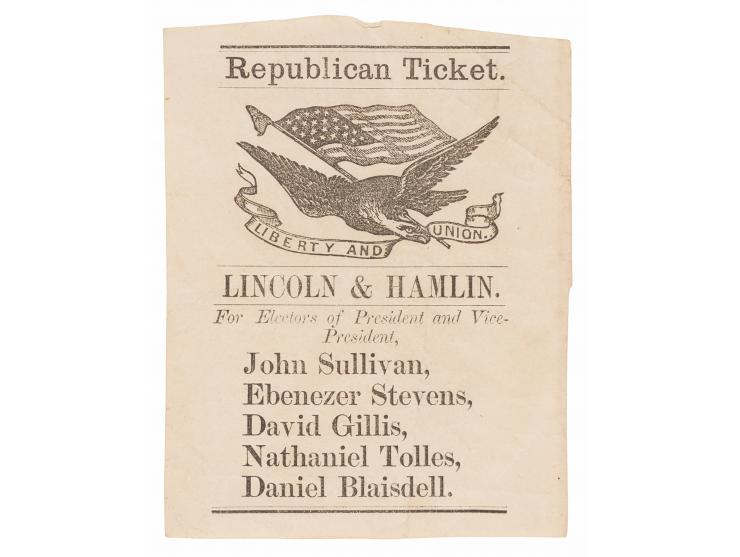
Republican ticket for the November 6, 1860 presidential election in New Hampshire, one page, 3 x 4, headed with "Republican Ticket" and the vignette of an eagle carrying an American flag and a banner reading: "Liberty and Union." The ticket reads: "Lincoln & Hamlin. For electors of President and Vice-President, John Sullivan, Ebenezer Stevens, David Gillis, Nathaniel Tolles, Daniel Blaisdell." In very good to fine condition. Lincoln carried the state with over 56% of the vote.
Opening: $200
Estimate: $200 - $400
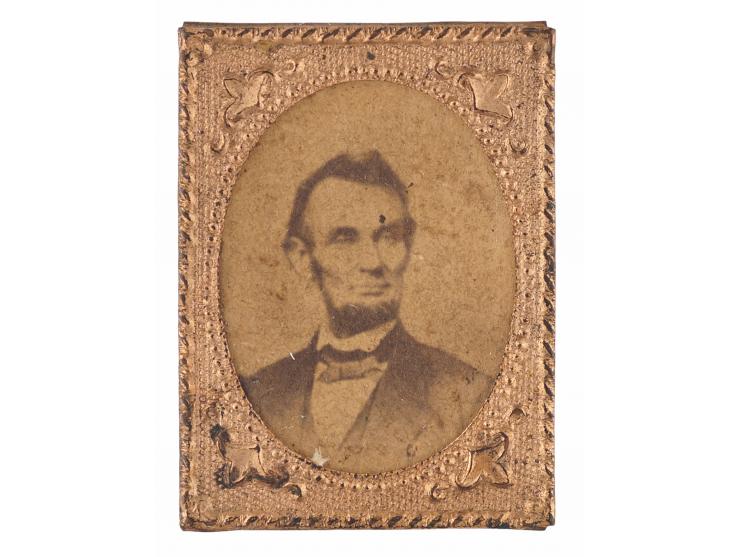
Small gem-size albumen photographic portrait of Abraham Lincoln mounted in decorative foil frame, measuring .75˝ x 1˝ overall, circa 1864–1880. In very good to fine condition.