Ulysses S. Grant
Opening: $1,000
Estimate: $20,000 - $30,000
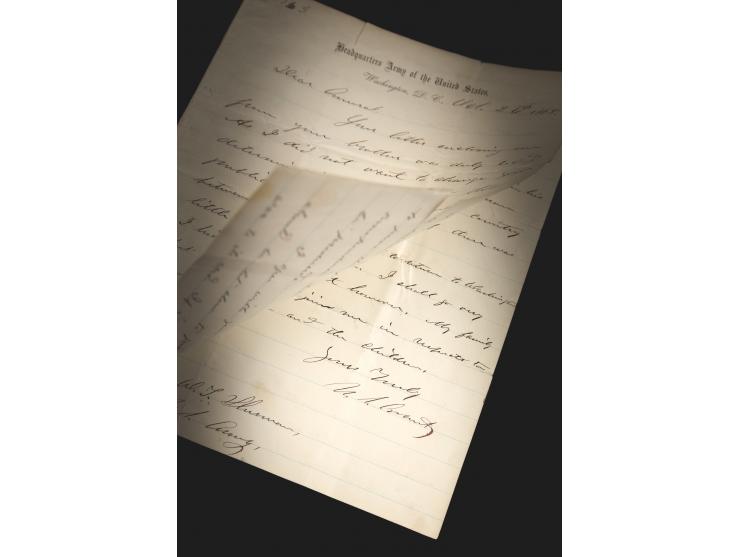
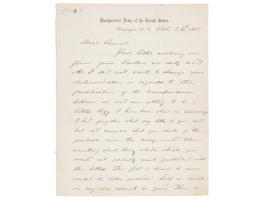
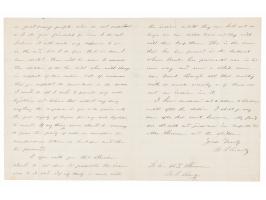
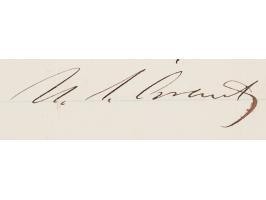
ALS signed “U. S. Grant,” three pages on two adjoining sheets, 7.75 x 10, Headquarters Army of the United States letterhead, October 26, 1868. Handwritten letter to "Lt. Gen. W. T. Sherman, U.S. Army," written just days before the presidential election of 1868. In full: "Your letter enclosing one from your brother was duly rec'd. As I did not want to change your determination in regard to the publication of the correspondence between us, and am getting to be a little lazy, I have been slow in answering. I had forgotten what my letter to you said but did remember that you spoke of the probable course the Ewings would take, or something absent them, which which you would not probably want published with the letters. The fact is General I never wanted the letters published half so much as my own account as yours.
There are a great many people who do not understand as I do your friendship for me. I do not believe it will make any difference to you in the end, but I do fear that, in case I am elected, there will be men to advocate the abolition of the Gen. bill who will charge in support of their motion lack of evidence that you supported the Union cause in the canvass. I would do all I could to prevent any such legislation and believe that without my doing anything the confidence in you is too genuine with the great majority of Congress for any such legislation to succeed. If any thing more should be necessary to prove the falsity of such an assumption the correspondence between us heretofore could then be produced.
I agree with you that Sheridan should be let alone to prosecute the indian war to its end. If no treaty is made with the indians untill they can hold out no longer we can dictate terms, and they will then keep them. This is the cause that has been pursued in the Northwest, where Crook has prosecuted war in his own way, and now a White man can travel through all that country with as much serenity as if there was not an indian in it.
I have concluded not to return to Washington untill after the election. I shall go very soon after that event however. My family are all well and join me in respects to Mrs. Sherman and the children."
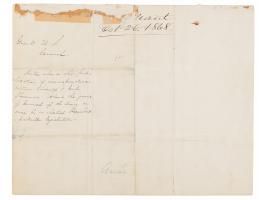
William T. Sherman dockets the reverse in his own hand, in full: "Grant, U. S., General, Writes about the publication of correspondence between himself & Genl. Sherman. About the grade of General of the Army in case he is elected President—probable legislation." In fine condition, with minor splitting to the ends of the folds, and some old mounting remnants to the back of the last page.
This letter finds Ulysses S. Grant balancing his roles as commanding general of the U.S. Army and Republican nominee for president. Grant expresses concern that, if elected, hostile members of Congress might revive efforts to remove the special rank of General of the Army by untruthfully asserting that William T. Sherman had failed to support the Union cause during the canvass.
Grant was preparing to relinquish the rank—created for him by Congress in 1866—upon assuming the presidency, a transition that would elevate Sherman to that position. His concern reflects an awareness that the rank itself remained subject to political attack, and that efforts to abolish it could directly affect Sherman’s standing—revealing how closely personal loyalties and congressional politics were intertwined on the eve of Grant’s election. These fears proved unfounded, and Sherman would indeed succeed Grant as General of the Army on March 4, 1869, the day of Grant’s inauguration.
Grant also addresses ongoing military operations, explicitly endorsing Philip H. Sheridan’s authority to prosecute the Indian wars without interference, advocating for sustained military pressure. He cites George Crook’s campaigns in the Northwest as a model, reflecting prevailing Army doctrine and foreshadowing the continuity of policy: first under Sherman, and later under Sheridan himself. Sheridan, too, would be named General of the Army in 1888, shortly before his death; the honor was then retired until World War II. The letter thus links politics, the U.S. military's senior command, and federal Indian policy at a critical moment preceding the first election of the Reconstruction Era.
Opening: $300
Estimate: $3,000 - $4,000
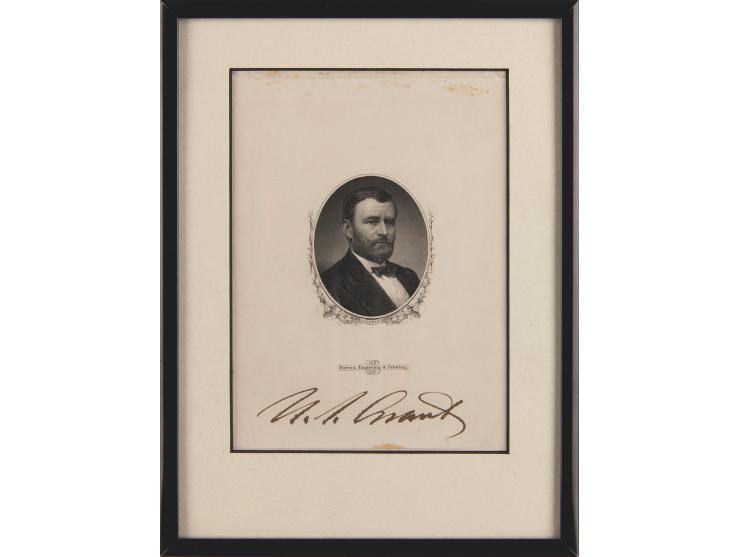
Handsome engraved portrait of Ulysses S. Grant by the Bureau of Engraving and Printing, 4 x 5.5, prominently signed below in bold ink, "U. S. Grant." Archivally matted and framed to an overall size of 6.25 x 8.25. In fine condition, with slight feathering to the ink, and a tiny stain to the bottom edge.
Opening: $300
Estimate: $2,000 - $3,000
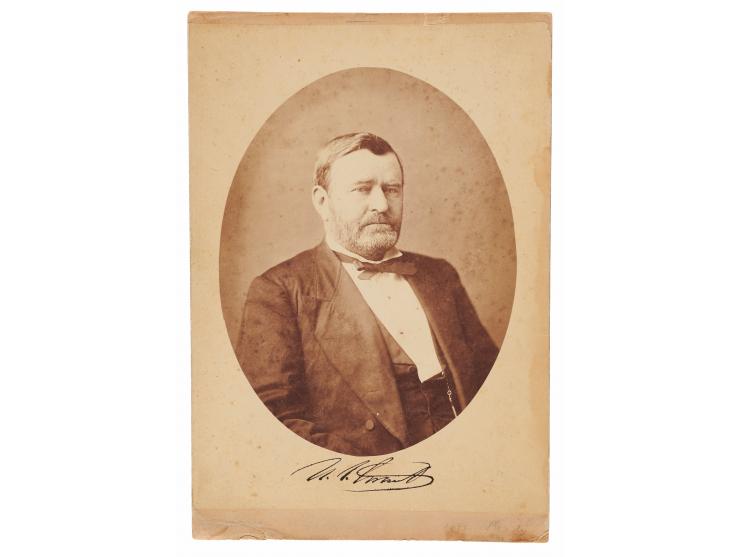
Rare oversized 7.25 x 10 albumen photo of Ulysses S. Grant, affixed to a 7.25 x 11 mount, signed below the image in bold ink, "U. S. Grant." Annotated on the reverse in ink, "Washington D.C., Aug. 4, 1876." A pencil notation on the mount attributes the photograph to Mathew Brady. In very good to fine condition, with scattered light foxing, staining along the right edge of the image, and short tears to the top and bottom edges of the mount. An unusually large signed photograph of the Civil War hero.
Provenance: by descent to the consignor, who notes that the photograph was once part of the collection of Winfred Porter Truesdell, collector, publisher, and cataloger of the known engravings and lithographs of Abraham Lincoln.
Opening: $200
Estimate: $1,500 - $2,000
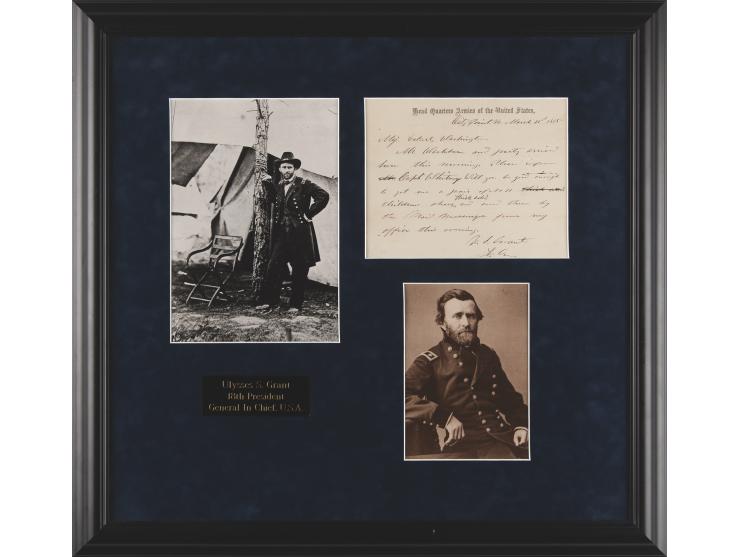
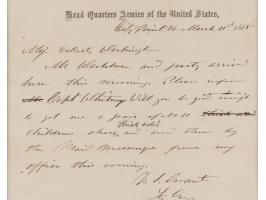
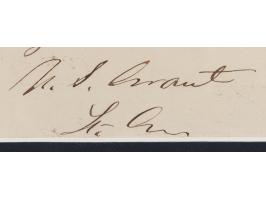
Civil War-dated ALS signed “U. S. Grant, Lt. Gen.,” one page, 7.5 x 6, Head Quarters Armies of the United States letterhead, March 11, 1865. Handwritten letter to "Maj. Eckert," in full: "Mr. Washburne and party arrived here this morning. Please inform Capt. Whitney. Will you be good enough to get me a pair of No. 10 children's shoes, thick soled, and send them by the mail messenger from my office this evening." Suede-matted and framed with two portraits and a nameplate to an overall size of 22.5 x 21. In fine condition.
Grant's visitor was Illinois Congressman Elihu B. Washburne, one of his longtime political allies. Washburne had played a pivotal role in Grant’s rise, having first proposed his name for appointment as a brigadier general of volunteers in 1861, and later sponsoring the legislation that elevated him to lieutenant general and then to full general. He would go on to support Grant's presidential bid, and in return, was appointed Secretary of State and later U.S. Minister to France.
This visit in March 1865, however, held special significance. Washburne had come to deliver a presentation on behalf of the nation. Back on December 17, 1863, Congress had passed a joint resolution thanking Grant for his victories in the Western Theater and authorizing President Lincoln to commission a gold medal in his honor. Now, more than a year later, on March 11th, Washburne presented Grant with the medal, an official copy of the Congressional resolution, and a letter from the president (see: The Papers of Ulysses S. Grant, vol. 14, pp. 131–32, ed. John Y. Simon). The children's shoes that Grant requests were most likely for his 7-year-old son, Jesse; both Jesse and his mother, Julia, were with Grant around this time.
Opening: $200
Estimate: $1,000 - $2,000
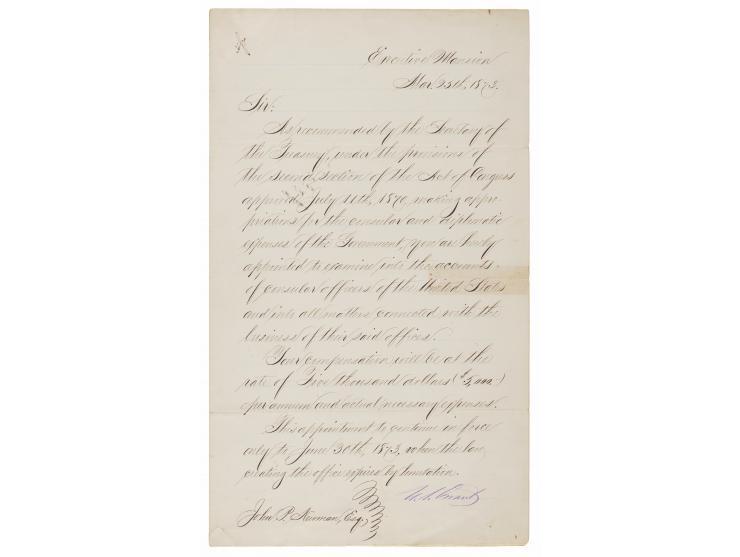
LS as president, signed "U. S. Grant," one page, 8.5 x 14, March 25, 1873. Official letter to John P. Newman, sent from the Executive Mansion. In part: "As recommended by the Secretary of the Treasury, under the provisions of the second section of the Act of Congress approved July 11th, 1870, making appropriations for the consular and diplomatic expenses of the Government, you are hereby appointed to examine into the accounts of consular officers of the United States and into all matters connected with the business of their said offices." In fine condition, with an old tape stain to the right side of the central horizontal fold.
Issued from the Executive Mansion, this letter marks President Ulysses S. Grant’s formal appointment of John Philip Newman—a noted Methodist pastor and Chaplain of the United States Senate—to the federal service as an examiner of U.S. consular accounts. This assignment would evolve into his role as Inspector of United States Consulates in Asia (1874–1876). Acting under congressional authority, Newman was tasked with investigating the financial records and operational conduct of American consular offices, a responsibility he carried out through extensive travel across China, Japan, and other nations with which the United States maintained diplomatic relations.
His detailed report to the State Department, exceeding two hundred pages, offered substantive observations and reform-minded recommendations. Summoned before a Congressional committee during the reform investigations of 1876, Newman provided important testimony that surprised critics who had dismissed his work as a mere 'pleasure tour.' The letter thus represents the inception of a serious government oversight mission, highlighting Reconstruction-era efforts to strengthen accountability within the U.S. diplomatic service.
Opening: $200
Estimate: $1,000 - $1,500
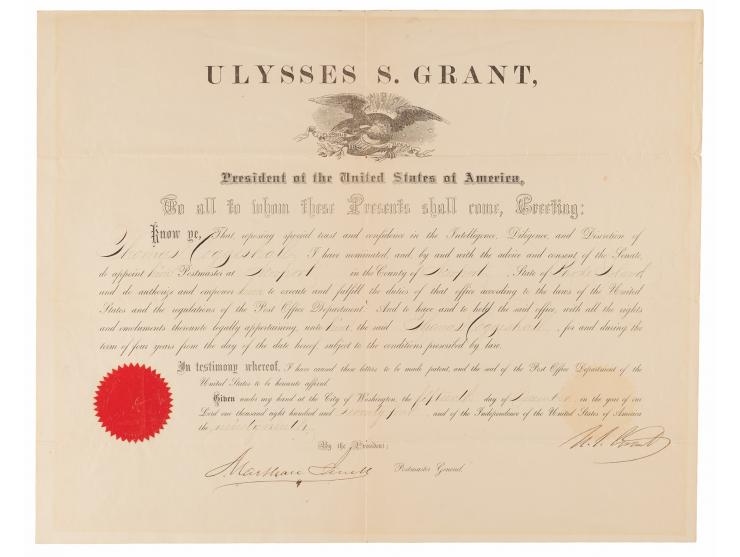
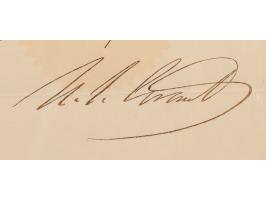
Partly-printed DS as president, one page, 17.25 x 14, December 15, 1874. President Grant appoints Thomas Coggeshall as "Postmaster at Newport, in the County of Newport, State of Rhode Island." Nicely signed at the conclusion in ink by President Ulysses S. Grant and countersigned by Postmaster General Marshall Jewell. The red seal affixed at the lower left remains fully intact. In fine condition, with light toning from prior display.
Opening: $200
Estimate: $1,000 - $2,000
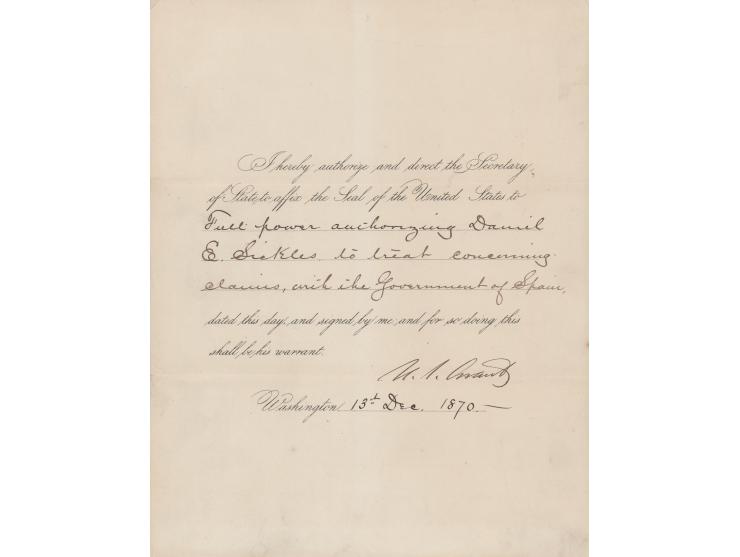
Partly-printed DS as president, one page, 8.5 x 11, December 13, 1870. President Grant authorizes and directs the Secretary of State to affix the Seal of the United States to the "Full power authorizing Daniel E. Sickles to treat concerning claims, with the Government of Spain." Neatly signed at the conclusion in ink by President Ulysses S. Grant. In fine condition.
Daniel E. Sickles served as U.S. Minister to Spain from 1869 to 1874, appointed by President Ulysses S. Grant during a period of political upheaval following the Spanish Revolution of 1868. During his tenure, he worked to protect American commercial interests and became deeply involved in diplomacy surrounding the Ten Years’ War in Cuba, particularly during the controversial Virginius Affair of 1873, when Spanish authorities executed several crew members of an American-flagged ship accused of aiding Cuban rebels. The crisis brought the United States and Spain to the brink of war and led to Sickles' resignation; his successor, Caleb Cushing, ultimately defused the situation and negotiated reparations for the families of the dead.
Opening: $200
Estimate: $1,000 - $2,000
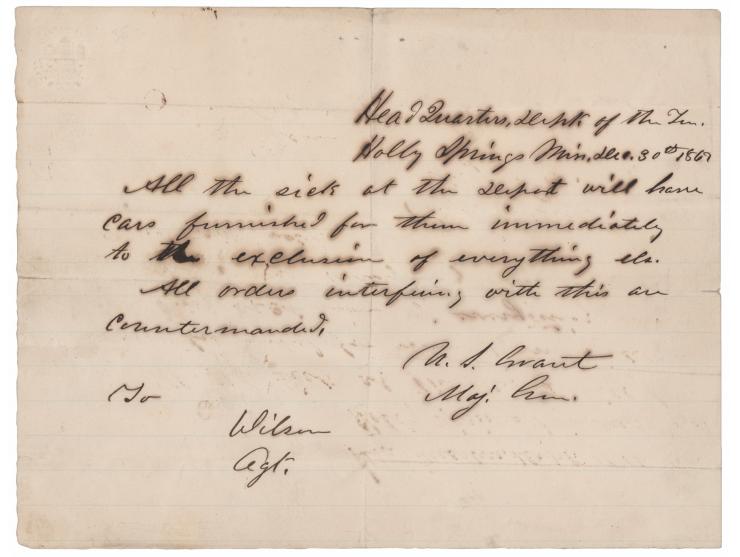
Civil War-dated ALS signed “U. S. Grant, Maj. Gen.," one page, 7.75 x 6, December 30, 1862. Addressed from “Head Quarters, Dept. of the Ten.,” in Holly Springs, Mississippi, a handwritten letter to “Wilson, Agt.,” the railroad agent responsible for managing car assignments at the Holly Springs depot. In full: "All the sick at the Depot will have cars furnished for them immediately to the exclusion of everything else. All orders interfering with this are Countermanded." In very good to fine condition, with multiple intersecting folds, and a couple of small repairs.
Grant was using Holly Springs as his forward supply base and headquarters during his first overland campaign against Vicksburg when Confederate Major General Earl Van Dorn led 3,500 cavalry in a surprise raid on December 20, 1862, destroying an estimated $1.5 million in Union supplies and forcing Grant to abandon his advance. Written ten days later as he withdrew toward Memphis, this order prioritizes the immediate rail evacuation of the sick above all other traffic, reflecting both the humanitarian urgency and the logistical upheaval left by Van Dorn’s raid. Its forceful language highlights the disruption to normal operations and Grant’s need to impose direct control in the campaign’s aftermath. Grant's first Vicksburg campaign had collapsed; he would not capture the city until July 4, 1863, after a siege of forty-seven days.
Opening: $1,000
Estimate: $10,000 - $20,000
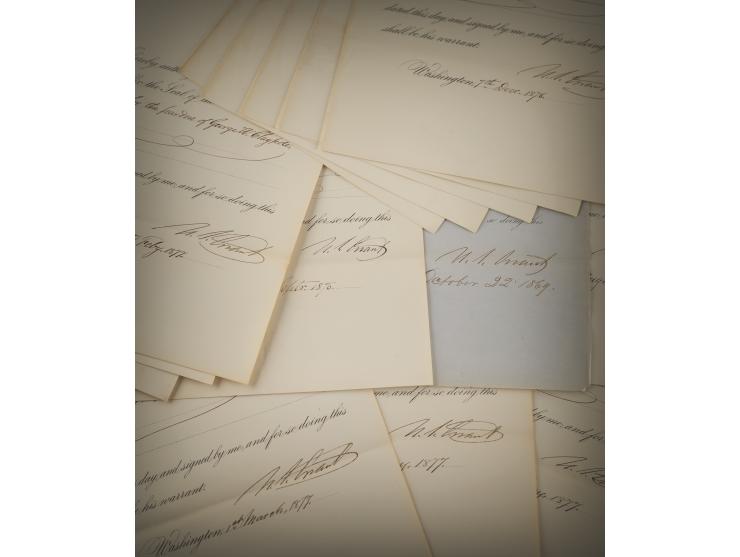
Uncommon archive of 20 partly-printed DSs as president, signed "U. S. Grant," all one page, 8 x 10, dated from October 22, 1869, to March 3, 1877. Several of these pardon warrants—signed in the waning days of Grant’s administration, which came to its end on March 4, 1877—reflect the president’s final exercise of executive authority before leaving office. In overall fine to very fine condition.
Complete list:
1. DS as President, Oct. 22, 1869 - Warrant for the pardon of John H. Garrison.
2. DS as President, August 9, 1876 - Warrant for the pardon of John D. Reynolds.
3. DS as President, Sept. 28, 1876 - Warrant for the pardon of James K. Hill.
4. DS as President, Nov. 24, 1876 - Warrant for the pardon of Diogenes Wetmore.
5. DS as President, Dec. 7, 1876 - Warrant for the pardon of George W. Adams.
6. DS as President, Dec. 9, 1876 - Warrant for the pardon of Harry McFarland.
7. DS as President, Dec. 15, 1876 - Warrant for the pardon of John E. Howard.
8. DS as President, Dec. 15, 1876 - Warrant for the pardon of Lewis Roberts.
9. DS as President, Dec. 15, 1876 - Warrant authorizing Timothy Golden to receive into custody Thomas R. Lewis, a fugitive from the justice of the United States.
10. DS as President, Jan. 10, 1877 - Warrant for the pardon of John Henderson.
11. DS as President, Jan. 11, 1877 - Warrant for the pardon of William H. Walker.
12. DS as President, Jan. 11, 1877 - Warrant for the pardon of John Oehr.
13. DS as President, Jan. 20, 1877 - Warrant for the pardon of Frank L. Taintor.
14. DS as President, Jan. 22, 1877 - Warrant for pardon of Edward Brady and Michael Mullady.
15. DS as President, Feb. 16. 1877 - Warrant for the pardon of George W. Claypole.
16. DS as President, Feb. 22, 1877 - Warrant for the pardon of John Mahoney.
17. DS as President, Feb. 27, 1877 - Warrant for pardon of Felix Jones.
18. DS as President, March 1, 1877 - Warrant for the pardon of Elbridge Crossman.
19. DS as President, March 1, 1877 - Warrant for the pardon of Sigismund Lindaur.
20. DS as President, March 3, 1877 - Warrant for the pardon of H. H. Harrington.