John Adams
Opening: $1,000
Estimate: $8,000 - $10,000
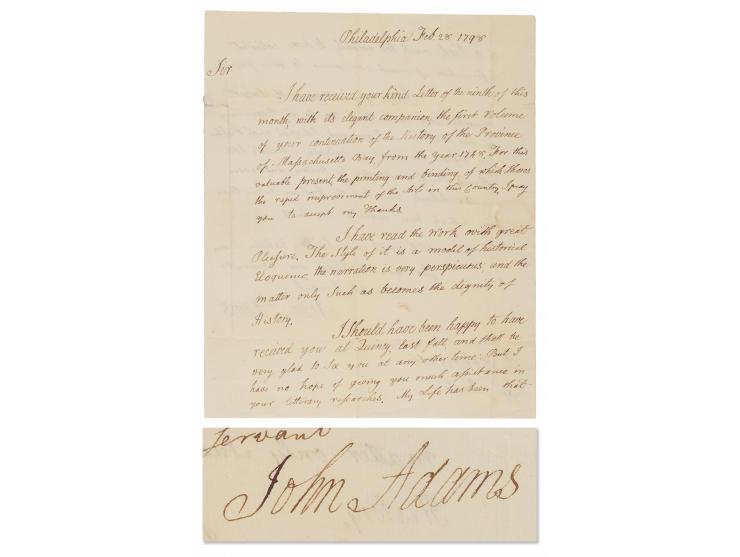
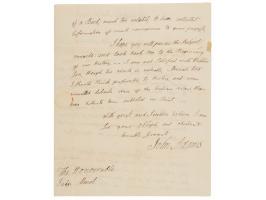
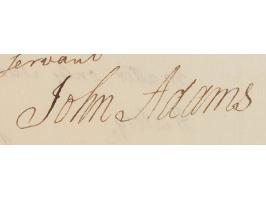
ALS as president, one page both sides, 8 x 9.75, February 28, 1798. Addressed from the United States Capitol in Philadelphia, a handwritten letter to Boston jurist and historian George Richards Minot, in full: “I have received your kind Letter of the ninth of this month, with its elegant companion, the first Volume of your continuation of the History of the Province of Massachusetts Bay, from the Year 1748. For this valuable present, the printing and binding of which shews the rapid improvement of the Arts in this Country, I pray you to accept my Thanks. I have read the work with great Pleasure. The Style of it is a model of historical Eloquence: the narration is very perspicuous; and the matter only Such as becomes the dignity of History.
I Should have been happy to have received you at Quincy last fall, and shall be very glad to See you at any other time: But I have no hope of giving you much assistance in your literary researches. My Life has been that of a Bird, much too volatile, to have collected Information of much consequence to your purpose. I hope you will pursue the Subject onwards: and look back too to the Beginning of our History. I am not Satisfied with Hutchinson, though his Work is valuable. Annals too I Should think preferable to History, and even minuter details even of the Indian Wars, than have hitherto been published in Print.” In fine condition.
George Richards Minot (1758–1802) was a Boston attorney, judge, and historian, a Fellow of the American Academy of Arts and Sciences, and a member of the Massachusetts Historical Society. His Continuation of the History of the Province of Massachusetts Bay, from the Year 1748, the first volume of which prompted this letter, was published in Boston by Manning and Loring in 1798. It picked up where loyalist Thomas Hutchinson's History of the Province of Massachusetts Bay had left off, carrying the narrative through the period leading to the Revolution.
Adams's pointed remark that he was "not Satisfied with Hutchinson, though his Work is valuable" reflects the deep personal and political animosity between Adams and Hutchinson, the royal governor whose enforcement of British policy Adams had opposed at every turn in the decade before independence. His suggestion that "Annals" and "minuter details even of the Indian Wars" would be preferable to formal history reflects Adams's lifelong preference for primary documentation over narrative synthesis. Minot died in 1802 at the age of forty-three, leaving the second volume of the Continuation unpublished at his death; it appeared posthumously. Adams wrote this letter during his single term as president, having defeated Thomas Jefferson in 1796 and three years before losing the rematch to Jefferson in 1800.
John Quincy Adams
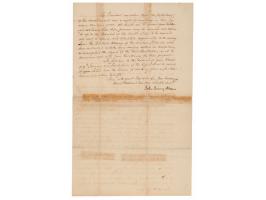
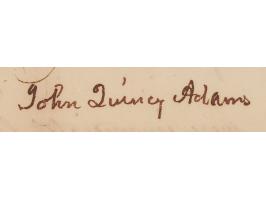
Opening: $200
Estimate: $2,000 - $4,000
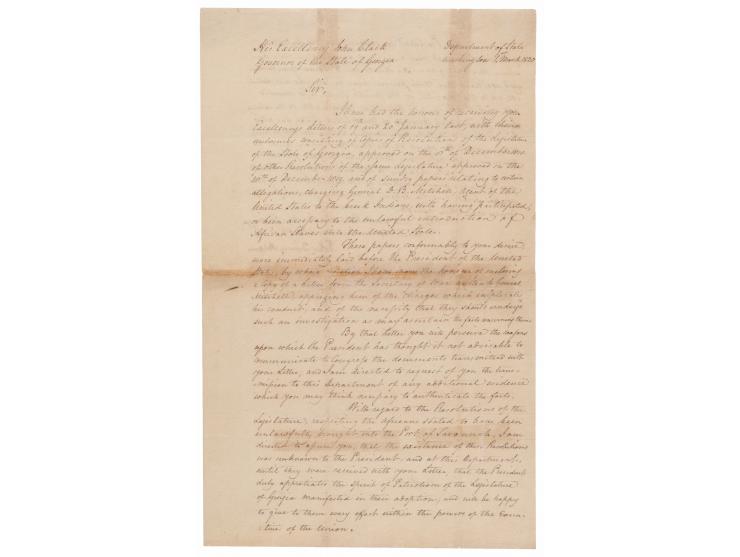
LS as secretary of state, one page, both sides, 8 x 13, March 1, 1820. Addressed from the “Department of State” in Washington, a letter to John Clark, governor of Georgia, acknowledging receipt of Clark's letters of January 19 and 20 with their enclosures: copies of resolutions of the Georgia Legislature approved December 8, 1810, and December 10, 1819, together with sundry papers relating to allegations charging General D.B. Mitchell, U.S. Agent to the Creek Indians, with having participated in or been accessory to the unlawful introduction of African slaves into the United States.
Adams advises that the papers were immediately laid before President Monroe, who directed Adams to enclose a copy of a letter from the Secretary of War to General Mitchell apprising him of the charges implicating his conduct and of the necessity for investigation, and that the president thought it inadvisable to communicate the documents to Congress at this time. He requests transmission to the State Department of any additional evidence Clark may think necessary to authenticate the facts. Regarding the resolutions concerning Africans unlawfully brought into the Port of Savannah, states that the existence of those resolutions was unknown to the President and the Department until received with Clark's letter, that the President "duly appreciates the Spirit of Patriotism of the Legislature of Georgia manifested in their adoption," and will give them every effect within the powers of the Executive.
Adams continues: “The President considers that the forfeiture of the bonds cannot vest a right of any kind in those by whom they were given — He directs me to request Your Excellency's exertions that those persons may be recovered and delivered up to the Marshal of the United States, to be removed and sent to Africa, and liberated conformably to the existing Law.” He concludes by noting that the District Attorney has been instructed to take every measure within his competency to accomplish the object of the third Resolution, and promises a further communication on the subject of Clark's January 19 letter. In very good to fine condition, with old tape stains and discreet professional repairs.
David Brydie Mitchell (1766–1837) had served two terms as Governor of Georgia before President Madison appointed him U.S. Agent to the Creek Indians in 1817. Within months of his appointment, he became involved in a slave-smuggling ring operating out of Amelia Island, Florida, through which at least 110 Africans were illegally imported into the United States in violation of the Act of 1807 prohibiting the slave trade.
The contraband enslaved people were brought up the Flint River to Mitchell's agency, where they were divided among Mitchell and his business partners. The investigation was triggered when John Clark, who had just defeated Mitchell's political faction to win the governorship of Georgia in 1819, found incriminating correspondence in Mitchell's desk and forwarded it to Washington.
This letter, written fourteen months before Mitchell's formal dismissal, documents the early stage of Monroe's response: the President was unwilling to send the evidence to Congress, but directed that the Africans be located, transferred to federal custody, and repatriated under the provisions of the 1819 Slave Trade Act. Mitchell was ultimately dismissed in 1821 following a formal opinion by Attorney General William Wirt concluding that he had ‘prostituted his power as agent for Indian affairs…to the purpose of aiding and assisting in a conscious breach of the act of Congress of 1807.’ Adams would later, as president and then as a congressman, become one of the most forceful antislavery voices in American political life.
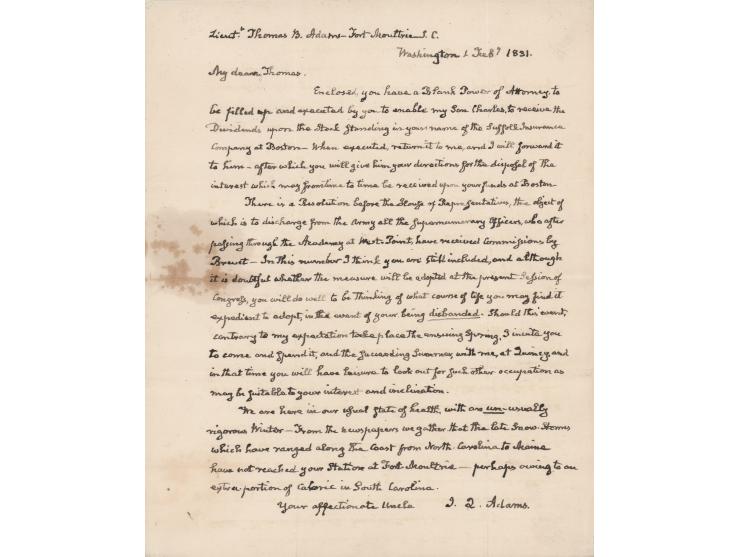
Opening: $200
Estimate: $1,000 - $2,000
ALS as a congressman-elect, signed "J. Q. Adams," one page, 7.75 x 9.75, February 1, 1831. Addressed from Washington, a handwritten letter to his nephew, Lieutenant Thomas B. Adams, stationed at Fort Moultrie in South Carolina, in which encloses a blank power of attorney to be executed by Adams to enable JQA's son, Charles, to receive dividends on stock in the Suffolk Insurance Company of Boston held in Adams’s name; instructs that once executed, Adams should give Charles directions for disposal of the interest accruing on his Boston funds.
The letter then turns to a more pressing matter: "There is a Resolution before the House of Representatives, the object of which is to discharge from the Army all the Supernumerary Officers, who after passing through the Academy at West Point, have received Commissions by Brevet — In This number I think you are still included, and although it is doubtful whether the measure will be adopted at the present Session of Congress, you will do well to be thinking of what course of life you may find it expedient to adopt, in the event of your being disbanded. Should this event, contrary to my expectation take place the ensuing Spring, I invite you to come and Spend it, and the Succeeding Summer, with me, at Quincy, and in that time you will have Leisure to look out for such other occupation as may be suitable to your interest and inclination." JQA closes with a note on the unusually rigorous Washington winter, observing that the heavy snowstorms ranging from North Carolina to Maine have apparently not reached Fort Moultrie, "perhaps owing to an extra portion of Caloric in South Carolina." In fine condition, with some light staining at the left edge.
John Quincy Adams wrote this letter from Washington at the opening of the Twenty-Second Congress, having just won election in the fall of 1830 as a representative from Massachusetts — the only former president to serve in the House after leaving the White House. He was fifty-three days from taking his seat when he wrote to his nephew. The recipient, Thomas Boylston Adams Jr. (1809–1837), was a grandson of President John Adams and a son of JQA's younger brother, Thomas Boylston Adams, Sr. He had graduated twelfth in the West Point Class of 1828 and was serving as a Second Lieutenant in the 2nd Artillery at Fort Moultrie, South Carolina. The congressional resolution JQA describes reflects the Jacksonian-era effort to reduce the officer corps by eliminating brevet commissions, a politically charged measure that targeted the professional military class closely associated with West Point. Thomas was not in fact discharged; he was promoted to First Lieutenant in 1834, served in the Second Seminole War in Florida, and died of typhoid fever at Fort Dade on December 14, 1837, at the age of twenty-eight. "Charles" is Charles Francis Adams (1807–1886), JQA's youngest surviving son, later minister to Great Britain during the Civil War.
Andrew Jackson
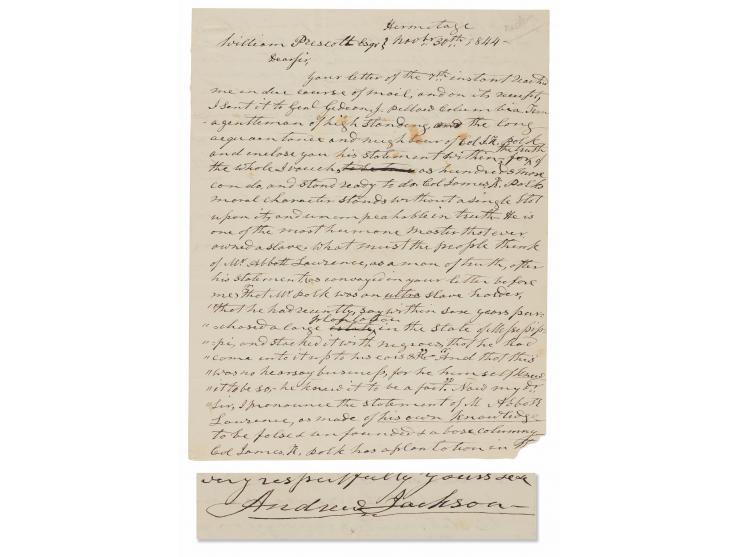
Opening: $300
Estimate: $4,000 - $6,000
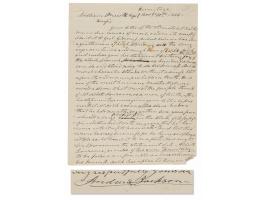
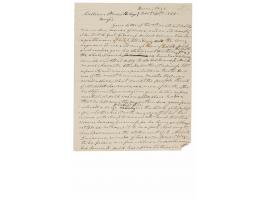
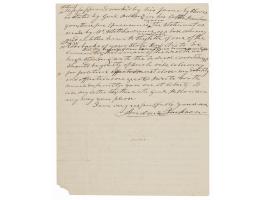
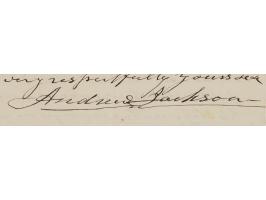
ALS, one page both sides, 7.5 x 9.75, November 30, 1844. Handwritten letter to American historian William Prescott, in full: "Your letter of the 7th instant reached me under course of mail, and on its receipt, I sent it to Gen'l Gideon J. Pillow, Columbia Tenn. a gentleman of high standing, of long acquaintance and neighbour of Col. J. K. Polk and enclose you his statement within, for the truth of the whole I vouch, as hundreds more can do, and stand ready to do. Col. James K. Polk's moral character stands without a single blot upon it, and unimpeachable in truth. He is one of the most humane Masters that ever owned a slave. What must the people think of Mr. Abbott Lawrence, as a man of truth, after his statement, (as conveyed in your letter before me) that Mr. Polk was an ultra slave holder, that he had recently, say within six years purchased a large plantation in the state of Mississippi, and stacked it with negroes, that he had come into it up to his ears &c. And that this was no hearsay business, for he himself knew it to be so, he knew it to be a fact.
Now my Dr. Sir, I pronounce the statement of Mr. Abbott Lawrence, as made of his own knowledge to be false & unfounded & a base calumny. Col. James K. Polk has a plantation in the State of Mississippi and worked by his family slaves as stated by Gen'l Pillow in his letter I enclose you, therefore I pronounce again the statement as made by Mr. Abbott Lawrence as a base calumny and entitles him to the unenviable title of one of the Whigg Roorbacks of your state. How is it to be lamented that the morals of men recently are become so corrupt, that a man of his wealth and a high standing with the Federal Coon Whiggs should be guilty of such vile calumny for political effect. I must close-my debility and afflictions are great, & I write with much difficulty. You are at liberty to use my letter together with Genl Pillows in any way you please." In fine condition, with small stains and trivial corner loss.
At the 1844 Democratic National Convention, James K. Polk—a lifelong supporter of Andrew Jackson—was nominated on the ninth ballot, defeating former president Martin Van Buren, whose opposition to the annexation of Texas cost him crucial support. The presidential campaign that followed was marked by sharp personal attacks. Democrats portrayed Whig candidate Henry Clay as a gambler and drunkard, and as an opportunistic seeker of the nation’s highest office. In turn, the Whigs attacked Polk as a mere puppet of Andrew Jackson and criticized him as a coward for once declining to participate in a duel. Polk’s steadfast loyalty to Jackson throughout his controversial career earned him the nickname 'Young Hickory.' In the general election, held in most states on November 12, 1844, Polk emerged victorious, carrying fifteen states in the Electoral College.
Abbott Lawrence (1792-1855), whose statements Jackson considered to be "a base calumny," was a merchant and statesman who founded and developed Lawrence, Massachusetts. An ardent Whig, he represented his district in Congress from 1834 to 1836 and 1838 to 1840 and attended the national convention in 1844 as a delegate. In 1848 he was a leading candidate for the vice-presidential nomination.
General Gideon John Pillow (1806–1878), to whom Jackson forwarded Prescott's letter, was a criminal lawyer in Columbia, Tennessee, who had fought for the Confederacy during the Civil War and was Polk's partner for some time. He claimed for himself the major responsibility for the nomination of Polk for the Presidency in 1844.
The term "Roorbach," a political canard (especially one that backfires), arose in the campaign of 1844, when the Ithaca (New York) Chronicle printed some alleged extracts from an imaginary book entitled Roorback's Tour Through the Western and Southern States containing grotesque charges against Polk, which were promptly copied by other Whig newspapers.
John Tyler
Opening: $300
Estimate: $4,000 - $6,000
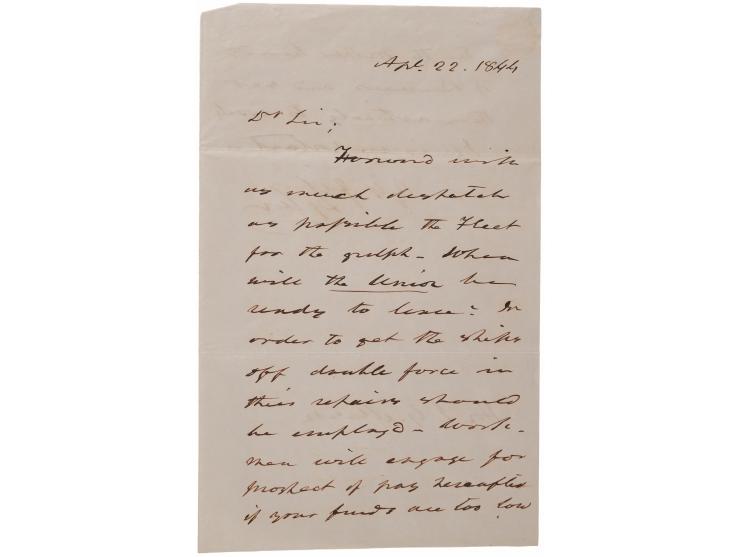
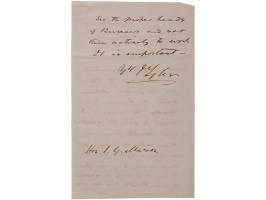
ALS signed “J. Tyler,” one page both sides, 5 x 8, April 22, 1844. Handwritten letter to Secretary of the Navy John Y. Mason, in full: "Forward with as much dispatch as possible the Fleet for the gulph. When will the Union be ready to leave? In order to get the ships off double force in their repair should be employed. Workmen will engage for prospect of pay hereafter if your funds are too low see the proper heads of Bureaus and get them actively to work. It is important." In fine condition.
Just six and a half weeks earlier, tragedy had struck aboard the USS Princeton, the Navy’s new propeller-driven warship. During a demonstration cruise on the Potomac River attended by President Tyler and approximately 400 guests, a massive naval gun exploded, killing Secretary of State Abel P. Upshur, Secretary of the Navy Thomas W. Gilmer, and four others. Tyler soon appointed John C. Calhoun as Secretary of State and named former Congressman John Y. Mason to succeed Gilmer as Secretary of the Navy. Mason assumed office on March 26, 1844.
On April 12, 1844, Tyler signed the Texas annexation treaty, which had been negotiated by Calhoun prior to formally taking office. On April 22—the same day he submitted the treaty to the U.S. Senate for ratification—Tyler wrote this urgent letter directing Mason to dispatch the fleet to the Gulf with “as much dispatch as possible,” strengthening naval readiness in case Mexico responded militarily.
The annexation treaty soon became a central issue in the presidential election of 1844. Former President Martin Van Buren publicly opposed annexation, while the Democratic Party ultimately nominated James K. Polk, whose expansionist platform supporting the acquisition of Texas, Oregon, and California proved popular. Although the Senate rejected Tyler’s treaty on June 8, 1844, Polk’s election in November ensured the issue’s revival. Texas was annexed by joint resolution in December 1845 and formally entered the Union on December 29, 1845. War with Mexico followed in May 1846.
An important Texas-related presidential letter written at a pivotal moment in American expansion.
Zachary Taylor
Opening: $200
Estimate: $1,000 - $2,000
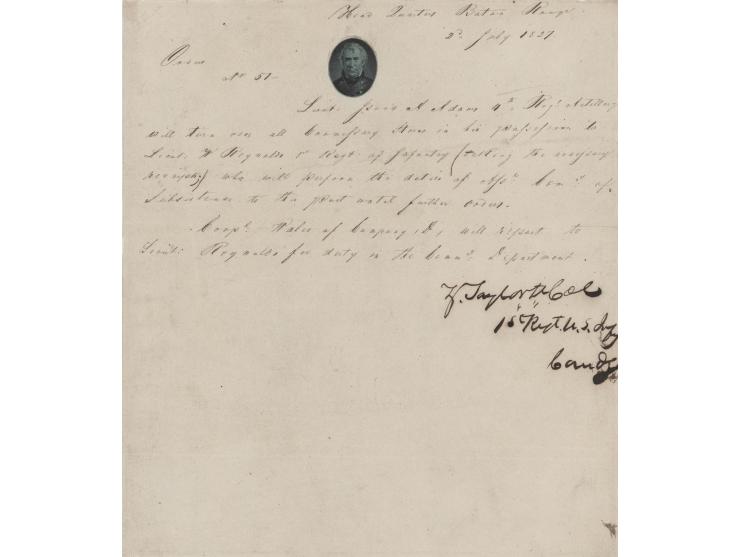
LS signed “Z. Taylor Lt. Col., 1st Regt. U.S. Infy, Comdg,” one page, 7.5 x 8.5, July 2, 1827. "Order No. 51" from his "Head Quarters, Baton Rouge," in full: "Lieut. Isaac A. Adams 4th Regt. Artillery will turn over all Commissary Stores in his possession to Lieut. W. Reynolds 1st Regt. of Infantry (taking the necessary receipts), who will perform the duties of Asst. Com'y of Subsistence to this post until further orders. Corp'l Wales of Company 'D' will report to Lieut. Reynolds for duty in the Comm'y Department." In fine condition.
Written from his headquarters in Baton Rouge, this orderly yet revealing document captures Zachary Taylor during his steady rise through the antebellum army, years before he emerged as a national hero of the Mexican–American War and the twelfth president of the United States. Commanding the 1st U.S. Infantry on the southwestern frontier, Taylor's “Order No. 51” reflects the everyday logistical responsibilities that underpinned military life—transferring commissary stores, assigning officers to subsistence duties, and detailing enlisted men to departmental service.
James Buchanan
Opening: $500
Estimate: $8,000 - $10,000
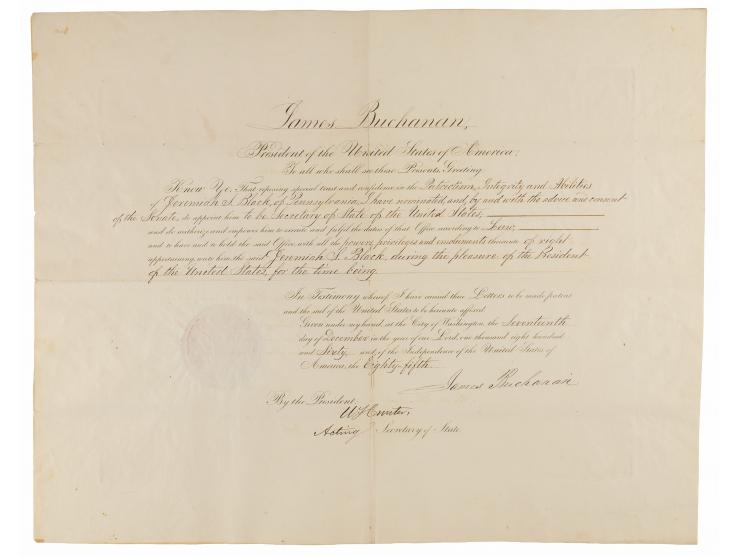
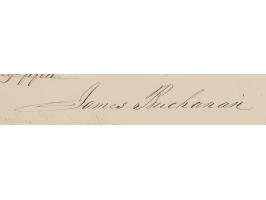
Partly-printed DS as president, one page, 19.5 x 15.5, December 17, 1860. President Buchanan, "by and with the advice and consent of the Senate," appoints Jeremiah S. Black of Pennsylvania "to be Secretary of State of the United States." Crisply signed at the conclusion in ink by President James Buchanan and countersigned by Acting Secretary of State William Hunter. In fine condition, with expert reinforcements to the backs of the intersecting folds.
This document was issued at a moment of extraordinary turmoil in President James Buchanan’s administration. After Abraham Lincoln’s election in November 1860, Southern states—led by South Carolina—moved rapidly toward secession. As tensions escalated, General Winfield Scott and several Cabinet members urged Buchanan to reinforce vulnerable federal forts in the South, particularly in Charleston Harbor. Buchanan’s reluctance to act prompted Secretary of State Lewis Cass to resign on December 14, 1860, in protest.
Just five days later, Buchanan appointed his trusted Attorney General, Jeremiah S. Black of Pennsylvania, as the new Secretary of State. A close friend and adviser, Black denied the constitutionality of secession, and urged that Fort Sumter be properly reinforced and defended. He remained at Buchanan’s side as the secession crisis deepened and much of the Cabinet fractured, with multiple members resigning over policy disagreements. This extremely scarce, cabinet-level appointment reflects the instability and urgency that defined the final months of Buchanan’s presidency on the eve of the Civil War.
Abraham Lincoln
Opening: $10,000
Estimate: $100,000 - $150,000
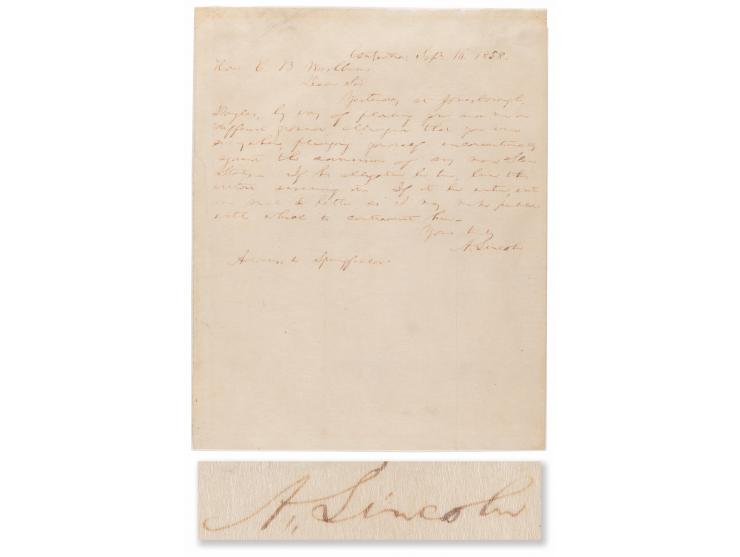
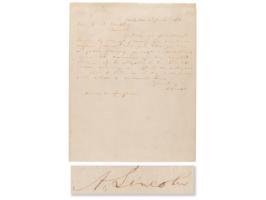
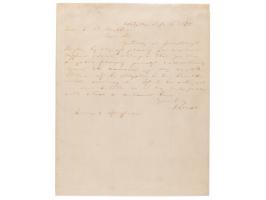
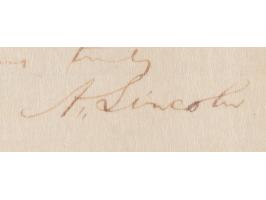
Historic ALS signed “A. Lincoln,” one page, 7.75 x 9.75, September 16, 1858. Handwritten letter to Congressman Elihu B. Washburne, concerning an allegation made by Stephen Douglas against Washburne at the preceding Lincoln-Douglas debate in Jonesboro, Illinois. Lincoln addressed the letter from Centralia, Illinois, a city about 80 miles north of Jonesboro and about 100 miles southwest of Charleston, Illinois, the site of Lincoln's next debate with Douglas two days later. Lincoln took the evening northbound train from Centralia on his way to Charleston.
The letter, in full: “Yesterday at Jonesborough, Douglas, by way of placing you and me on different ground, alledged that you were everywhere, pledging yourself unconditionally against the admission of any more Slave States. If his allegation be true, burn this without answering it. If it be untrue, write me such a letter as I may make public with which to contradict him.” To the lower left, Lincoln adds, “Address to Springfield.” Elihu B. Washburne was elected as a Whig to the 33rd Congress in 1852 and was reelected as a Republican in 1854 and 1856. By this time, he was seeking his fourth term in Congress and had been present at the second Lincoln-Douglas debate held in his congressional district of Freeport on August 27, 1858. Includes a handsome presentation folder with quarter-bound slipcase. Professionally cleaned, rice paper-backed, and restored to near-fine condition. An astounding Lincoln letter that mentions both his pivotal debates with Douglas and the admission of slave states to the Union, the issue that divided the nation and led to the Civil War.
The day before, in their third debate held at Jonesboro, Illinois, on September 15, 1858, Sen. Stephen A. Douglas said, in part, ‘But Mr. Lincoln does not want to be held responsible for the Black Republican doctrine of no more slave States…Washburne, the Black Republican candidate for Congress in the Galena district, is making speeches in favor of this same abolition platform declaring no more slave States. Why are men running for Congress in the northern districts, and taking that abolition platform for their guide, when Mr. Lincoln does not want to be held to it down here in Egypt and in the centre of the State, and objects to it so as to get votes here.’
In the Freeport debates on August 27, 1858, Lincoln affirmed that he was not against the admission of new slave states, stating: ‘I do not now, nor ever did, stand pledged against the admission of any more slave states into the Union.’ Lincoln’s stance seemed clear, but Douglas, a shrewd politician, called into doubt his sincerity by referencing fellow party members like Washburne while emphasizing Lincoln’s adherence to his party's abolitionist platform and advocacy of social equality between the races, a radical position guaranteed to cause Lincoln to lose.
In Jonesboro, Lincoln stayed firm by challenging the implications of the Dred Scott decision, stating that the Supreme Court had ruled ‘any Congressional prohibition of slavery in the Territories is unconstitutional.’ He then asked his audience: ‘What would be the first thing you would have to do before entering upon your duties? Swear to support the Constitution of the United States.’ Lincoln emphasized that failing to support such rights, while claiming to uphold the Constitution, would be a contradiction, and concluded that if he accepted the Dred Scott decision as a correct interpretation of the Constitution, then refusing to support slavery in the territories would make him ‘a perjured man.’ Lincoln’s counter made it clear that he would be violating his duty to support the Constitution if he were against the admission of any more Slave States.
Over the next two debates, held in Charleston and Galesburg, Douglas continued to accuse Lincoln and the Republican Party of hypocrisy, arguing that Republicans said one thing in the North and another in the South, all while mocking Lincoln for supposedly distancing himself from a position his supporters openly embraced. He questioned Lincoln’s leadership and accused him of political evasiveness: ‘Why cannot Abraham Lincoln… speak out their principles so that they may be understood?’
Douglas defeated Lincoln for the Senate seat, but Lincoln's popularity was boosted by the debates, setting the stage for his presidential election in 1860. After that election, Washburne and William Seward were appointed to meet and escort the newly elected president to his hotel upon his first arrival in Washington in 1861. Washburne later served as President Grant's Secretary of State.
The Lincoln letter here offered is published in Roy P. Basler's ‘The Complete Works of Abraham Lincoln’ (Rutgers University Press, 1953). Basler notes, ‘Apparently, Washburne did not reply to this letter, for in the Lincoln Papers there are no Washburne letters between May 31, 1858 and May 20, 1860.’ It is possible that Washburne did reply, addressing his letter “to Springfield” as requested by Lincoln, but Lincoln would not have received it until he returned home on October 16th after the final debate with Douglas. If he did receive Washburne's reply, the issue was now moot, so Lincoln may have destroyed it. According to The Collected Works, after Elihu Washburne died, this letter was owned by his son, Hempstead Washburne.
Opening: $1,000
Estimate: $10,000 - $15,000
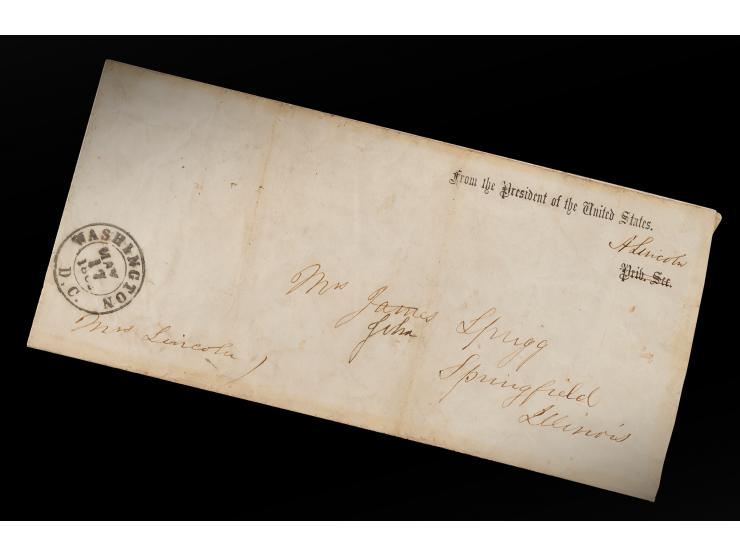
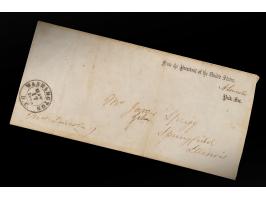
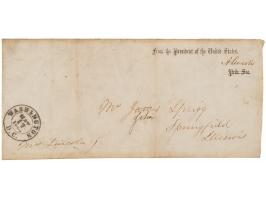
Franking signature as president, "A. Lincoln," on a 9.25 x 4.25 "From the President of the United States" mailing envelope, postmarked at Washington, May 17, 1862. The envelope has been addressed in Mary Lincoln's hand to "Mrs. James [struck out] John Sprigg, Springfield, Illinois," and signed by her at lower left "Mrs. Lincoln." In very good condition, with light creasing, several vertical folds, and overall soiling; both signatures are clear, dark, and well contrasted.
The addressee is evidently Mrs. Julia Sprigg, a widow who purchased a home next to the Lincolns' in Springfield in 1853. Sprigg and Mary Lincoln became close friends, and Sprigg's daughter sometimes babysat the younger Lincoln boys. An exceedingly scarce and desirable president-and-first-lady combination.
Opening: $1,000
Estimate: $4,000 - $6,000
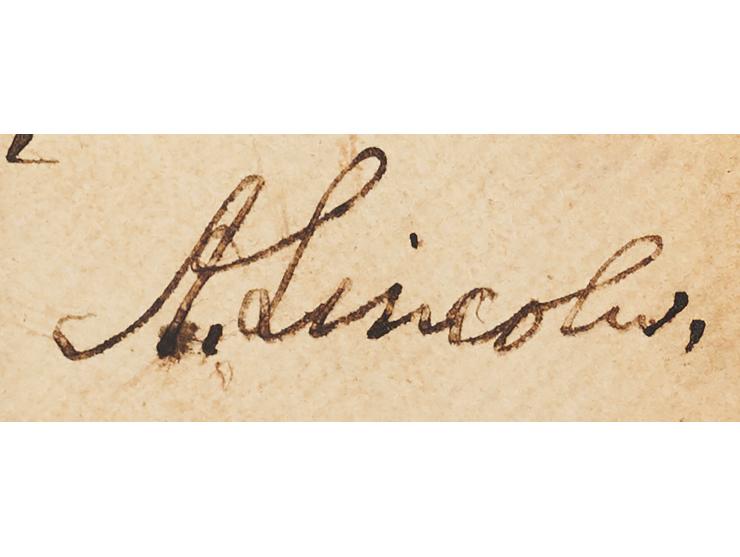
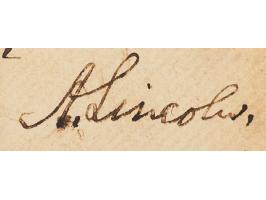
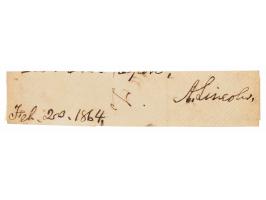
Civil War-dated ink signature as president, “A. Lincoln, Feb. 20, 1864,” on an off-white 3.75 x .75 slip. In fine condition. Accompanied by an engraving of Abraham Lincoln with a facsimile signature. According to ‘Lincoln Day By Day: A Chronology, 1809-1865,’ on February 20, 1864, the ‘President attends Mrs. Lincoln's regular Saturday afternoon reception,’ and, as noted in the ‘Collected Works of Abraham Lincoln,’ on this date Lincoln forwarded an endorsement to Edwin Stanton, his Secretary of War, on a letter from Edward Cooper and Judge Henry Cooper of Tennessee, regarding a prisoner of war, ill with tuberculosis, at Camp Morton, Indiana. Lincoln wrote: ‘I specifically request that you will see Judge Cooper and allow him to take his brother home with him.’
Opening: $200
Estimate: $1,000 - $1,500
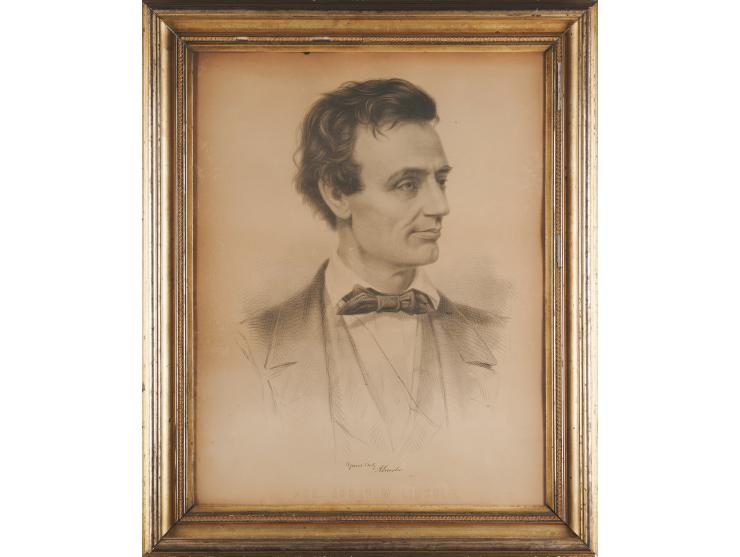
Original circa 1860 preliminary proof of a campaign lithograph depicting Abraham Lincoln, 19.5 x 25.5, featuring his printed facsimile signature in the lower border, "Yours truly, A. Lincoln," with "Hon. Abraham Lincoln," printed in block letters below. The portrait of Lincoln is based on one done by artist Thomas Hicks, the first to come west to paint the new Republican candidate in June 1860. Lincoln is said to have joked to Hicks: 'It will give the people of the East a correct idea how I look at home, and, in fact, how I look in my office. I think the picture has a somewhat pleasanter expression than I usually have, but that, perhaps, is not an objection' (see: Reminiscences of Abraham Lincoln, edited by C. Allen Thorndike Rice, p. 602).
This example appears to be a preliminary first state of the more common campaign poster, lacking the plate signature of lithographer Leopold Grozelier, the imprint line, the complete title, and some extra linework in the margins. Later examples feature the complete block-letter caption: "Hon. Abraham Lincoln, Republican Candidate for the Presidency, 1860." Other examples of this scarce printing reside in the collections of the Library of Congress and the Library Company of Philadelphia, while another was sold at Swann's in 2018.
Framed to an overall size of 25.5 x 31. In very good condition, with light toning and scattered small surface scuffs.
Opening: $200
Estimate: $1,000 - $2,000
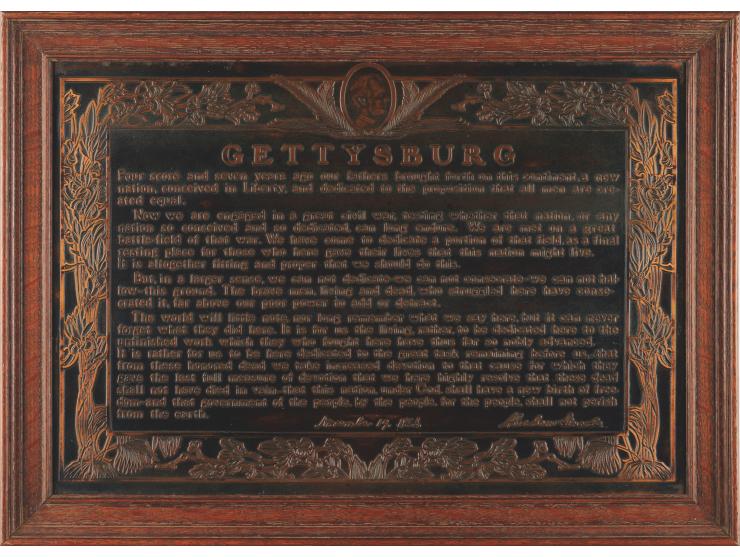
Mid-century bronzed plaque commemorating the Gettysburg Address made by President Abraham Lincoln on November 19, 1863. The plaque, 19 x 13, features the full text of the iconic Civil War speech in raised text with Lincoln’s facsimile signature and date below. A floral border wraps the plaque, which is surmounted by the president’s likeness in profile. Framed to an overall size of 22 x 16. In fine condition, with some surface wear.
Opening: $1,000
Estimate: $10,000 - $15,000
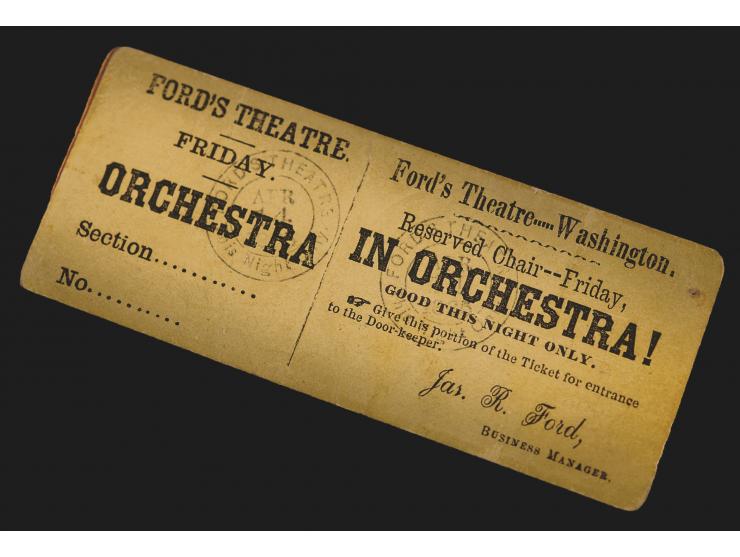
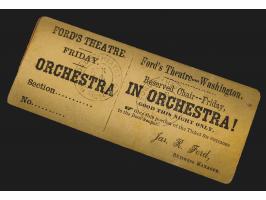
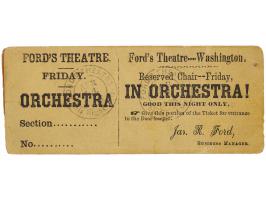
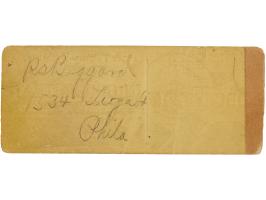
Rare original unissued 'Orchestra' level ticket from Ford's Theatre in Washington, D.C., bearing two circular date stamps, "Ford's Theatre, APR 14, 1865, This Night Only," the date of the performance of Our American Cousin when assassin John Wilkes Booth shot President Abraham Lincoln. The yellow ticket, 4.25˝ x 1.75˝, is imprinted on the left side, "Ford's Theatre., Friday., Orchestra," with the lower "Section" and "No." fields left blank. The right side carries the printed signature of "Jas. R. Ford, Business Manager," below the following text: "Ford's Theatre …. Washington. / Reserved Chair – Friday, In Orchestra! Good This Night Only. / Give this portion of the Ticket for entrance to the Door-keeper." The reverse is annotated in a contemporary hand: "R.S. Biggard, 1534 Tioga St., Phila." In fine condition, with a light vertical fold.
The circular April 14th date stamps match those seen on both known, authentic used tickets as well as on unissued examples, including a similar unused yellow 'Orchestra' level ticket held by the Shapell Manuscript Foundation, whose reverse bears a handwritten certification, signed by John M. Haseltine and dated July 14, 1865, stating that the ticket is an original from the evening of Lincoln's assassination and was presented to him personally by James R. Ford.
That notation is significant: Ford was barred from accessing Ford's Theatre — including its box office — following the federal government's seizure of the building after the assassination. He did not regain entry until July 1865. At that point, he was able to retrieve surviving box office stock and, as the Haseltine inscription confirms, present examples to acquaintances as mementos.
Also consistent with this history are the unissued tickets published in the Restoration of Ford's Theatre Historic Structures Report. This ticket almost certainly shares that provenance. The blank "Section" and "No." fields indicate it was never issued to a patron; it survived intact in the box office because Ford had no access to distribute it until three months after the performance for which it was printed.
Interested parties are encouraged to read the following RR Auction blog post from September 2023, which covers in detail the various types of Ford’s Theatre tickets known to exist.
Opening: $200
Estimate: $1,000 - $2,000
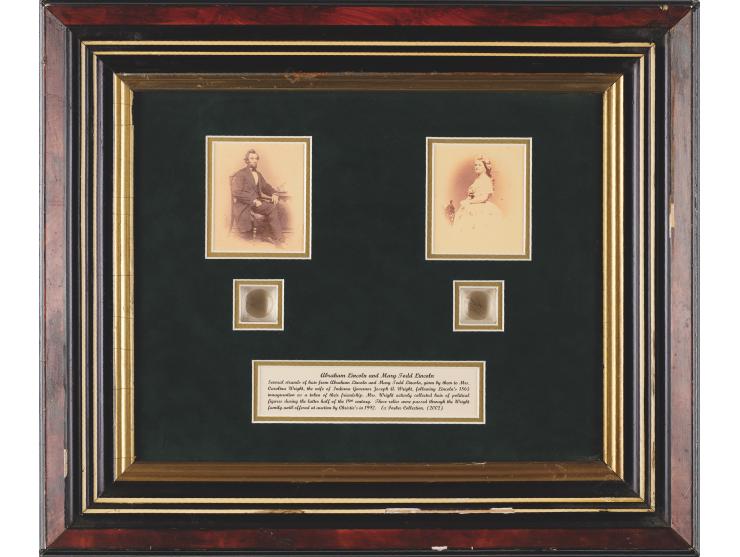
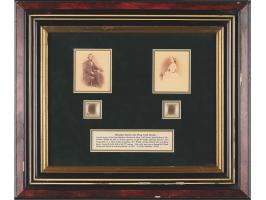
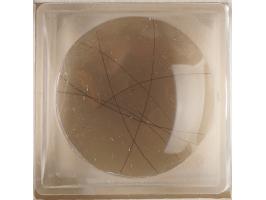
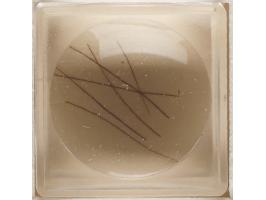
Several strands of hair from both Abraham and Mary Todd Lincoln, housed in small magnified plastic cases and double-suede-matted and framed with images of the Lincolns and a descriptive caption to an overall size of 18.5 x 16. In fine condition, with light damage only to the frame. The hair was originally collected by Caroline Wright, wife of Indiana governor Joseph Wright. The Wrights were close friends of Lincoln and the hair was presented to Mrs. Wright after Lincoln’s 1865 inauguration. Accompanied by a certificate of authenticity from Cary J. Delery, stating the hair was in the possession of the Wright family until 1992, when it was sold at Christie’s. The hair was sold again by Christie’s in 2002, as part of the Forbes Collection.
Opening: $200
Estimate: $1,500 - $2,000
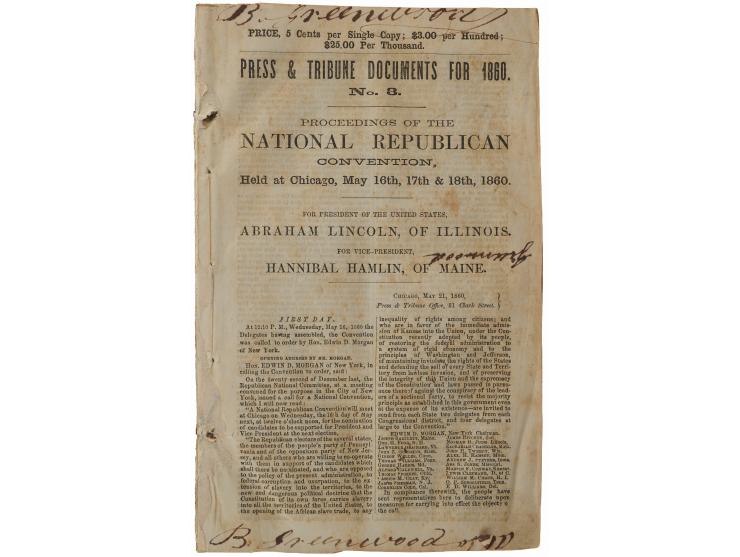
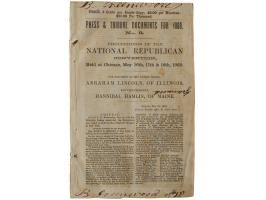
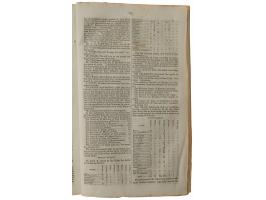
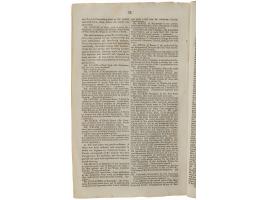
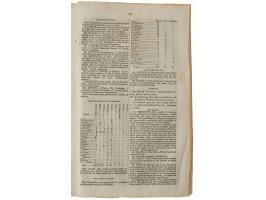
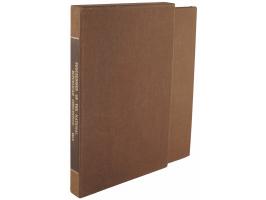
String-bound pamphlet entitled “Proceedings of the Republican National Convention Held at Chicago, May 16th, 17th & 18th, 1860. For President of the United States, Abraham Lincoln, of Illinois. For Vice-President, Hannibal Hamlin, of Maine.” Published by the Chicago Press & Tribune newspaper, the pamphlet, 44 pages, 5.5 x 8.75, issued as “Press & Tribune Documents for 1860. No. 3.,” contains a detailed synopsis of the convention’s three busy days, culminating in the dramatic events that secured Lincoln’s rise to national prominence.
Day 3, May 18, 1860, was the decisive and dramatic climax of the Republican National Convention in Chicago, when Abraham Lincoln secured the presidential nomination after three intense ballots. Entering the day, William H. Seward led but lacked a majority; on the first ballot, he held a strong advantage, yet Lincoln surged on the second as delegates from key states shifted their support to the more broadly acceptable Illinois candidate. On the third ballot, Lincoln reached 231½ votes—just shy of the required majority—before several delegates switched their votes, pushing him over the threshold and igniting an eruption of cheers, shouting, and celebration. The nomination was then made unanimous, and later that day, Hannibal Hamlin of Maine was chosen as the vice-presidential candidate, completing the ticket that would win the 1860 election and alter the course of American history. The first page bears ink ownership notations. Housed in a custom-bound slipcase with matching chemise. In very good to fine condition, with scattered light foxing and staining, and trimming to the top and bottom edges.
Opening: $200
Estimate: $1,000 - $1,500
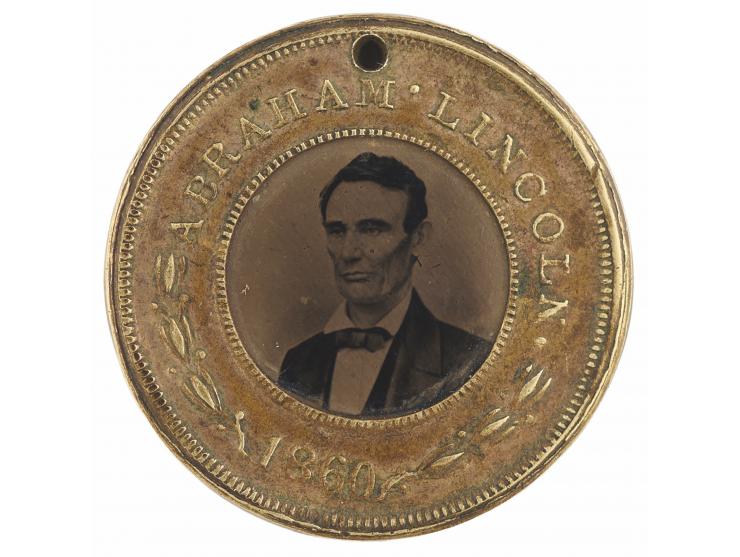
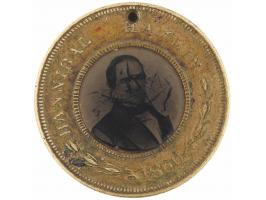
Extremely desirable ferrotype button from the 1860 presidential campaign, 1˝ in diameter, featuring a portrait of the beardless Abraham Lincoln on one side, with his vice presidential running mate Hannibal Hamlin on the other. Their portraits are encircled with raised text, "Abraham Lincoln, 1860" and "Hannibal Hamlin, 1860." In fine condition, with marks to the Hamlin image; Lincoln's image is uncommonly sharp.
Ulysses S. Grant
Opening: $1,000
Estimate: $20,000 - $30,000
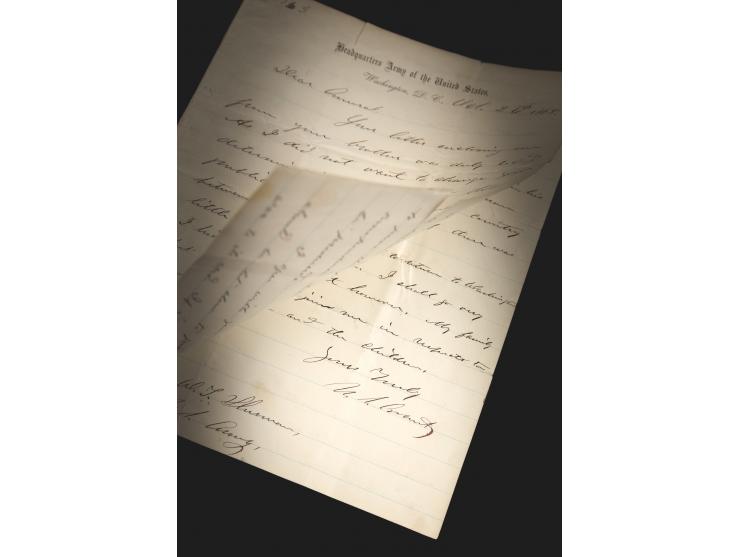
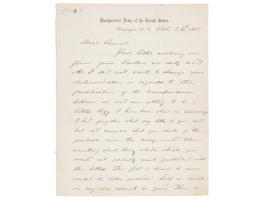
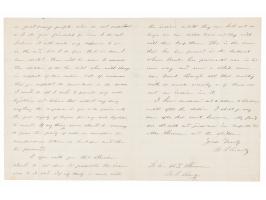
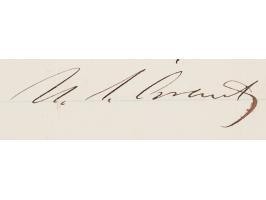
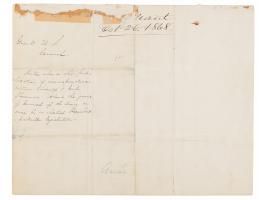
ALS signed “U. S. Grant,” three pages on two adjoining sheets, 7.75 x 10, Headquarters Army of the United States letterhead, October 26, 1868. Handwritten letter to "Lt. Gen. W. T. Sherman, U.S. Army," written just days before the presidential election of 1868. In full: "Your letter enclosing one from your brother was duly rec'd. As I did not want to change your determination in regard to the publication of the correspondence between us, and am getting to be a little lazy, I have been slow in answering. I had forgotten what my letter to you said but did remember that you spoke of the probable course the Ewings would take, or something absent them, which which you would not probably want published with the letters. The fact is General I never wanted the letters published half so much as my own account as yours.
There are a great many people who do not understand as I do your friendship for me. I do not believe it will make any difference to you in the end, but I do fear that, in case I am elected, there will be men to advocate the abolition of the Gen. bill who will charge in support of their motion lack of evidence that you supported the Union cause in the canvass. I would do all I could to prevent any such legislation and believe that without my doing anything the confidence in you is too genuine with the great majority of Congress for any such legislation to succeed. If any thing more should be necessary to prove the falsity of such an assumption the correspondence between us heretofore could then be produced.
I agree with you that Sheridan should be let alone to prosecute the indian war to its end. If no treaty is made with the indians untill they can hold out no longer we can dictate terms, and they will then keep them. This is the cause that has been pursued in the Northwest, where Crook has prosecuted war in his own way, and now a White man can travel through all that country with as much serenity as if there was not an indian in it.
I have concluded not to return to Washington untill after the election. I shall go very soon after that event however. My family are all well and join me in respects to Mrs. Sherman and the children."
William T. Sherman dockets the reverse in his own hand, in full: "Grant, U. S., General, Writes about the publication of correspondence between himself & Genl. Sherman. About the grade of General of the Army in case he is elected President—probable legislation." In fine condition, with minor splitting to the ends of the folds, and some old mounting remnants to the back of the last page.
This letter finds Ulysses S. Grant balancing his roles as commanding general of the U.S. Army and Republican nominee for president. Grant expresses concern that, if elected, hostile members of Congress might revive efforts to remove the special rank of General of the Army by untruthfully asserting that William T. Sherman had failed to support the Union cause during the canvass.
Grant was preparing to relinquish the rank—created for him by Congress in 1866—upon assuming the presidency, a transition that would elevate Sherman to that position. His concern reflects an awareness that the rank itself remained subject to political attack, and that efforts to abolish it could directly affect Sherman’s standing—revealing how closely personal loyalties and congressional politics were intertwined on the eve of Grant’s election. These fears proved unfounded, and Sherman would indeed succeed Grant as General of the Army on March 4, 1869, the day of Grant’s inauguration.
Grant also addresses ongoing military operations, explicitly endorsing Philip H. Sheridan’s authority to prosecute the Indian wars without interference, advocating for sustained military pressure. He cites George Crook’s campaigns in the Northwest as a model, reflecting prevailing Army doctrine and foreshadowing the continuity of policy: first under Sherman, and later under Sheridan himself. Sheridan, too, would be named General of the Army in 1888, shortly before his death; the honor was then retired until World War II. The letter thus links politics, the U.S. military's senior command, and federal Indian policy at a critical moment preceding the first election of the Reconstruction Era.
Opening: $300
Estimate: $3,000 - $4,000
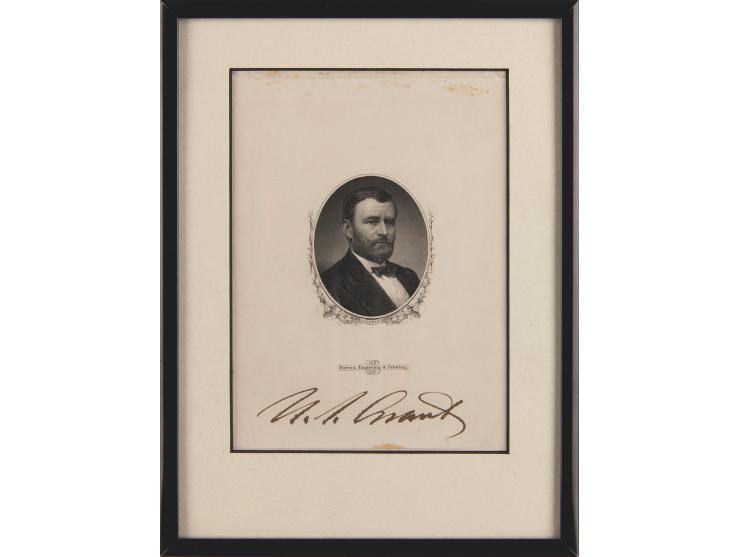
Handsome engraved portrait of Ulysses S. Grant by the Bureau of Engraving and Printing, 4 x 5.5, prominently signed below in bold ink, "U. S. Grant." Archivally matted and framed to an overall size of 6.25 x 8.25. In fine condition, with slight feathering to the ink, and a tiny stain to the bottom edge.
Opening: $300
Estimate: $2,000 - $3,000
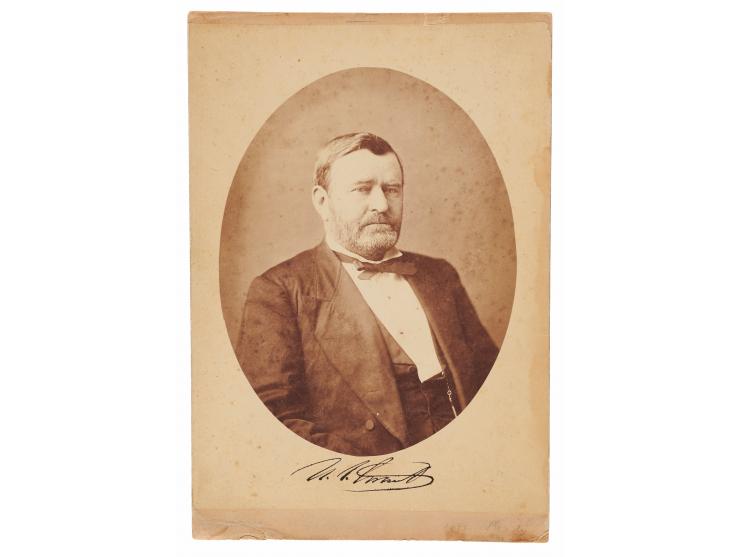
Rare oversized 7.25 x 10 albumen photo of Ulysses S. Grant, affixed to a 7.25 x 11 mount, signed below the image in bold ink, "U. S. Grant." Annotated on the reverse in ink, "Washington D.C., Aug. 4, 1876." A pencil notation on the mount attributes the photograph to Mathew Brady. In very good to fine condition, with scattered light foxing, staining along the right edge of the image, and short tears to the top and bottom edges of the mount. An unusually large signed photograph of the Civil War hero.
Provenance: by descent to the consignor, who notes that the photograph was once part of the collection of Winfred Porter Truesdell, collector, publisher, and cataloger of the known engravings and lithographs of Abraham Lincoln.
Opening: $200
Estimate: $1,500 - $2,000
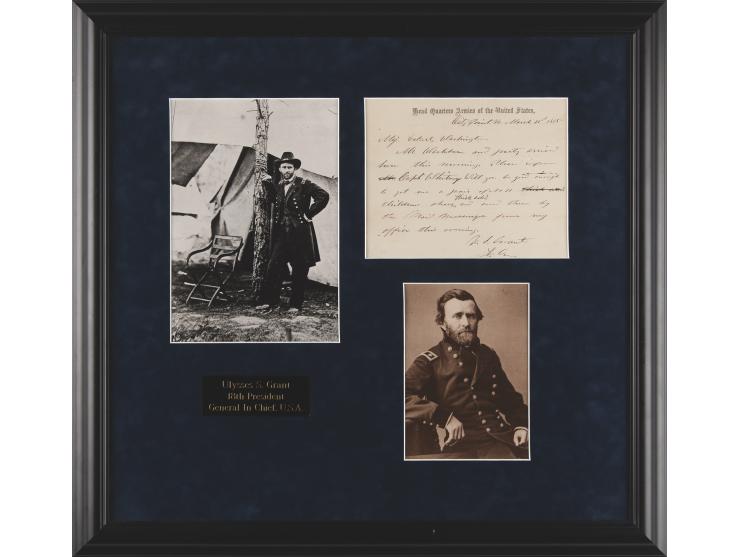
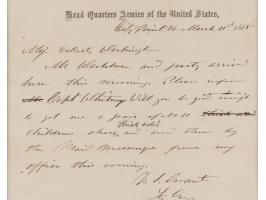
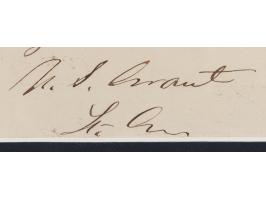
Civil War-dated ALS signed “U. S. Grant, Lt. Gen.,” one page, 7.5 x 6, Head Quarters Armies of the United States letterhead, March 11, 1865. Handwritten letter to "Maj. Eckert," in full: "Mr. Washburne and party arrived here this morning. Please inform Capt. Whitney. Will you be good enough to get me a pair of No. 10 children's shoes, thick soled, and send them by the mail messenger from my office this evening." Suede-matted and framed with two portraits and a nameplate to an overall size of 22.5 x 21. In fine condition.
Grant's visitor was Illinois Congressman Elihu B. Washburne, one of his longtime political allies. Washburne had played a pivotal role in Grant’s rise, having first proposed his name for appointment as a brigadier general of volunteers in 1861, and later sponsoring the legislation that elevated him to lieutenant general and then to full general. He would go on to support Grant's presidential bid, and in return, was appointed Secretary of State and later U.S. Minister to France.
This visit in March 1865, however, held special significance. Washburne had come to deliver a presentation on behalf of the nation. Back on December 17, 1863, Congress had passed a joint resolution thanking Grant for his victories in the Western Theater and authorizing President Lincoln to commission a gold medal in his honor. Now, more than a year later, on March 11th, Washburne presented Grant with the medal, an official copy of the Congressional resolution, and a letter from the president (see: The Papers of Ulysses S. Grant, vol. 14, pp. 131–32, ed. John Y. Simon). The children's shoes that Grant requests were most likely for his 7-year-old son, Jesse; both Jesse and his mother, Julia, were with Grant around this time.
Opening: $200
Estimate: $1,000 - $2,000
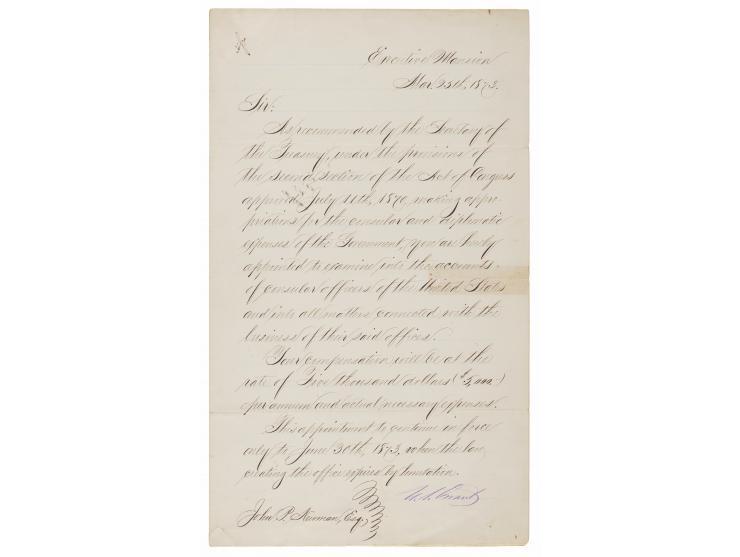
LS as president, signed "U. S. Grant," one page, 8.5 x 14, March 25, 1873. Official letter to John P. Newman, sent from the Executive Mansion. In part: "As recommended by the Secretary of the Treasury, under the provisions of the second section of the Act of Congress approved July 11th, 1870, making appropriations for the consular and diplomatic expenses of the Government, you are hereby appointed to examine into the accounts of consular officers of the United States and into all matters connected with the business of their said offices." In fine condition, with an old tape stain to the right side of the central horizontal fold.
Issued from the Executive Mansion, this letter marks President Ulysses S. Grant’s formal appointment of John Philip Newman—a noted Methodist pastor and Chaplain of the United States Senate—to the federal service as an examiner of U.S. consular accounts. This assignment would evolve into his role as Inspector of United States Consulates in Asia (1874–1876). Acting under congressional authority, Newman was tasked with investigating the financial records and operational conduct of American consular offices, a responsibility he carried out through extensive travel across China, Japan, and other nations with which the United States maintained diplomatic relations.
His detailed report to the State Department, exceeding two hundred pages, offered substantive observations and reform-minded recommendations. Summoned before a Congressional committee during the reform investigations of 1876, Newman provided important testimony that surprised critics who had dismissed his work as a mere 'pleasure tour.' The letter thus represents the inception of a serious government oversight mission, highlighting Reconstruction-era efforts to strengthen accountability within the U.S. diplomatic service.
Opening: $200
Estimate: $1,000 - $1,500
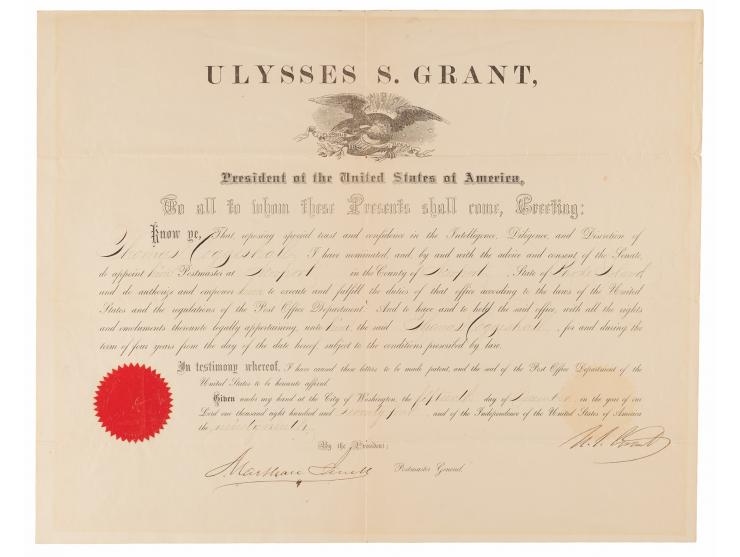
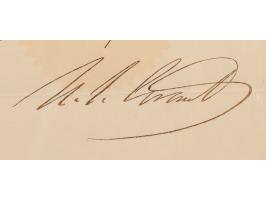
Partly-printed DS as president, one page, 17.25 x 14, December 15, 1874. President Grant appoints Thomas Coggeshall as "Postmaster at Newport, in the County of Newport, State of Rhode Island." Nicely signed at the conclusion in ink by President Ulysses S. Grant and countersigned by Postmaster General Marshall Jewell. The red seal affixed at the lower left remains fully intact. In fine condition, with light toning from prior display.
Opening: $200
Estimate: $1,000 - $2,000
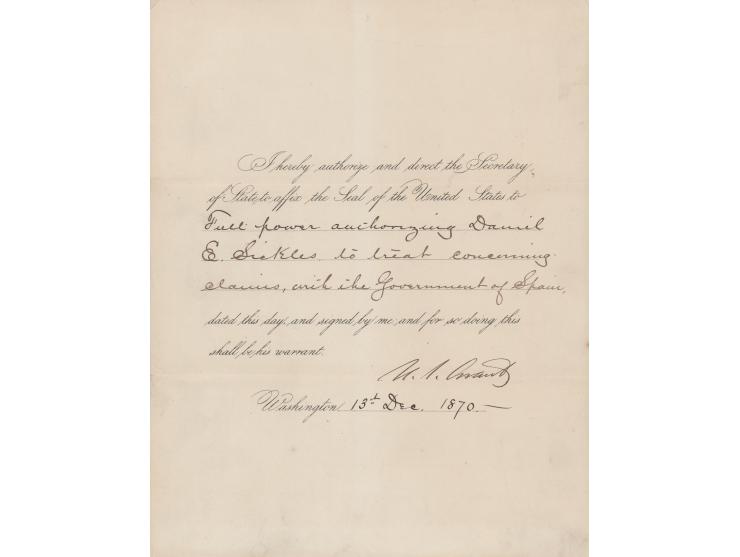
Partly-printed DS as president, one page, 8.5 x 11, December 13, 1870. President Grant authorizes and directs the Secretary of State to affix the Seal of the United States to the "Full power authorizing Daniel E. Sickles to treat concerning claims, with the Government of Spain." Neatly signed at the conclusion in ink by President Ulysses S. Grant. In fine condition.
Daniel E. Sickles served as U.S. Minister to Spain from 1869 to 1874, appointed by President Ulysses S. Grant during a period of political upheaval following the Spanish Revolution of 1868. During his tenure, he worked to protect American commercial interests and became deeply involved in diplomacy surrounding the Ten Years’ War in Cuba, particularly during the controversial Virginius Affair of 1873, when Spanish authorities executed several crew members of an American-flagged ship accused of aiding Cuban rebels. The crisis brought the United States and Spain to the brink of war and led to Sickles' resignation; his successor, Caleb Cushing, ultimately defused the situation and negotiated reparations for the families of the dead.
Opening: $200
Estimate: $1,000 - $2,000
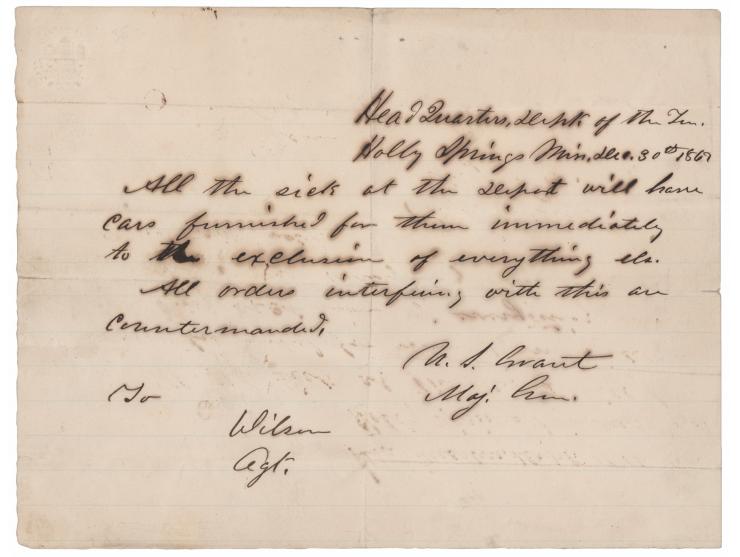
Civil War-dated ALS signed “U. S. Grant, Maj. Gen.," one page, 7.75 x 6, December 30, 1862. Addressed from “Head Quarters, Dept. of the Ten.,” in Holly Springs, Mississippi, a handwritten letter to “Wilson, Agt.,” the railroad agent responsible for managing car assignments at the Holly Springs depot. In full: "All the sick at the Depot will have cars furnished for them immediately to the exclusion of everything else. All orders interfering with this are Countermanded." In very good to fine condition, with multiple intersecting folds, and a couple of small repairs.
Grant was using Holly Springs as his forward supply base and headquarters during his first overland campaign against Vicksburg when Confederate Major General Earl Van Dorn led 3,500 cavalry in a surprise raid on December 20, 1862, destroying an estimated $1.5 million in Union supplies and forcing Grant to abandon his advance. Written ten days later as he withdrew toward Memphis, this order prioritizes the immediate rail evacuation of the sick above all other traffic, reflecting both the humanitarian urgency and the logistical upheaval left by Van Dorn’s raid. Its forceful language highlights the disruption to normal operations and Grant’s need to impose direct control in the campaign’s aftermath. Grant's first Vicksburg campaign had collapsed; he would not capture the city until July 4, 1863, after a siege of forty-seven days.
Opening: $1,000
Estimate: $10,000 - $20,000
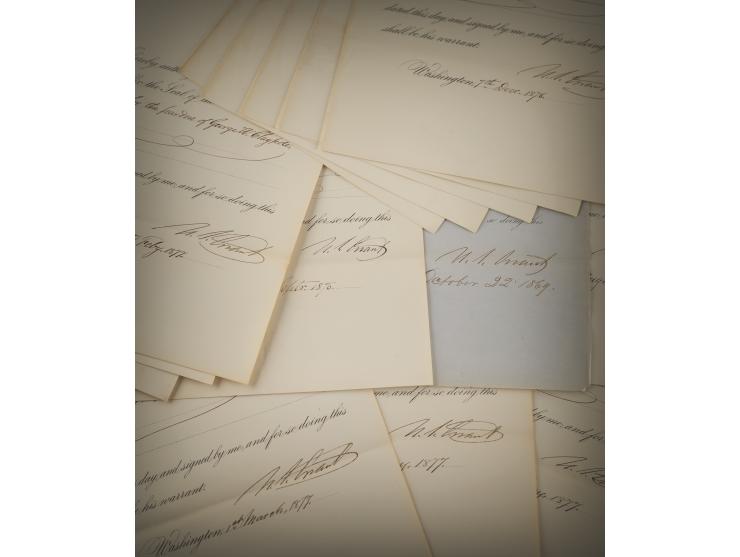
Uncommon archive of 20 partly-printed DSs as president, signed "U. S. Grant," all one page, 8 x 10, dated from October 22, 1869, to March 3, 1877. Several of these pardon warrants—signed in the waning days of Grant’s administration, which came to its end on March 4, 1877—reflect the president’s final exercise of executive authority before leaving office. In overall fine to very fine condition.
Complete list:
1. DS as President, Oct. 22, 1869 - Warrant for the pardon of John H. Garrison.
2. DS as President, August 9, 1876 - Warrant for the pardon of John D. Reynolds.
3. DS as President, Sept. 28, 1876 - Warrant for the pardon of James K. Hill.
4. DS as President, Nov. 24, 1876 - Warrant for the pardon of Diogenes Wetmore.
5. DS as President, Dec. 7, 1876 - Warrant for the pardon of George W. Adams.
6. DS as President, Dec. 9, 1876 - Warrant for the pardon of Harry McFarland.
7. DS as President, Dec. 15, 1876 - Warrant for the pardon of John E. Howard.
8. DS as President, Dec. 15, 1876 - Warrant for the pardon of Lewis Roberts.
9. DS as President, Dec. 15, 1876 - Warrant authorizing Timothy Golden to receive into custody Thomas R. Lewis, a fugitive from the justice of the United States.
10. DS as President, Jan. 10, 1877 - Warrant for the pardon of John Henderson.
11. DS as President, Jan. 11, 1877 - Warrant for the pardon of William H. Walker.
12. DS as President, Jan. 11, 1877 - Warrant for the pardon of John Oehr.
13. DS as President, Jan. 20, 1877 - Warrant for the pardon of Frank L. Taintor.
14. DS as President, Jan. 22, 1877 - Warrant for pardon of Edward Brady and Michael Mullady.
15. DS as President, Feb. 16. 1877 - Warrant for the pardon of George W. Claypole.
16. DS as President, Feb. 22, 1877 - Warrant for the pardon of John Mahoney.
17. DS as President, Feb. 27, 1877 - Warrant for pardon of Felix Jones.
18. DS as President, March 1, 1877 - Warrant for the pardon of Elbridge Crossman.
19. DS as President, March 1, 1877 - Warrant for the pardon of Sigismund Lindaur.
20. DS as President, March 3, 1877 - Warrant for the pardon of H. H. Harrington.