James Buchanan
Opening: $500
Estimate: $8,000 - $10,000
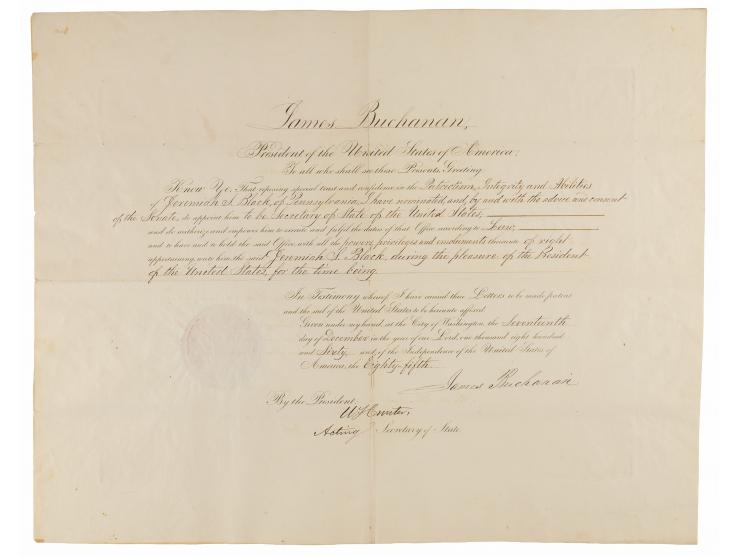
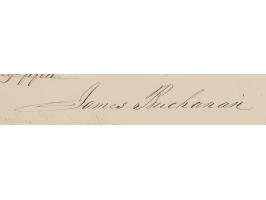
Partly-printed DS as president, one page, 19.5 x 15.5, December 17, 1860. President Buchanan, "by and with the advice and consent of the Senate," appoints Jeremiah S. Black of Pennsylvania "to be Secretary of State of the United States." Crisply signed at the conclusion in ink by President James Buchanan and countersigned by Acting Secretary of State William Hunter. In fine condition, with expert reinforcements to the backs of the intersecting folds.
This document was issued at a moment of extraordinary turmoil in President James Buchanan’s administration. After Abraham Lincoln’s election in November 1860, Southern states—led by South Carolina—moved rapidly toward secession. As tensions escalated, General Winfield Scott and several Cabinet members urged Buchanan to reinforce vulnerable federal forts in the South, particularly in Charleston Harbor. Buchanan’s reluctance to act prompted Secretary of State Lewis Cass to resign on December 14, 1860, in protest.
Just five days later, Buchanan appointed his trusted Attorney General, Jeremiah S. Black of Pennsylvania, as the new Secretary of State. A close friend and adviser, Black denied the constitutionality of secession, and urged that Fort Sumter be properly reinforced and defended. He remained at Buchanan’s side as the secession crisis deepened and much of the Cabinet fractured, with multiple members resigning over policy disagreements. This extremely scarce, cabinet-level appointment reflects the instability and urgency that defined the final months of Buchanan’s presidency on the eve of the Civil War.
Opening: $200
Estimate: $500 - $700
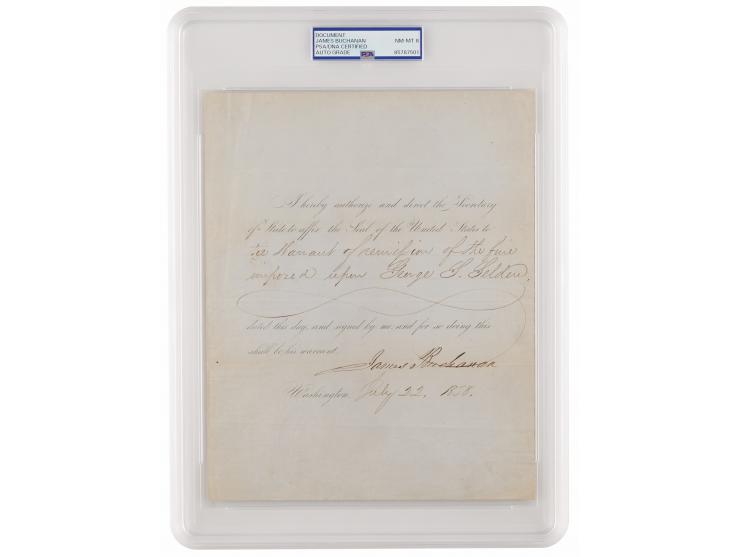
Partly-printed DS as president, one page, 8 x 10, July 22, 1858. President Buchanan directs the Secretary of State to affix the Seal of the United States to “the Warrant of remission of the fine imposed upon George S. Selden.” Signed prominently at the conclusion by James Buchanan. In fine condition, with some light creasing and faint toning. Encapsulated and graded by PSA/DNA as “NM - MT 8.”
The defendant, “George S. Selden,” was ostensibly a lawyer from Philadelphia who had been fined for contempt of court. Per an article in The Easton Gazette from June 5, 1858: ‘Judge Irwin, of the U.S. Circuit Court at Pittsburgh his imposed a fine ot $500 on George S. Selden, a member of the bar, and ordered his name to be stricken from the roll of practicing attorneys before that tribunal, for an alleged contempt of court in relation to a decision, which it deemed offensive and insulting.’