James A. Garfield
Opening: $500
Estimate: $4,000 - $6,000
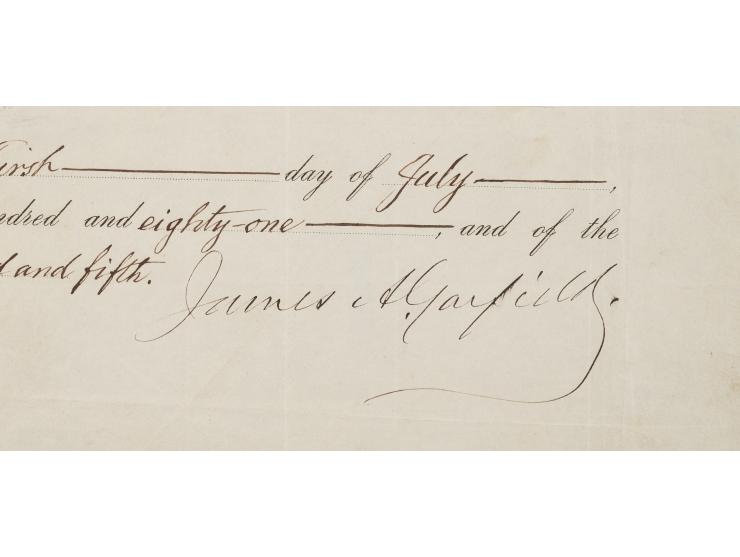
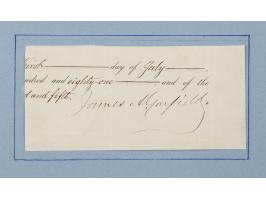
Large ink signature as president, “James A. Garfield,” on an off-white 7 x 3.5 sheet clipped from a partly-printed document dated July 1, 1881. Mounted to a slightly larger backing sheet and in fine condition, with very light folds and creases.
A noteworthy signature from President James A. Garfield, who, just a day later, was shot by assassin Charles Guiteau at the Baltimore and Potomac Railroad Station on July 2, 1881. Although Garfield survived the attack for approximately 80 days, he was gravely ill and largely bedridden throughout that period, ultimately passing away on September 19, 1881. Notably, there is no historical record of him formally signing any official government documents after the shooting, making signatures from immediately before the assassination especially rare and significant.
Opening: $200
Estimate: $1,000 - $2,000
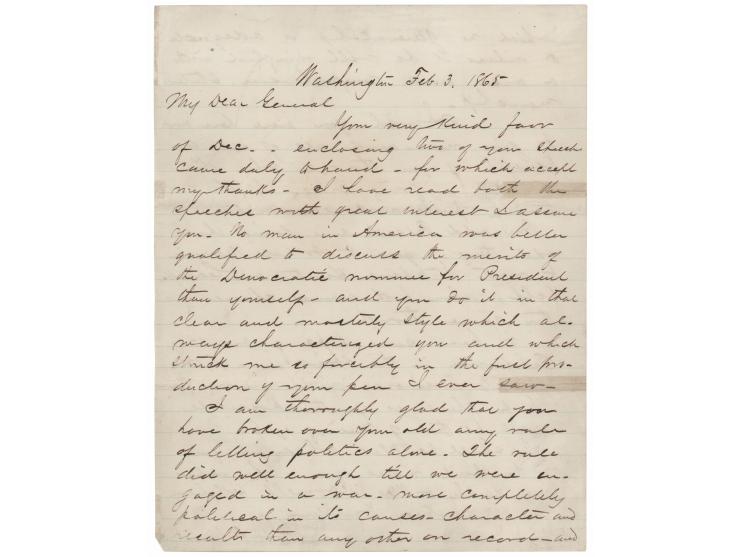
Civil War-dated ALS as an Ohio congressman, signed “J. A. Garfield,” one page both sides, 7.75 x 9.75, February 3, 1865. Addressed from Washington, a handwritten letter to a general, ostensibly Major General Irvin McDowell, in full: “Your very kind favor of Dec., enclosing two of your speeches came duly to hand, for which accept my thanks. I have read both the speeches with great interest I assure you. No man in America was better qualified to discuss the merits of the Democratic nominee for President than yourself, and you do it in that clear and masterly style which always characterized you and which struck me so forcibly in the first production of your pen I ever saw. I am thoroughly glad that you have broken over your old army rule of letting politics alone. The rule did well enough till we were engaged in a war, more completely political in its causes, character and…than any other on record, and which no generalship is adequate to unless it be well mingled with a wise and comprehensive statesmanship.
I wish you were here now to give me, and all of us the benefit of your thought, when the country is going crazy on the question of peace and reconstruction. Our odd President is doing that odd thing – gone to Fortress Monroe to meet Stephens, Hunter and Campbell, whom both armies cheered as they came through. I have some hope of visiting California in the spring on a little official business, and among the chief pleasures of the possible visit be that of seeing you. I shall be glad to hear from you if the spirit moves you. Remember me kindly to Mrs. McDowell.” In fine condition, with two small fold repairs.
This fascinating letter was written on the day of the Hampton Roads Peace Conference, and captures Garfield’s immediate reaction to one of the Civil War’s final diplomatic efforts. Referring to Lincoln’s trip, Garfield writes, “Our odd President is doing that odd thing – gone to Fortress Monroe to meet Stephens, Hunter and Campbell.” On February 3, 1865, Lincoln and Secretary of State William H. Seward met aboard the steamer River Queen at Fortress Monroe, Virginia, with three Confederate commissioners — Confederate Vice President Alexander H. Stephens, Assistant Secretary of War John A. Campbell, and Senator Robert M. T. Hunter — to explore the possibility of ending the war. With Confederate defeat looming, Southern leaders hoped to secure negotiated terms, but Lincoln held firmly to reunion and the abolition of slavery. The meeting ended without agreement, and the war continued until Lee’s surrender at Appomattox two months later. Lincoln was assassinated just ten weeks after this conference on April 15, 1865.
Opening: $200
Estimate: $600 - $800
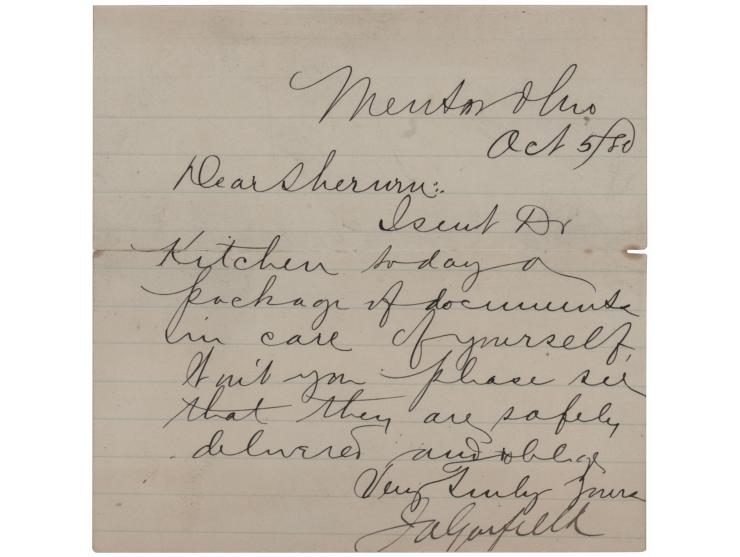
LS signed “J. A. Garfield,” one page, 5 x 5, October 5, 1880. Addressed from Mentor, Ohio, a letter to Ohio businessman Henry Sherwin, co-founder of the Sherwin-Williams Co., in full: “I sent Dr. Kitchen today a package of documents in care of yourself. Won’t you please see that they are safely delivered and oblige.” In very good to fine condition, with trimmed edges, truncating the bottom of the signature.
As the Republican nominee, James A. Garfield would win the United States presidential election just a month later on November 2, 1880, defeating Democrat Winfield Scott Hancock. In the end, the popular vote totals of the two main candidates were separated by 1,898 votes (0.11%), the smallest victory in the national popular vote ever recorded. In the electoral college, however, Garfield's victory was much larger (214 to 155) – he won the tipping point state of New York by 21,033 votes (1.91%).