Opening: $200
Estimate: $200 - $400
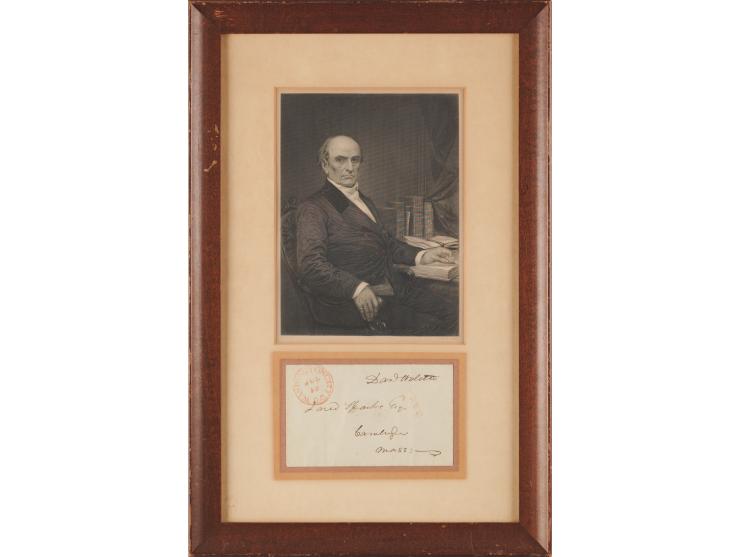
Hand-addressed and free-franked mailing panel, 5 x 3, addressed by Webster to "Jared Sparks, Esq., Cambridge, Mass.," and franked in the upper right, "Dan'l Webster." Mounted, matted, and framed with an engraved portrait to an overall size of 11 x 17. In very good to fine condition, with light creasing and two vertical folds.
Jared Sparks (1789–1866) was a prominent American historian, educator, and minister who served as president of Harvard College from 1849 to 1853.
Opening: $200
Estimate: $200 - $400
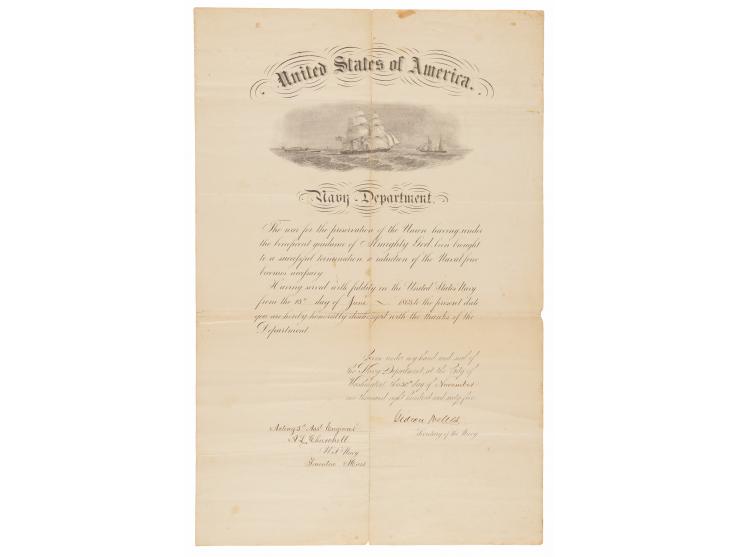
Partly-printed DS, one page, 11.75 x 18, November 30, 1863. Discharge certificate issued to "Acting 3d Asst. Engineer A. L. Churchill," in part: "The war for the preservation of the Union having, under the beneficent guidance of Almighty God, been brought to a successful termination, a reduction of the Naval force becomes necessary. Having served with fidelity in the United States Navy from the 13th day of June 1863 to the present date, you are hereby discharged with the thanks of the Department." Signed at the conclusion in ink by Secretary of the Navy Gideon Welles. The lower left bears an embossed seal, and the upper portion features a handsome maritime engraving. In very good to fine condition, with small stain, light creasing, and tape reinforcements to fold separations.
Opening: $100
Estimate: $100 - $200
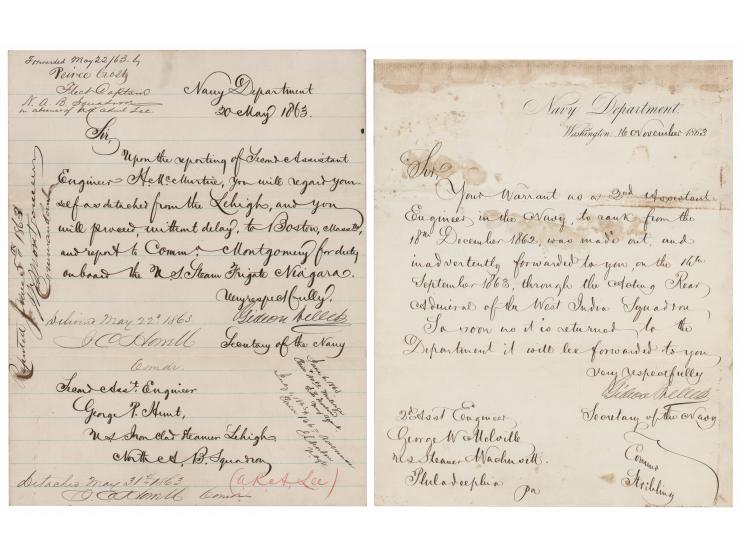
Two Civil War-dated LSs from Gideon Welles as Secretary of the Navy, both one page, 7.75 x 10, both dated to 1863. The earlier letter, May 20, 1863, sent to First Assistant Engineer George P. Hunt of the ironclad steamer Lehigh, in part: “You will regard yourself detached from the Lehigh, and…report to Commd. Montgomery for duty onboard the U.S. Steam Frigate Niagara.” This letter is also signed by future admirals John B. Montgomery, John C. Howell (twice), and Peirce Crosby. The second letter, November 16, 1863, addressed to future admiral and Arctic hero George Melville, informing him that his warrant as 2nd Assistant Engineer was inadvertently forwarded to him “through the Acting Rear Admiral of the West India Squadron. So soon as it is returned to the Department it will be forwarded to you.” In overall very good to fine condition, with scattered staining to the November letter.
Melville was engineer on the tragic Jeannette expedition (1879-81). For his heroics in leading some of the crew to safety through Siberia, Congress awarded him a Gold Medal and advanced him 15 numbers on the promotion list, making him Chief Engineer of the U.S. Navy. In 1885, he was the Chief Engineer of the Thetis for the Greely Relief Expedition, another Arctic saga. He retired as Rear Admiral and Engineer-in-Chief of the U.S. Navy.
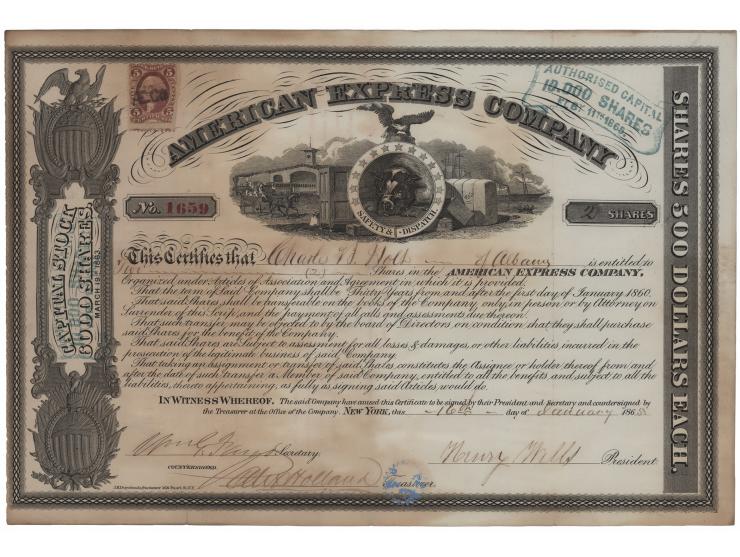
Opening: $200
Estimate: $400 - $600
Partly-printed DS, signed “Henry Wells" and "Wm. G. Fargo,” one page, 12 x 8.25, January 16, 1865. Handsomely engraved stock certificate for two shares in the American Express Company, issued to Charles B. Holt of Albany. Signed at the conclusion by Henry Wells as president, William Fargo as secretary, and Alex Holland as treasurer. In very good to fine condition, with light irregular toning.
Henry Wells (1805-1878) was a co-founder, with William Fargo (1818-1881), of both the American Express Company and Wells Fargo & Company.
War of 1812
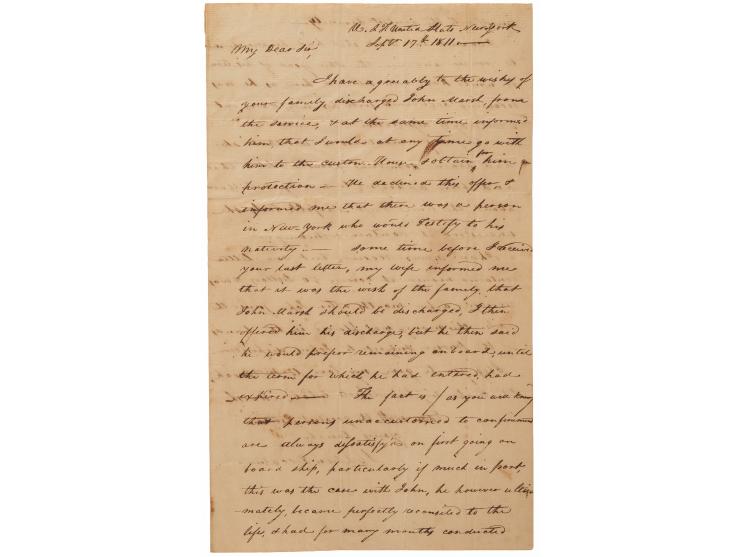
Opening: $200
Estimate: $2,000 - $4,000
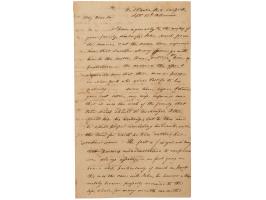
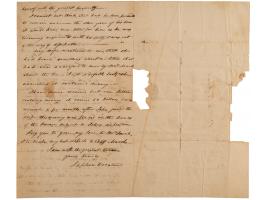
ALS, one page both sides, 7.5 x 12.75, September 11, 1811. Addressed from aboard the heavy frigate USS United States, a handwritten letter from Decatur to Revolutionary naval officer Captain James Josiah, in full: “I have agreeably to the wishes of your family, discharged John Marsh, from the service, & at the same time informed him, that I would at any time go with him to the custom-house & obtain for him a protection. He declined this offer, & informed me that there was a person in New-York who would testify to his nativity. Some time before I received your last letter, my wife informed me that it was the wish of the family that John Marsh should be discharged. I then offered him his discharge, but he then said he would prefer remaining onboard, until the term for which he had entered had expired. The fact is, as you well know, that persons unaccustomed to confinement are always dissatisfied on first going on board ship, particularly if much in port, this was the case with John, he however ultimately, became perfectly reconciled to the life, & had for many months conducted himself with the greatest propriety.
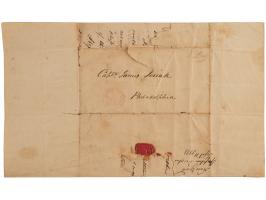
I cannot but think that had he been permitted to remain on board the other year of his term it would have been better for him, as he was becoming acquainted with his duty, & was out of the way of dissipation. My wife mentioned to me, that she had heard something about a letter that had been addressed to me by Mrs. Marsh about the time I left Norfolk last; she understood it contained money. I have never received but one letter containing money – it covered 50 Dollars, & was received a few months after John joined the ship – this money was placed in the hands of the Purser, subject to John’s disposition. I beg you to give my love to Mrs. Josiah, & to make my best respects to Col’l Marsh.” The reverse of the second integral page is addressed by Decatur and bears remnants of the original red wax seal. In very good to fine condition, with tears and seal-related paper loss only to the integral address leaf.
In May 1810, Stephen Decatur took command of the 44-gun heavy frigate USS United States, a ship he had earlier helped oversee during construction and on which he had begun his naval career as a midshipman under Commodore John Barry. Throughout 1811, Decatur cruised along the eastern seaboard, maintaining readiness and protecting American commerce during a period of increasing tension with Great Britain.
Following the declaration of the War of 1812 on June 18th, the United States sailed with Commodore John Rodgers’s squadron before separating for independent operations. On October 25, 1812, Decatur engaged HMS Macedonian off the Azores in a sustained and hard-fought action. The British frigate was dismasted and compelled to surrender, and Decatur brought his prize back to the United States. It was the first British warship ever captured and brought into an American harbor.
Civil War
Opening: $1,000
Estimate: $20,000 - $25,000
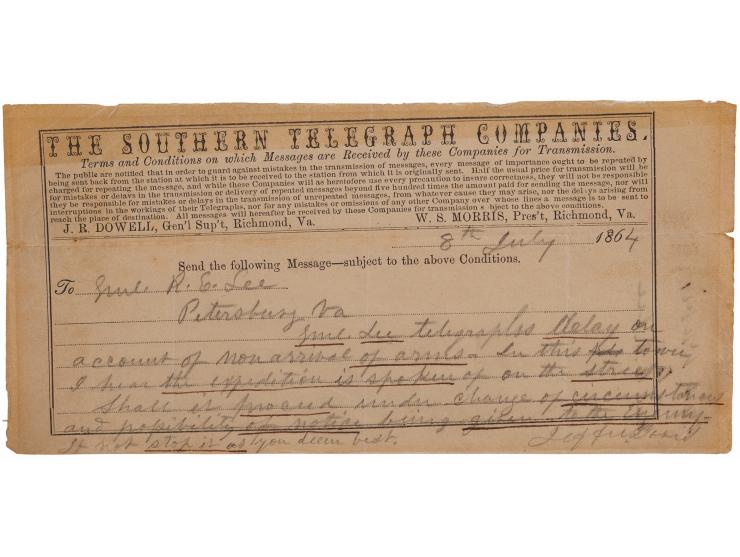
Civil War-dated ALS signed as president of the Confederate States, signed “Jeffer. Davis,” one page on an 8.5 x 4 sheet from The Southern Telegraph Company, July 8, 1864. Handwritten letter in pencil directed to Confederate General Robert E. Lee, who was then in defense of Petersburg, Virginia, in full: "Genl. Lee telegraphs delay on account of nonarrival of arms. In this town I hear the expedition is spoken of on the streets. Shall it proceed, under change of circumstances and possibility of notice being given to the enemy. If not stop it as you deem best.” In fine condition, with a thin tape stain along the top edge.
Most interesting about this telegraph is that it mentions "Genl. Lee,” who is most likely cavalryman William Henry Fitzhugh Lee. Just four days from the date of this telegraph, General Early's troops moved on the outskirts of Washington in an attempt to draw Union forces out to fight and test the defenses of that city. The language of Davis' communiqué to Lee is tantalizing, in that it may relate to the planning of this daring maneuver in the days leading up to it.
At the time this telegraph was sent, Grant's Federal army was preparing for a long-term siege of Petersburg, just a few miles from the Confederate capital at Richmond. In the middle of June, Grant's campaign against Richmond was over; the Battle of the Wilderness (May 5-6, 1864) and the Battle of Cold Harbor (June 3, 1864) had demonstrated to Grant the difficulty of smashing through Confederate General Robert E. Lee's Army of Northern Virginia.
However, the situation for Lee was far from victorious. Though he was able to save his supply sources and keep open Richmond's communications north of the James, Lee had reduced his own army to just 28,000 infantry and two lean cavalry brigades. It was also the end of Lee's capacity to maneuver. Though he had achieved a stalemate against Grant's vast Army of the Potomac, he had been forced into static fortifications that he greatly dreaded. Lee once told C.S.A. General Jubal Early that once his army was placed in a position to withstand a siege, ‘it will be a mere question of time.’
But Lee was severely handicapped: his troop numbers were scarcely more than half of his opponent's; he had no prospect of any large reinforcements; his artillery was inferior in weight of metal and in range to that of the enemy; and the mounts of his cavalry could not endure hard service and could not be replaced when worn out. Only Lee's resolve and the courage of his gallant men in battle kept the hopes of the Confederacy alive. He told C.S.A. President Jefferson Davis: ‘General Grant will concentrate all the troops here he can raise, from every section of the United States…The enemy has a strong position, and is able to deal us more injury than from any other point he has ever taken. Still we must try and defeat him.’ It was Lee's hope that Grant would attack, but, to his disappointment, Grant did not.
The siege of Petersburg began, in effect, on June 19th, the day after Lee reached the city, initiating the start of the lengthy Petersburg Campaign, the longest sustained operation of the Civil War. For a full ten months, the Union Army of the Potomac besieged the vital railroad center of Petersburg, located 20 miles south of Richmond, the Confederate capital. The battlefront was twenty-six miles in length, and Lee needed to hold the whole of the line at all times to prevent the Federals from seizing ground that would force the Confederate army back into the defense of Richmond. Lee also had to keep open the railroads on which he was dependent for supplies. Over the ten months of the campaign, Grant's forces slowly extended their lines westward, stretching the thinning ranks of the Confederate army and threatening the vital southern rail lines into the city. Time was on Grant's side.
Opening: $300
Estimate: $3,000 - $5,000
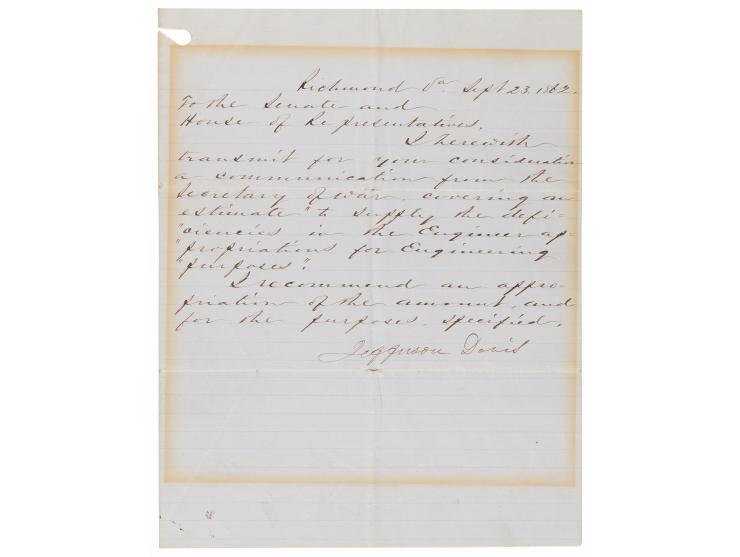
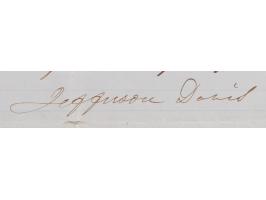
LS signed “Jefferson Davis,” one page, 7.75 x 10, September 23, 1862. Letter to "the Senate and House of Representatives" at Richmond, in full: "I herewith transmit for your consideration a communication from the Secretary of War, covering an estimate 'to supply the deficiencies in the Engineering appropriations for Engineering purposes.' I recommend an appropriation of the amount, and for the purposes specified." In very good to fine condition, with a torn file hole to the upper left corner, and toning from prior display.
On October 9th, the Confederate Congress approved an appropriation of $800,000 to 'supply the deficiencies in the Engineer appropriations for engineering purposes.' The Confederate Corps of Engineers played a critical role in the Civil War by designing and constructing fortifications, bridges, roads, and defensive earthworks essential to Southern military strategy. Despite limited resources, they built formidable defenses such as those at Vicksburg, Richmond, and Petersburg, often using local terrain to their advantage. Their efforts greatly prolonged Confederate resistance, especially in siege warfare, and helped offset the Union’s superior manpower and industrial capacity.
Opening: $200
Estimate: $2,500 - $3,500
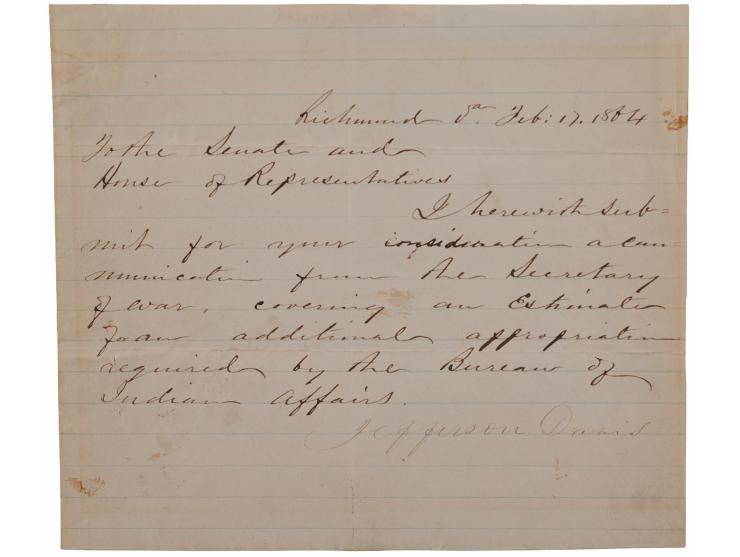
LS, signed "Jefferson Davis," one page, 7.75 x 6.75, January 17, 1864. Letter from Richmond to "the Senate and House of Representatives," in full: "I herewith submit for your consideration a communication from the Secretary of War, covering an estimate for additional appropriation required by the Bureau of Indian Affairs." In fine condition, with light soiling, faint toning, and tastefully trimmed edges.
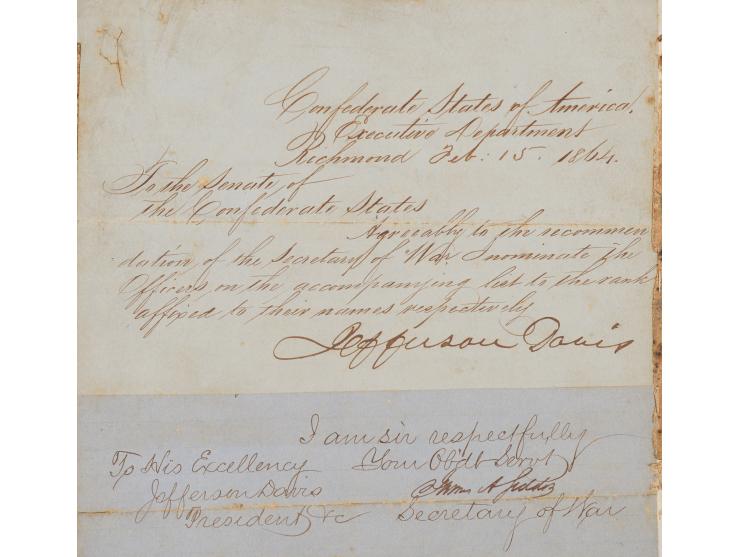
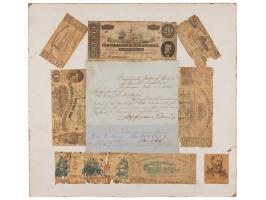
Opening: $200
Estimate: $1,500 - $2,000
Civil War–dated partly-printed LS, signed "Jefferson Davis," one page, 7.5 x 5.25, February 15, 1864. Letter to "the Senate of the Confederate States," sent from the "Confederate States of America Executive Department, Richmond." In full: "Agreeably to the recommendation of the Secretary of War I nominate the Officers, on the accompanying list to the rank affixed to their names respectively." The Davis letter is affixed at the center of a 16.75 x 15.75 mount, surrounded by seven pieces of original Confederate currency and a slip signed by Confederate States Secretary of War James A. Seddon. In very good to fine condition, with a tear to the upper left corner, and separation along the central horizontal fold of the Davis letter; the currency ranges from poor to very good condition.
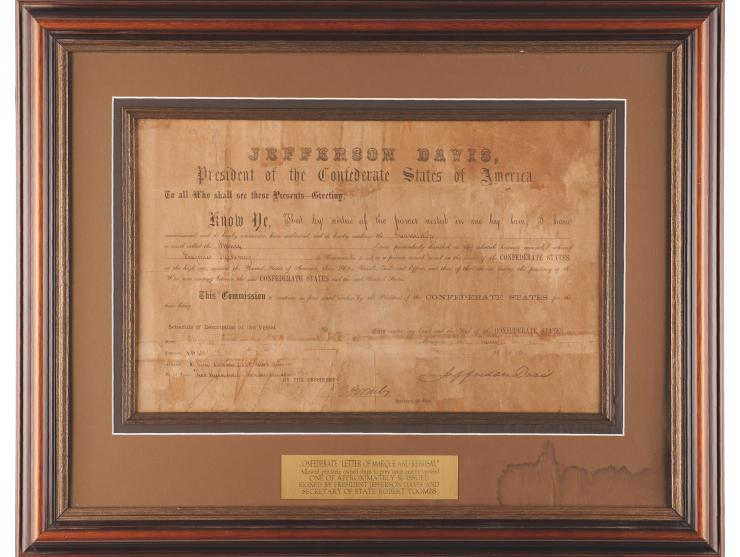
Opening: $200
Estimate: $4,000 - $6,000
Civil War–dated partly-printed DS, one page, 16 x 10, May 27, 1861. As president of the Confederate States of America, Jefferson Davis authorizes "Steamship or vessel called the Phenix…whereof Eugene Dellaney is Commander to act as a private armed vessel in the service of the Confederate States on the high seas, against the United States of America, their Ships, Vessels, Goods and Effects, and those of their citizens, during the pendency of the War now existing between the said Confederate States and the said United States." Neatly signed at the conclusion in ink by President Jefferson Davis and countersigned by Secretary of State Robert Toombs. Double-matted and framed to an overall size of 24 x 19. In very good condition, with damstaining to the mat, and creasing and heavy toning and staining to the document.
According to the work The Confederate Privateers by William M. Robinson, Jr., the Phenix, with a crew of over 200 men and armed with six rifled cannon and one pivot gun, was the largest privateer commissioned by the Confederacy.
Opening: $1,000
Estimate: $20,000 - $25,000
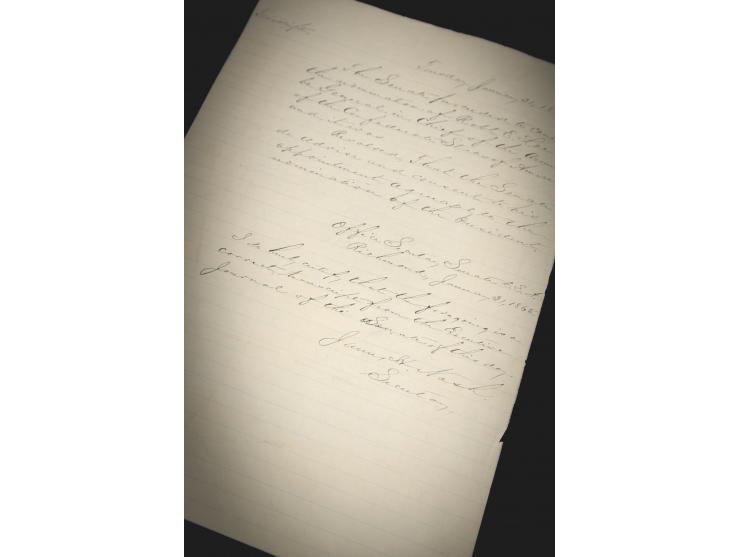
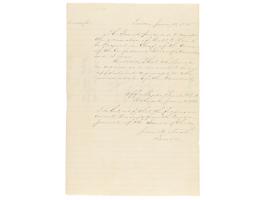
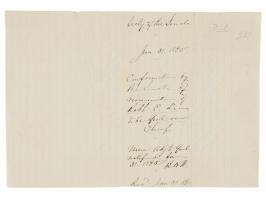
Civil War-dated manuscript document from the personal files of Confederate President Jefferson Davis, endorsed on the reverse in pencil, “File—J.D.,” one page, 8 x 11.5, January 31, 1865. Official manuscript transcript of proceedings in the Senate of the Confederate States of America, in full: "The Senate proceeded to consider the nomination of Robt. E. Lee to be General in Chief of the Armies of the Confederate States of America; and, it was Resolved, That the Senate do advise and consent to his appointment agreeable to the nomination of the President…I do hereby certify that the foregoing is a correct transcript from the Executive Journal of the Senate of this day. James H. Nash, Secretary." In addition to Davis's endorsement on the reverse, the transcript is docketed in ink by his private secretary, Burton N. Harrison: "Sect'y of the Senate. Jan. 31, 1865, Confirmation by the Senate of nomination of Rob't E. Lee to be Gen'l-in-Chief, Mem: Adjt. Genl. notified Jan. 31, 1865, B.N.H., Rec'd Jan. 31, 1865." In fine condition.
Accompanied by a letter of provenance from a previous owner, in part: "It comes from a group of Jefferson Davis presidential papers 1861-65, probably kept by his personal secretary Burton J. Harrison. They were separated from official keeping during the evacuation of Richmond on April 2, 1865 when the Confederate Government fled southward—first to Danville Va 'the new capital' and later to the Carolinas and Georgia. Somewhere en route, wagons and archives were lost or stolen despite the efforts of Gen. Samuel Cooper to keep it all intact. Provenance to me: Parke-Bernet Galleries, sale of autograph collection of Philip D. Sang of Chicago. December 2-3, 1981, lot 460, 41 items."
This document reflects a pivotal moment in the final phase of the American Civil War, when the Confederate government sought to consolidate its faltering military command amid mounting defeats and dwindling resources. By early 1865, Union forces under Ulysses S. Grant and William T. Sherman had gained decisive momentum, with Confederate armies stretched thin and key cities under threat. In response to the deteriorating situation, Confederate leadership created the position of General-in-Chief—an authority the Confederacy had avoided earlier in the war—and appointed Robert E. Lee, its most respected and capable commander, in hopes that centralized leadership might stabilize the collapsing war effort. Lee’s elevation came just months before the fall of Richmond and the Confederacy’s ultimate surrender, making the moment emblematic of the Confederacy’s last attempts to reorganize and resist in the face of inevitable defeat.
Opening: $300
Estimate: $3,000 - $4,000
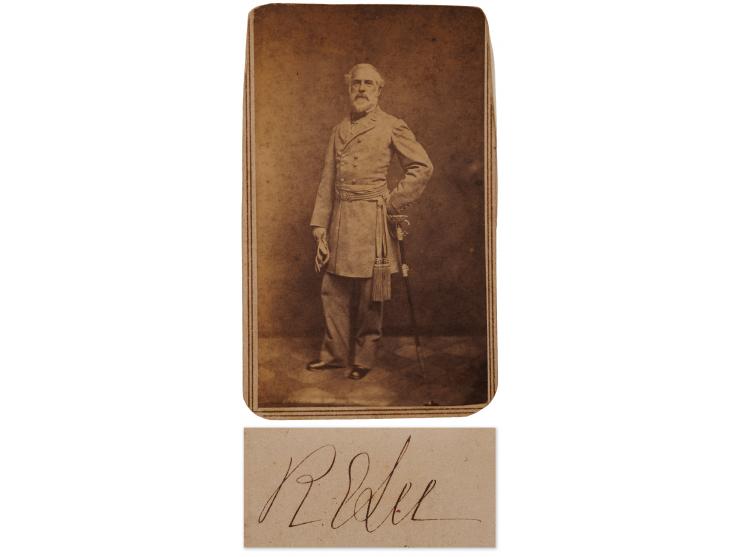
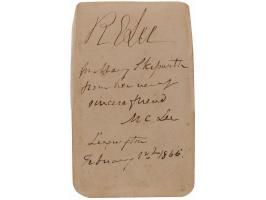
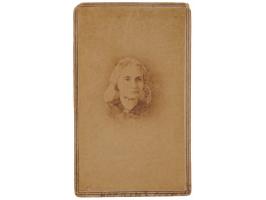
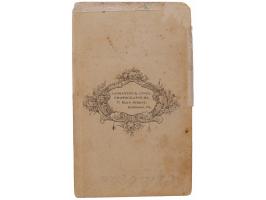
Rare original 2.25 x 3.75 carte-de-visite portrait of Confederate General Robert E. Lee in a full-figure pose, dressed in his military uniform, with his DeVisme presentation sword (given to him by the ladies of Baltimore) in one hand and his gloves in the other, signed neatly on the reverse in ink, “R. E. Lee.” The reverse is also signed and inscribed by Lee’s wife, Mary Custis Lee: “For Mary Skipwith from her very sincere friend, M. C. Lee, Lexington, February 1st, 1866.” Includes a 2.25 x 4 carte-de-visite photograph of Mary Custis Lee published by Vannerson & Jones of Richmond, Virginia. In fine condition, with lightly trimmed edges. Of the eight photographs of Lee known to have been taken during the Civil War, the present is the only full-standing portrait. ‘The standing view is especially notable in that Lee is wearing both his military sash and his dress sword—the only time he was ever photographed in his sash’ (Meredith, The Face of Robert E. Lee, p. 40).
Opening: $300
Estimate: $2,000 - $4,000
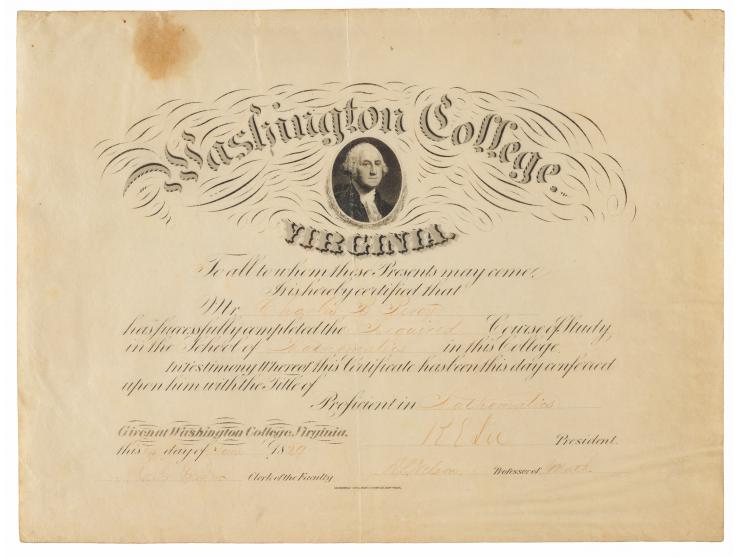
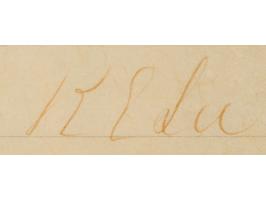
Partly-printed vellum DS, signed “R. E. Lee,” one page, 11.5 x 9, June 24, 1869. Washington College certificate awarded to Charles B. Percy, stating that he "has successfully completed the required course of study in the School of Mathematics in this College. In testimony whereof this Certificate has been this day conferred upon him with the Title of Proficient in Mathematics." Signed at the conclusion in ink by Robert E. Lee as president of the college, and countersigned by a clerk and professor. In very good to fine condition, with a stain near the top edge, creasing to the lower right corner area, and all of the handwritten portions, including Lee's signature, light but legible.
After the Civil War, Robert E. Lee served as president of Washington College (now Washington and Lee University) in Lexington, Virginia, from 1865 until his death in 1870. Taking the position during the difficult Reconstruction era, Lee focused on stabilizing the financially struggling institution and promoting reconciliation and practical education for the postwar South. He expanded the curriculum beyond classical studies to include subjects such as engineering, journalism, and modern languages. His leadership helped restore the college’s enrollment and reputation, and the institution was later renamed in his honor.
Opening: $200
Estimate: $1,500 - $2,500
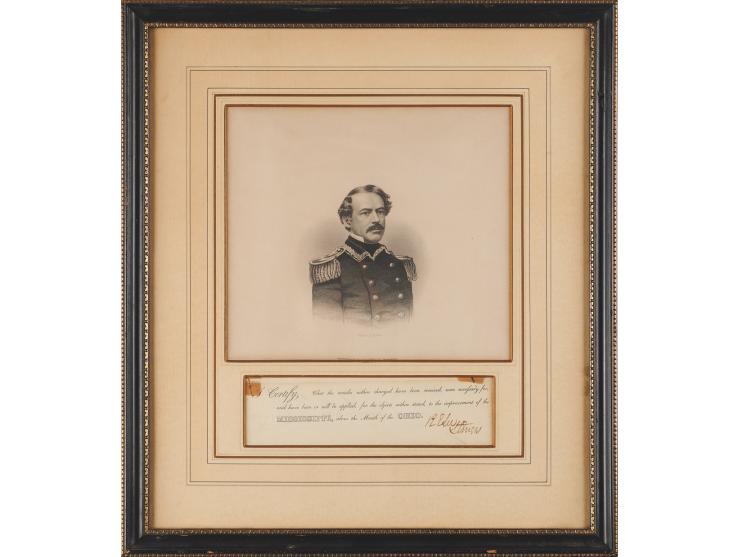
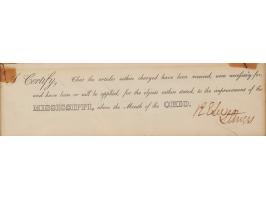
Partial self-contained partly-printed DS, signed “R. E. Lee, Lt. Engrs.,” one page, 7.75 x 2, no date but circa 1837–1838. Lee certifies the necessity of services rendered for the “Improvement of the Mississippi, above the Mouth of the Ohio.” Neatly signed at the conclusion in ink by Robert E. Lee. Matted and framed with an engraved portrait to an overall size of 14.5 x 16.5. In fine condition, with two small old tape stains in the margins.
At the time of the signature, Lee was a decade removed from graduating West Point as a lieutenant in the Corps of Engineers. Between 1837 and 1842, he supervised the development of St. Louis harbor and the upper Mississippi and Missouri rivers, ultimately earning a promotion to captain for his work there.
![[Robert E. Lee]](https://demo-backoffice.s3.eu-central-1.amazonaws.com/files/styles/gallery-big/s3/SaleImages/739/324_1.jpg)
Opening: $200
Estimate: $2,500 - $3,500
Manuscript document issued in the name of "General R. E. Lee," one page, 8 x 12.75, August 17, 1863. "General Order No. 85" from the headquarters of the Army of Northern Virginia, in part: "In connection with the recent call of the President…requiring all white male residents of the Confederate States between the ages of 18 and 45 not exempted by law, and not already in service, to be enrolled…in all cases of substitution, when the substitute becomes liable to conscription his principal is rendered again liable to service, unless exempt on other grounds. In all cases where a substitute has been received who was under 45 years of age on the day the President's call for men to this age was issued, or has reached the age of 18 since his reception, the name & residence of the principal will be promptly reported to these Hd Quarters." Signed at the conclusion in ink by Assistant Adjutant General James P. Smith. In fine condition, with a small chip to the bottom edge.
Opening: $200
Estimate: $1,000 - $1,500
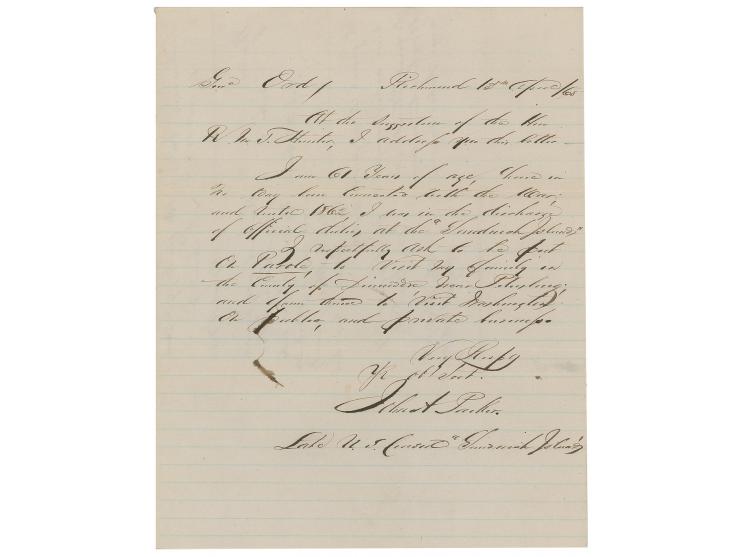
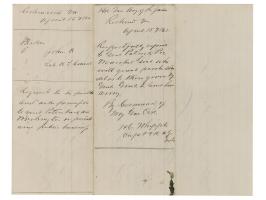
Rare Civil War-dated ALS signed "John A. Parker, Late U.S. Consul 'Sandwich Islands,'" one page, 7.75 x 10, April 13, 1865. Handwritten letter to General Ord, in full: "I am 61 years of age, have in no way been connected with the war, and until 1862, I was in the discharge of official duties at the 'Sandwich Islands.' I respectfully ask to be put on parole, to visit my family in the county of Dinwiddie, near Petersburg; and from there to visit Washington on public and private business." Docketing on the reverse, dated April 15, 1865, issued from “Hd. Qrs. Ary. of the James, Richmond Va.” reads: “Respectfully referred to Gen. Patrick Pro. Marshal Genl. who will grant parole and direct him give [pass] to Genl. Grant to Genl. Lee's army." In fine condition.
Richmond fell to Union forces on April 3, 1865, and Lee surrendered at Appomattox on April 9; this document was executed just six days later, in the first uncertain days of Union occupation of the former Confederate capital. Its endorsement directs that Parker be passed through “to Genl. Lee’s army” — meaning the surrendered Army of Northern Virginia encamped in Dinwiddie County — perfectly captures the brief administrative moment when one army was victorious and the other dissolved, yet both were still sorting out the practical geography of peace. Major General Edward O.C. Ord commanded the Army of the James, while Brigadier General Marsena Patrick, as Provost Marshal General, oversaw the issuance of paroles and passes in occupied Virginia. Parker, a former U.S. Consul to the Sandwich Islands (Hawaii) who had returned to Virginia in 1862, appealed to his age, civilian status, and prior federal service, securing approval within forty-eight hours.
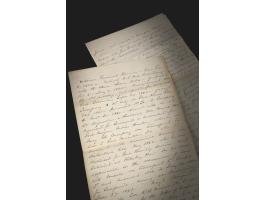
Opening: $1,000
Estimate: $15,000 - $20,000
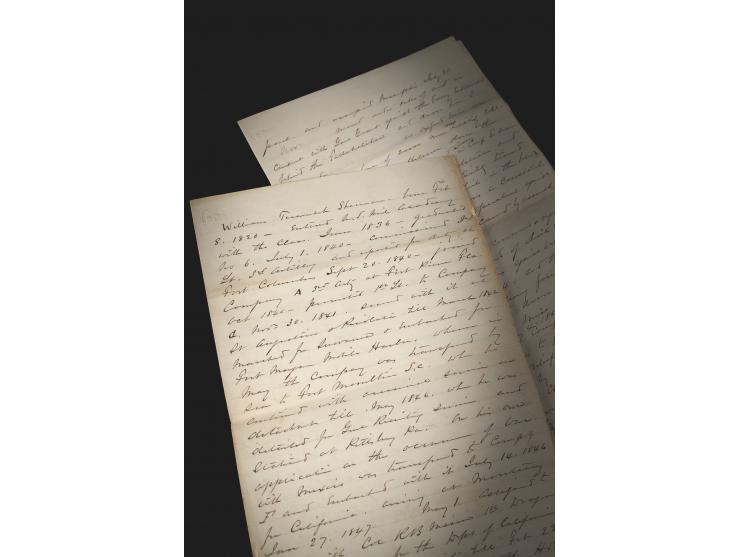
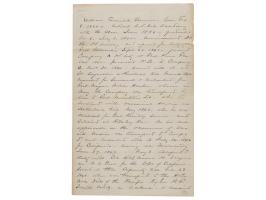
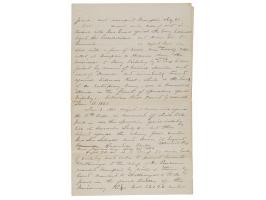
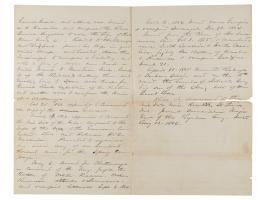
AMS signed within the text, "William Tecumseh Sherman," seven pages on two sets of adjoining sheets, 8 x 12.5, no date but annotated on the reverse in another hand, "Gen. Sherman's Military Record, written by himself," and by his son Philemon T. Sherman, "Written by Gen. Sherman in 1865, at the close of the war. P. T. Sherman."
Sherman's military autobiography begins: "William Tecumseh Sherman—born Feb. 8, 1820—entered U.S. Mil. Academy with the class from 1836—graduated No. 6, July 1, 1840—commissioned Jun'r Lt. 3rd Artillery and reported for duty at Fort Columbus, Sept. 20, 1840—joined Company A, 3rd Art'y at Fort Pierce, Fla., Oct. 1840—promoted to 1st Lt. to Company G, Nov'r 30, 1841."
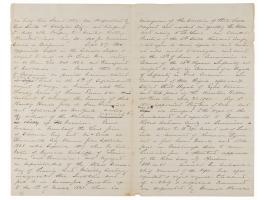
After tracing his assignments and promotions through the 1840s and 1850s, he joined the private sector: "Became a member of the Law firm of Sherman, Ewing and McCook at Leavenworth City, Kansas, from September 1858 until September 1859. When by invitation of Governor Wickliffe of Louisiana went to Louisiana and engaged as Superintendent of the State Seminary of Learning and Military Academy, inaugurated that Institution and put it in successful operation up to the 1st of March 1861, when in consequence of the secession of that State resigned and insisted on quitting the State and returning to St. Louis. Was elected President of the 5th Street Railroad Comp'y, entered upon its duties April 1, and continued until invited to Washington and received on the 13th of June a Commission as Colonel of the 13th Regular Infantry, and assigned to duty in command of a Brigade of Infantry at Fort Corcoran…
Took part in the disastrous battle at Bull Run July 21, 1861. Aug. 3 1861 appointed Brig. Genl. of Vols. and Aug. 28 was transferred to the Dept. of the Cumberland and reported to General Robert Anderson…Oct. 61 succeeded Gen. Anderson in chief command of the Dept. but after repeated & urgent requests to be relieved of a chief & important command was superseded by General Buell and Nov. 13, 1861 ordered to report for duty to Maj. Genl. Halleck at St. Louis…On the 23 Dec'r placed in command of Benton Barracks. Feb. 17 62 ordered to Paducah to expedite reinforcements and supplies to General Grant then operating up the Tennessee River, and by instructions of Gen. Halleck made up a Division of new troops which has arrived at Paducah…
April 6 & 7 in command…took part in the hard fought Battle of Shiloh under Genl. Grant, and afterwards on the successful advance and occupation of Corinth by General Halleck. May 26, appointed Maj. Genl. of Volunteers—during June & July 1862. Moved westward along the Memphis Road…and occupied Memphis July 21. Nov. moved under orders of and in concert with Genl. Grant against the enemy entrenched behind the Tallahatchie…At Oxford, Miss. was sent with a force of 20,000 men hastily collected at Memphis & Helena down the Mississippi to carry Vicksburg…failed by reason of natural obstacles…and immediately turned against Arkansas Post…Arkansas Post carried by assault Jan. 11, 1863.
Jan. 2, 1863 assigned to command & organize the 15th Corps. in command of which took part in all the operations against Vicksburg till its surrender July 4, and then turned against the relieving force under Gen. Joe Johnston…Sept. 23 63 at a camp 20 miles back of Vicksburg rec'd orders to proceed towards Chattanooga to the relief of Gen. Rosecrans, reached Memphis by water & then by land marched to Chattanooga & took part in the great Battles of the Missionary Ridge, Nov'r 23 & 24 under General Grant, and without rest, hurried on to Knoxville and compelled the Rebel General Longstreet to miss the siege of that place Nov'r 4.—Returned to Chattanooga and Bridgeport…and hastened down the Mississippi to Memphis & Vicksburg, and with a force of 20,000 men made a winter march to Meridian, Miss….
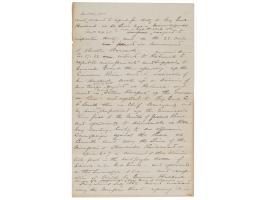
Oct. 25, 1863 appointed to command the Dept. of the Tennessee. March…1864, appointed to command the Mil. Div'n of the Miss. composed to the Depts. of the Tennessee, Cumberland, Ohio, and Arkansas. Hd Qrs Nashville. Proceeded to organize an active Army of one hundred thousand men, for the spring campaign.
May 6. Moved for Chattanooga in command of the Army, fought the Battles of Dalton, Resaca, Dallas, Kennesaw, Atlanta & Jonesboro, and occupied Atlanta Sept. 2, 1864. Nov. 16, 1864, moved across Georgia & occupied Savannah Dec. 21, 1864. Moved from the base of the Savannah River Feb. 1, 1865, & marched across South Carolina & North Carolina, fighting the Battles of Averasboro & Bentonville & occupied Goldsboro, March 21.
April 10, 1865, moved to Raleigh & Durham Station and on the 18th received the surrender of Johnston's Army being one of the closing acts of the Great War. Still in command of the Mil. Div'n Miss, Head Qrs St. Louis, Mo. Present commission Major Gen'l of the Regular Army." In very good to fine condition, with small chips and fold splits.
Opening: $1,000
Estimate: $10,000 - $15,000
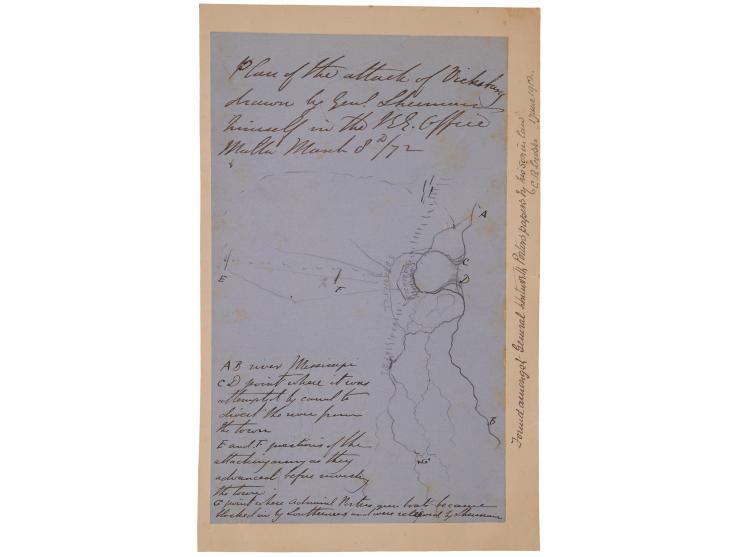
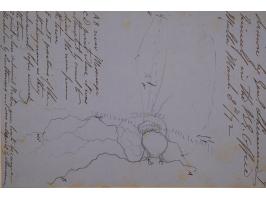
Hand-drawn map by William T. Sherman outlining the Union plan of attack for the Siege of Vicksburg, the decisive 1863 campaign that secured control of the Mississippi River, split the Confederacy in two, and is widely regarded as one of the war’s great turning points. The map, accomplished by Sherman in pencil on a blue 7.25 x 4.25 sheet, shows the Mississippi River bend, the town of Vicksburg, and Union trenches indicated west of the city. Lettered positions A through G are penned in a contemporary hand and explained in the lower section: “AB river Mississippi / CD point where it was attempted by canal to direct the river from the town / E and F positions of the attacking army as they advanced before invading the town / G point where Admiral Porters gun boats became blocked in by Southerners and were relieved by Sherman." The upper section is inscribed by a contemporary witness: “Plan of the attack of Vicksburg drawn by Genl. Sherman himself in the W. R. Office, Mullin, March 8th/72.” Affixed to a slightly larger backing sheet annotated in the right border: “Found amongst General Shutworth Ralors papers by his son in law, C. A. Croble, 1 June 1912.” In fine condition.
The Vicksburg Campaign was essentially the Union's strategic penetration of the south down the Mississippi, and in this map with its notes, Sherman documents some points of attack: ‘Admiral Porter with 11 vessels pushed his way through the heavily obstructed waterways while Sherman followed with foot troops. The Confederates, however, stopped the boats at Rolling Fork and almost succeeded in bottling up and destroying Porter's fleet. Word of Porter's danger reached Sherman late in the day…Undertaking a daring night march, lighted by candles stuck in their rifle barrels, Sherman's men arrived in time to save Porter.’ [Boatner, The Civil War Dictionary]
Major General Ulysses S. Grant began the Vicksburg campaign in late 1862 and captured the city on July 4, 1863, the same day Major General George G. Meade’s army held at Gettysburg — the twin turning points of the war. Major General William T. Sherman commanded the XV Corps throughout the campaign, personally leading the relief of Rear Admiral David Dixon Porter’s gunboat flotilla when Confederate forces bottled it up in the Yazoo Delta bayous in February 1863. Sherman’s men marched through the night with candles stuck in their rifle barrels for light, arriving in time to prevent the destruction of Porter’s fleet. The canal at point CD was Grant’s failed attempt to divert the Mississippi around the Vicksburg batteries, one of four approaches abandoned before his decisive overland move south of the city. Sherman drew this map in 1872 at what a contemporary inscription identifies as the “W.R. Office,” almost certainly the War Records Office in Washington, where he was then serving as General of the Army and Commanding General of the United States Army, and where the official records of the war were being compiled. The map is thus both a battle document and an act of historical witness: Sherman reconstructing on paper, for the record, what he and Grant had fought nine years before.
Opening: $500
Estimate: $5,000 - $6,000
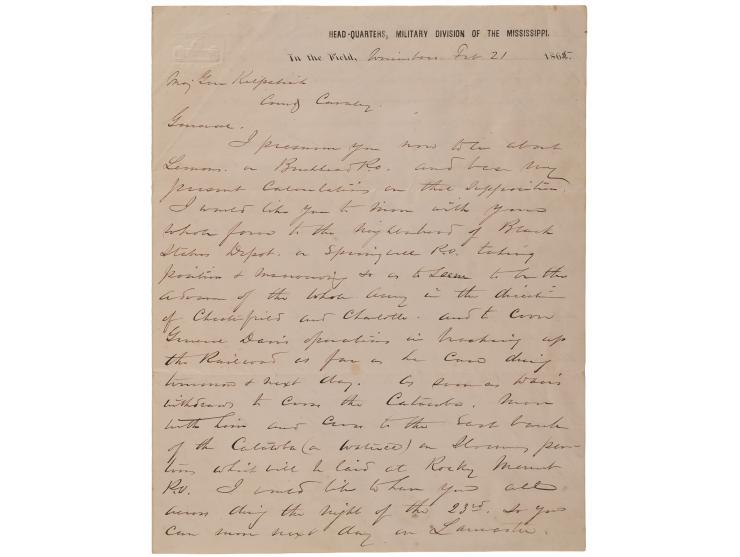
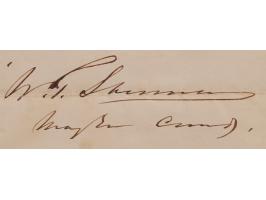
Civil War-dated ALS signed “W. T. Sherman, Maj. Gen. Comd'g,” three pages on two adjoining sheets, 7.75 x 9.75, Head-Quarters, Military Division of the Mississippi letterhead, February 21, 1865. Handwritten letter to Maj. Gen. Hugh Judson Kilpatrick, relating to operations in South Carolina. In part: "I presume you now to be about Lemon's or or Buckhead P.O. and base my present calculations on that supposition. I would like you to move with your whole force to the neighborhood of Black Station Depot or Springwell P.O. taking position & maneuvering so as to seem to be the advance of the whole army in the direction of Chesterfield and Charlotte, and to cover General Davis' operations in breaking up the Railroad as far as he can during tomorrow & next day. As soon as David withdraws to cross the Catawba, move with him and cross to the east bank…
I would like to have the RR Bridge across Broad River at the mouth of Tiger burned, and think the enemy himself will burn it if you approach it or send a small party to threaten it. Also several of the bridges & trestles on the same railroad below where it crosses Broad River about Ashford's Ferry and Dawkins. I hope you have already damaged that Road considerably. I wish, as a rule, whenever you are near a Railroad you will unless cautioned otherwise have your men burn bridges, depots, and water-tanks and break switches.—also all sawmills should be destroyed, not only burned, but the engines and boilers disabled.
Davis will be near you and will be at hand in case of need, but I don't want you to be drawn off so that you cannot have your trains & men ready to piss the pontoons during the night of the 23rd. Better caution your commanders so as to keep in the foragers, else they will be left behind, as some were about Columbia. I will be with this wing some days, and should like to see you. Either here or better at the Bridge in crossing the Catawba." In fine condition, with a few scattered small stains.
Written just days after the fall of Columbia, this battlefield letter belongs to the climactic phase of Sherman’s Carolinas Campaign, the final destructive sweep that followed his March to the Sea. Addressed to Maj. Gen. Hugh Judson Kilpatrick, it captures Sherman actively directing cavalry movements in South Carolina while coordinating with General Davis’s operations against Confederate rail lines. The letter reflects the fluid, fast-moving nature of the campaign, with specific references to strategic points as Sherman pressed northward toward North Carolina in the closing weeks of the war.
Most significantly, the letter provides vivid, firsthand evidence of Sherman’s 'hard war' strategy. He explicitly orders the systematic destruction of railroads, bridges, depots, water tanks, and sawmills—directing not only that structures be burned, but that engines and boilers be disabled to ensure lasting damage to Confederate infrastructure. Such instructions illustrate the deliberate dismantling of the South’s logistical and industrial capacity that defined Sherman’s campaigns of 1864–65. Written less than seven weeks before Lee’s surrender at Appomattox, the letter stands as a powerful operational document from the war’s final chapter, embodying the tactics that helped bring about the Confederacy’s collapse.
Opening: $200
Estimate: $1,000 - $1,500
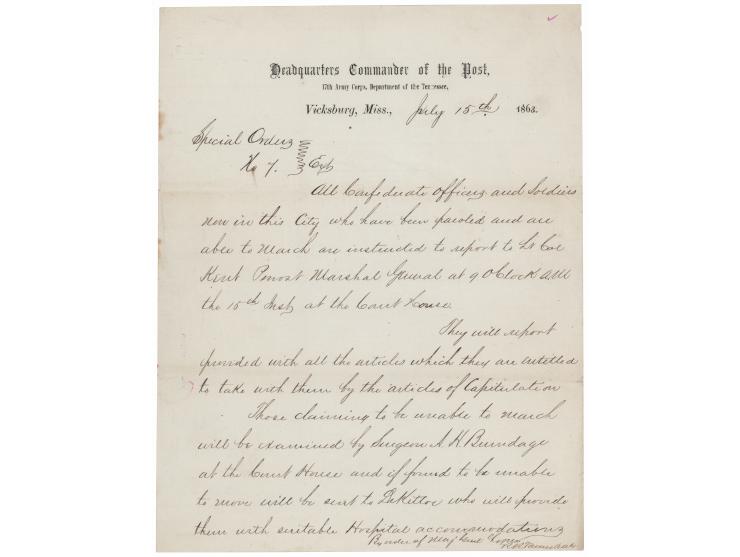
Civil War-dated ALS signed “R. R. Townes A.A.G.,” one page, 7.75 x 9.75, Headquarters, Commander of the Post, 17th Army Corps, Department of the Tennessee letterhead, July 15, 1863. Handwritten extract from "Special Orders No. 7," in part: "All Confederate officers and Soldiers now in this City who have been paroled and are able to march are instructed to report to Lt. Col. Kent Prevost Marshal General at 9 o'clock A.M. the 15th day at the Court House. They will report provided with all the articles which they are entitled to take with them by the articles of Capitulation. Those claiming to be unable to march will be examined by Surgeon A. H. Brundage." In fine condition.
The Confederate surrender of Vicksburg on July 4, 1863, marked a turning point in the Civil War, giving the Union complete control of the Mississippi River. After a six-week siege by Union forces under General Ulysses S. Grant, Confederate General John C. Pemberton capitulated, surrendering nearly 30,000 troops. Grant, not wanting to guard and feed thousands of rebel captives, offered to immediately parole all prisoners of war. The fall of Vicksburg, combined with the Union victory at Gettysburg a day earlier, dealt a severe blow to the Confederacy's hopes of independence.
Opening: $200
Estimate: $1,000 - $1,500
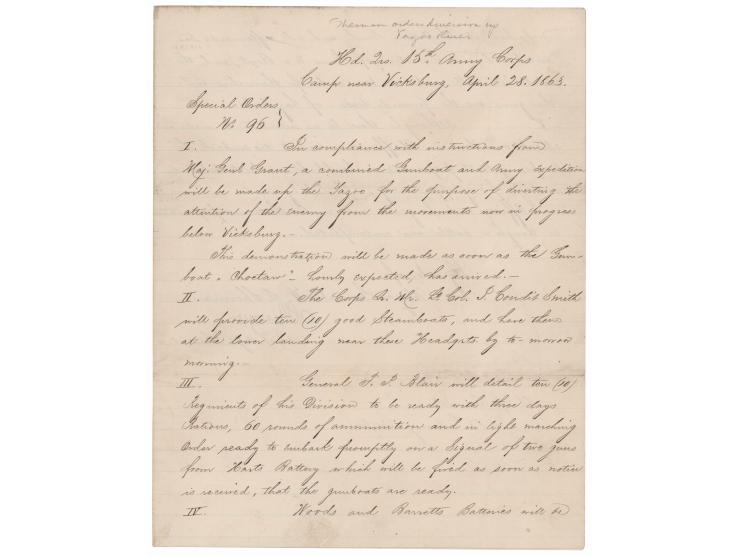
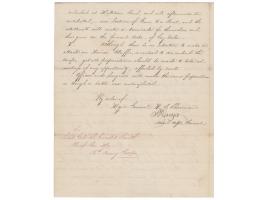
LS signed “R. M. Sawyer,” one page both sides, 7.75 x 9.75, April 28, 1863. "Special Orders No. 96," issued under command of General William T. Sherman at "Hd. Qrs. 15th Army Corps, Camp near Vicksburg," in part: "In compliance with instructions from Maj. Gen'l Grant, a combined Gunboat and Army Expedition will be made up the Yazoo for the purpose of diverting the attention of the enemy from the movements now in progress below Vicksburg. This demonstration will be made as soon as the Gunboat 'Choctaw,' hourly expected, has arrived…The Corps…will provide ten (10) good Steamboats, and have them at the lower landing near these Headqrts. by to-morrow morning…General F. P. Blair will detail ten (10) Regiments of his Division to be ready with three days Rations, 60 rounds of ammunition and in light marching order ready to embark…Woods and Barrett's Batteries will be embarked at Millikens Bend, and will afterwards be distributed;—one Section of Guns to a Boat, and the artillerists will make a barricade for themselves and their guns in the forward decks, of hay bales…Although there be no intention to make an attack on Haines' Bluff, or indeed to disembark the troops, yet all preparations should be male to take advantage of any opportunity, afforded by events." In fine condition.
These special orders make notable reference to the USS Choctaw and its feigned attack on Haynes' Bluff, Mississippi, an operation held from April 29–May 1, 1863, intended to prevent the Confederates from reinforcing Grand Gulf. During this diversionary action, the Choctaw was struck 53 times. The gunboat remained in the Yazoo, taking part in operations that destroyed Confederate defenses and naval assets at Yazoo City later on in May. In June 1863, she helped repel a Confederate assault at Milliken's Bend, capturing several enemy soldiers as prisoners of war.
Weapons, Uniforms, and Artifacts
Opening: $500
Estimate: $4,000 - $6,000
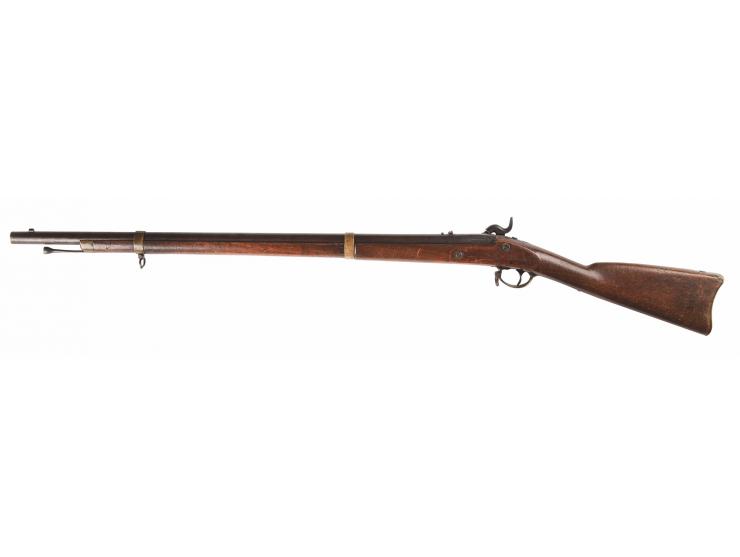
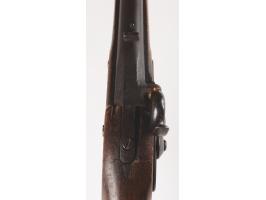
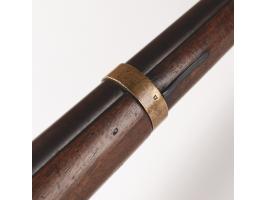
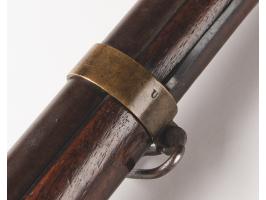
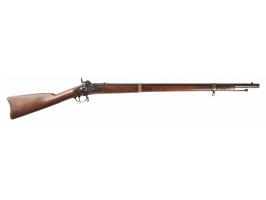
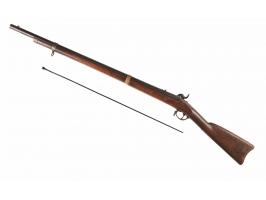
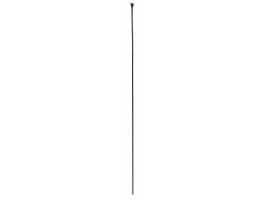
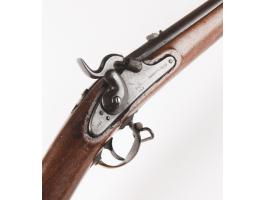
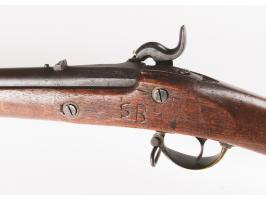
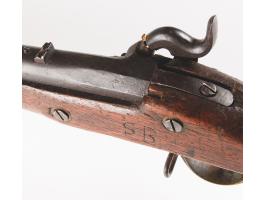
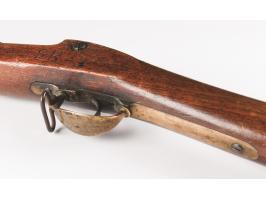
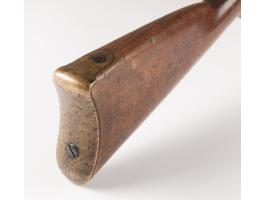
Civil War Confederate Fayetteville Type IV Percussion Rifle, approximately .67 caliber, 33˝ smoothbore barrel with a fine, lightly freckled bore. This is a so-called 'Model 1855' two band rifle that was altered to smoothbore at some point and given an enlarged bore diameter. The metal has an overall dark plum-brown patina with areas of light-moderate pitting, heaviest at the breech-end of the barrel and on the nipple bolster. Some further impact marks and minor scratches are present near the muzzle, as well as some small spots of white paint on the right side, and the rear sight is a single-notch replacement. Additionally, vise marks are present on the left side of the barrel breech. The 1864 dated lockplate matches the patina on the barrel, with the characteristic inverted "S" in the "CSA," and lacks the 'hump' present on the earlier types of Fayetteville arms. The walnut stock is not equipped with a patchbox, and has numerous small handling marks and small surface blemishes scattered throughout, as well as a stable with-the-grain crack running forward from the rear lock screw bolster, and some small chips missing from around the top tang. The wood retains an old varnish finish that thins considerably at the butt, and has a deeply carved set of initials on the left side opposite the lock, "SB." The brass furniture has developed a dark ochre-brown patina, including the "CSA" marked buttplate. The rifle is equipped with an original metal ramrod that is slightly bent near the head and shortened by about 2˝. The lock is mechanically excellent and functions firmly and flawlessly. This is a rare, late-war Confederate rifle in very good condition overall.
As an antique gun this will transfer without any restrictions.
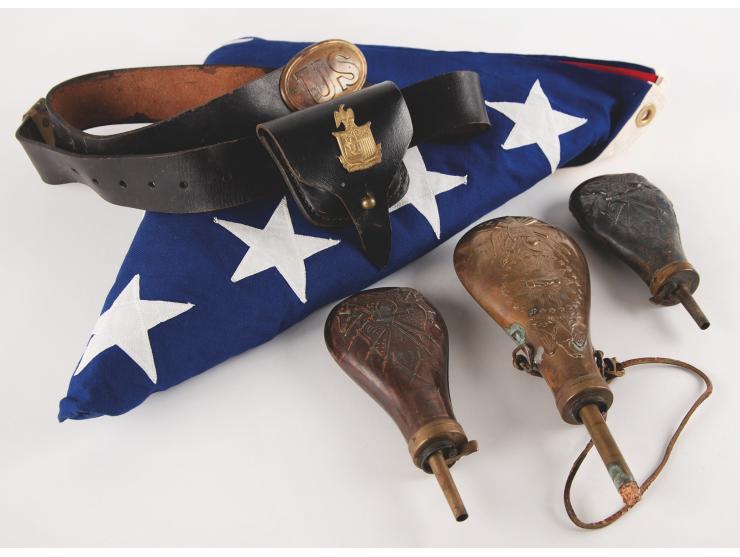
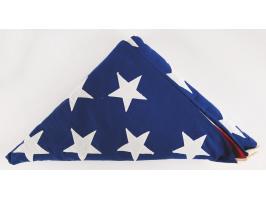
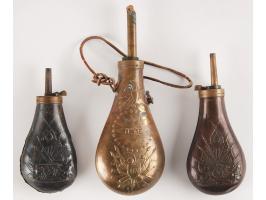
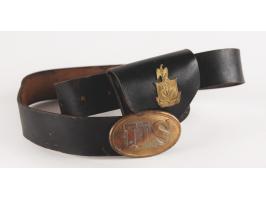
American Flag (50 Star) by Valley Forge Flag Co., with Civil War Belt (Reproduction) and Antique Powder Horns (4)
Opening: $200
Estimate: $200 - $400
Vintage 50-star United States flag by Valley Forge Flag Co. (post 1959), approximately 115˝ x 56˝, machine-sewn and made of cotton, with 50 double-appliqued cotton stars, and metal grommets on the header, which bears the “Valley Forge Flag Company” manufacturing label. Included with the flag is a reproduction Civil War Union belt and cap box, approximately 45˝ in length, with a reproduction New York Militia cap badge, and a lot of three vintage reproduction metal powder horns from the mid-to-late 20th century. In overall very good condition.
The current flag of the United States, adorned with 50 stars, represents each of the fifty states in the Union. This iconic symbol of American unity and pride underwent several iterations before arriving at its present design. The 50-star flag came into official use on July 4, 1960, following the admission of Hawaii as the 50th state on August 21, 1959. The design was created by Robert G. Heft, a 17-year-old high school student from Ohio, as part of a school project. Heft's design was chosen out of over 1,500 submissions and was officially adopted by President Dwight D. Eisenhower. The flag’s design adheres to a pattern of nine rows of stars staggered horizontally and eleven rows staggered vertically on a blue field, accompanied by thirteen horizontal stripes representing the original thirteen colonies.
The journey to the 50-star flag began with the 13-star version, first adopted on June 14, 1777, by the Second Continental Congress. As the nation expanded, additional stars and stripes were incorporated to represent new states. However, in 1818, Congress passed an act maintaining thirteen stripes to honor the original colonies and adding new stars for each new state. Throughout the centuries, the flag evolved with the nation's growth, reflecting its dynamic history. The transition to the 50-star flag marked a significant milestone, symbolizing not only the geographical expansion but also the unity and diversity of the American people. Today, the flag remains a powerful emblem of national identity, flown proudly across the nation and recognized globally.
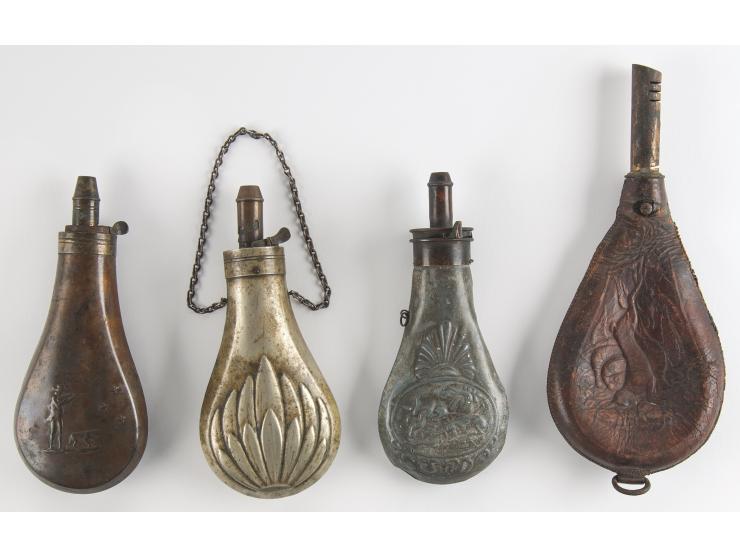
Opening: $200
Estimate: $200 - $400
Group of four antique powder horns from the 19th-20th century, metal and leather, ranging in size from 3.25˝ x 7.5˝ to 4.25˝ x 10˝, each with embossed designs to the body. In overall very good to fine condition.
Civil War
Opening: $200
Estimate: $200 - $400
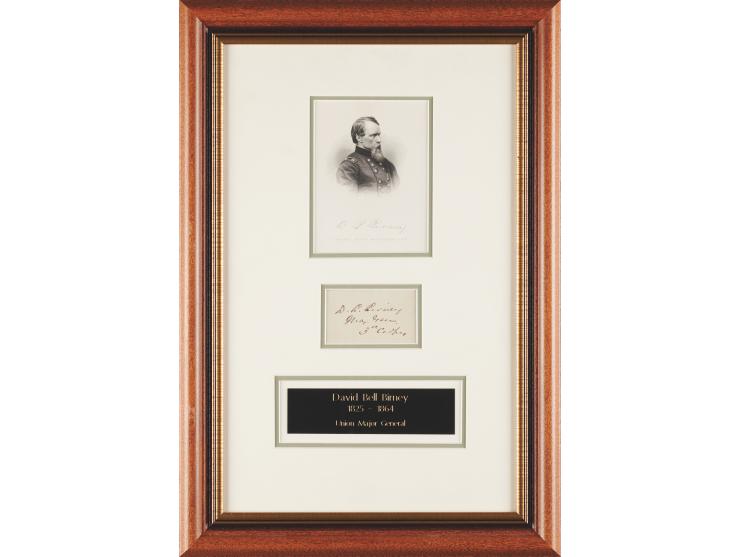
Ink signature, "D. B. Birney, Maj. Gen., 3d Corps,” on an off-white 3 x 1.75 slip. Double-matted and framed with an engraved portrait (featuring a facsimile signature) and plaque to an overall size of 12.5 x 18.25. In fine condition.