Opening: $200
Estimate: $1,000 - $2,000
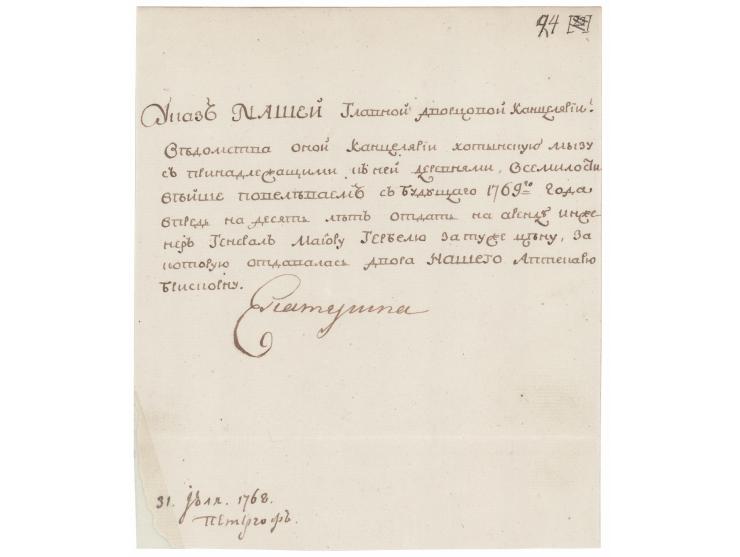
Manuscript DS in Cyrillic, signed "Ekaterina,” one page, 6.75 x 7.75, July 31, 1768. Addressed from Peterhof Palace, an imperial order entitled “Ukaz of OUR Main Palace Chancellery,” which directs the chancellery to lease the Khotyn estate, together with its associated villages, to Engineer General Major Gerbel for ten years beginning in 1769, at the same price previously paid for the lease of the Appellate Court. Signed beautifully at the conclusion by Catherine the Great. In fine condition, with trimmed edges, and reinforced loss to the lower left corner tip.
Catherine II issued this ukaz from Peterhof, her summer residence on the Gulf of Finland outside St. Petersburg, on July 31, 1768. That same year, she opened the First Russo-Turkish War against the Ottoman Empire, and underwent smallpox inoculation by Dr. Thomas Dimsdale, eventually making the procedure publicly available throughout Russia. The ukaz concerns the administration of imperial estates, a routine but substantial function of the Palace Chancellery, which managed the vast landholdings of the Russian crown. Catherine reigned from 1762 until her death in 1796, presiding over a dramatic expansion of Russian territory and influence. She is the longest-ruling female leader in Russian history.
Opening: $1,000
Estimate: $10,000 - $15,000
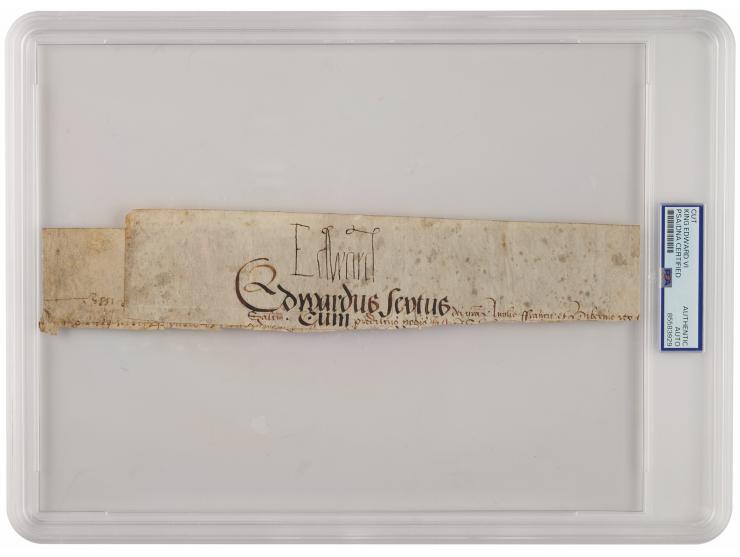
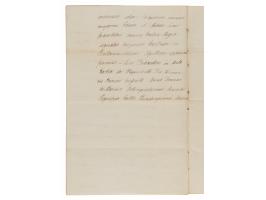
Large and neat ink signature, "Edward,” on a long off-white vellum slip cut from the top of a manuscript document, folded to 10.75 x 2. In very good to fine condition, with scattered staining and soiling. Encapsulated in a PSA/DNA authentication holder.
Because of his young age and early death, King Edward VI's autograph takes a place among the rarest of all English royalty. This is just the third Edward VI autograph we have ever offered.
Opening: $300
Estimate: $4,000 - $6,000
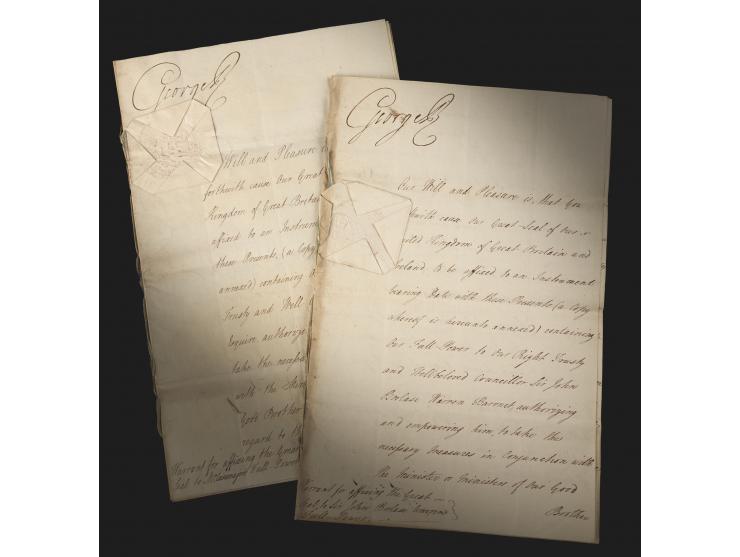
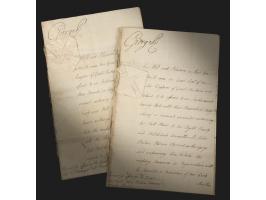
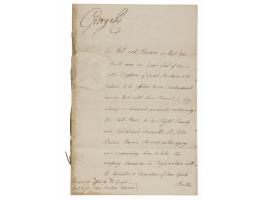
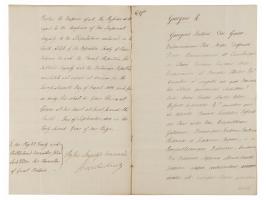
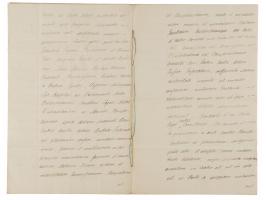
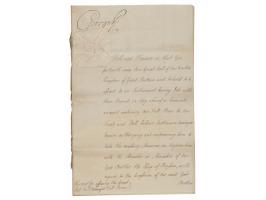
Significant pairing of documents signed by King George III, both pertaining to the Treaty of Amiens, which temporarily ended hostilities between France, the Spanish Empire, and the United Kingdom at the end of the War of the Second Coalition. It marked the end of the French Revolutionary Wars and set the stage for the Napoleonic Wars. Includes:
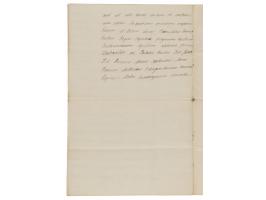
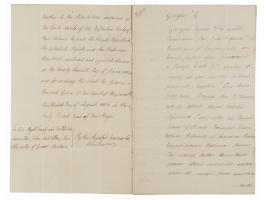
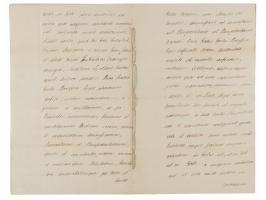
- a manuscript DS, signed "George R," one page both sides, August 30, 1802, being a warrant for affixing the Great Seal to Justinian Casamajor's full power to "take the necessary measures, in conjunction with the Minister or Ministers of our good brother the King of Prussia, with regard to the accession of our said good brother to the stipulations contained in the Tenth Article of the Definitive Treaty of Peace between us and the French Republick, His Catholick Majesty, and the Batavian Republick, concluded and signed at Amiens on the Twenty-Seventh Day of March 1802," with annexed four-page manuscript of the full power's text.
- manuscript DS, signed "George R," one page both sides, 7.75 x 12, September 10, 1802, being a warrant for affixing the Great Seal to Sir John Borlase Warren's full power to "take the necessary measures in conjunction with the minister or ministers of our good brother the Emperor of all the Russias, with regard to the accession of His Imperial Majesty to the stipulations contained in the Tenth Article of the Definitive Treaty of Peace between us and the French Republic, His Catholic Majesty and the Batavian Republic, concluded and signed at Amiens on the Twenty-Seventh Day of March, 1802," with annexed four-page manuscript of the full power's text.
Both retain their white paper seals affixed at the head. In overall fine condition.
Concluded on March 27, 1802, the Treaty of Amiens brought a rare and fragile peace to Europe after nearly a decade of continuous warfare following the French Revolution. For Great Britain, the agreement required difficult concessions, including the restoration of several colonial possessions, while for Napoleon Bonaparte—then First Consul—it represented both diplomatic recognition and a strategic pause to consolidate French power on the Continent.
The treaty’s Tenth Article, referenced in these documents, concerned the complex reordering of territories and guarantees involving other European powers, focused on the islands of Malta, Gozo, and Comino. The peace proved short-lived: mounting distrust, imperial rivalry, and Napoleon’s ambitions led Britain to declare war again in May 1803, ushering in the far-reaching Napoleonic Wars.
Opening: $200
Estimate: $1,000 - $2,000
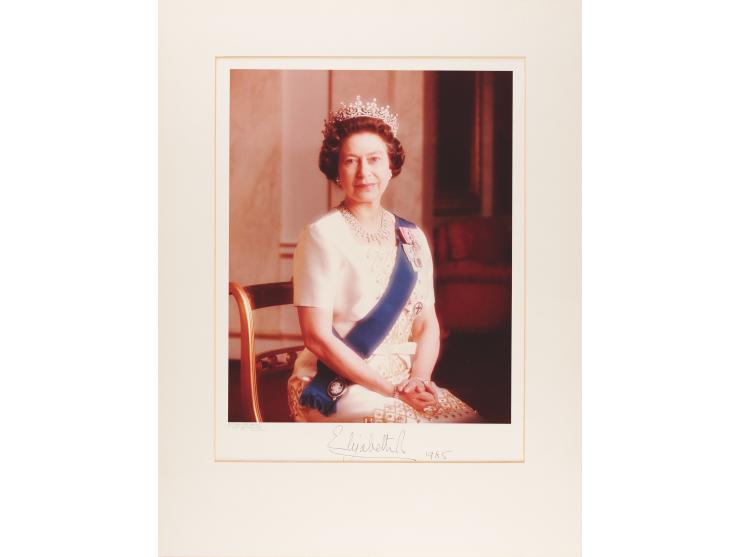
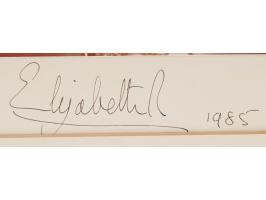
Color semi-glossy 12 x 15 photo of Queen Elizabeth II wearing her crown jewels and Order of the Garter sash, affixed to its original 13 x 17 studio mount, signed on the mount in ink, "Elizabeth R, 1985." Also signed on the mount in pencil by the photographer, "Anthony Buckley and Constantine, London." Matted to an overall size of 18 x 24. In very fine condition.
Opening: $200
Estimate: $1,000 - $1,500
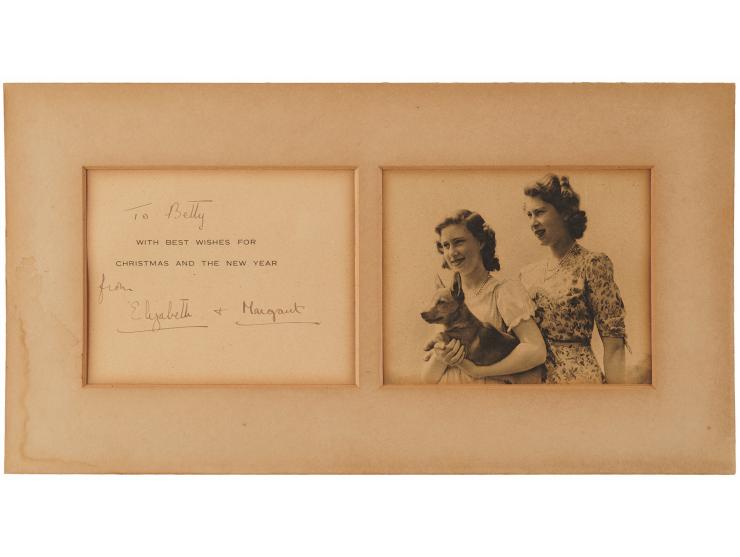
Vintage circa 1940s Christmas card depicting the young Princess Elizabeth and Princess Margaret with a beloved corgi, measuring 11.75 x 5 open, signed and inscribed around the printed greeting in fountain pen, "To Betty, from Elizabeth" and "Margaret." Matted to an overall size of 13.5 x 7. In very good to fine condition, with edge toning to the card, and toning and damstaining to the mat.
Opening: $300
Estimate: $3,000 - $5,000
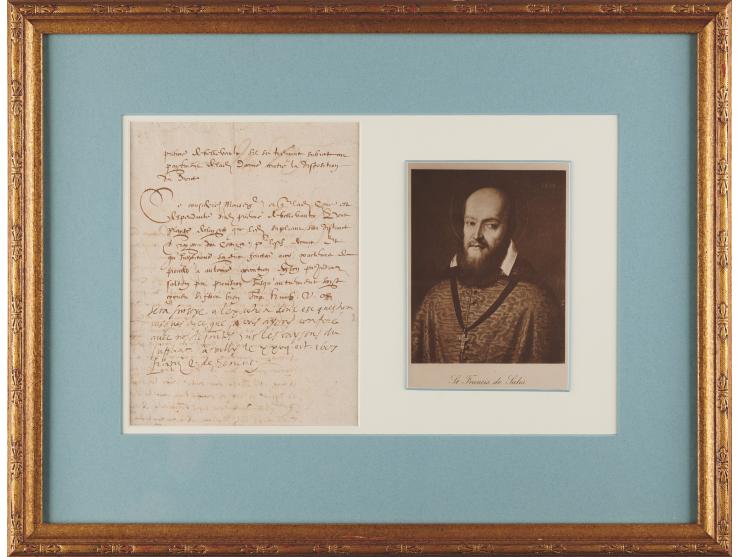
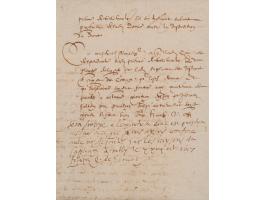
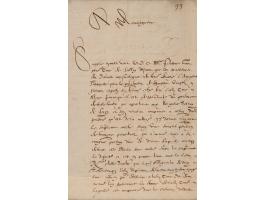
Extremely rare ANS in French, signed “Franc's ev. De Geneve,” penned at the conclusion of a manuscript appeal for tax exemption, one page both sides, 6 x 8, October 27, 1607. The appeal, sent to de Sales while serving as Bishop of Geneva, requests for an exemption from ecclesiastical taxes. Addressed from the Swiss town of Villy, near the Lake Geneva town Evian, where de Sales was reputed to have seen a vision of St. Francis of Assisi, the Bishop’s handwritten response reads: “Exacting of taxes suspended until we have had a chance to confer with Our deputies on the reasons of the petitioner.” Double-matted and framed with a portrait to an overall size of 19 x 14.75; a window to the frame backing reveals the front of the appeal. In fine condition. Since 1536, Geneva had retained taxes formerly rendered to the Catholic Church, and the practice of ecclesiastical taxation was being challenged across Europe by the end of the 16th century.
Born into a noble family in the Duchy of Savoy, de Sales was highly educated, studying theology and law. Despite his father’s strenuous and repeated insistence that he marry and pursue a political career, he joined a holy order. After the intervention of Geneva Bishop Claude de Granier, his father relented and de Sales was ordained into the priesthood in 1593 whereupon he was made provost of the cathedral chapter of Geneva, a hotbed of Calvinism. Despite resistance from Calvinist inhabitants, he evangelized while residing in a garrisoned fortress, though he narrowly escaped assassination on several occasions. In 1602, de Sales succeeded the bishop of Geneva, but due to Calvinist control of Geneva, he was forced to reside in the French alpine city of Annecy. The efficiency of his diocese as well as the evangelical zeal that permeated it was known throughout Europe as was Francis’ preaching. His popular and influential books Introduction to the Devout Life, unusual in that it was written for the laity, was published in 1607, and Treatise on the Love of God, increased the public’s regard for him. A beloved figure, de Sales was venerated after his death, and canonized by Pope Alexander VII in 1665. St. Francis is both the patron saint of the deaf and the patron saint of writers and journalists, because of the printed matter he used in his efforts to convert Calvinists.
Opening: $300
Estimate: $2,000 - $4,000
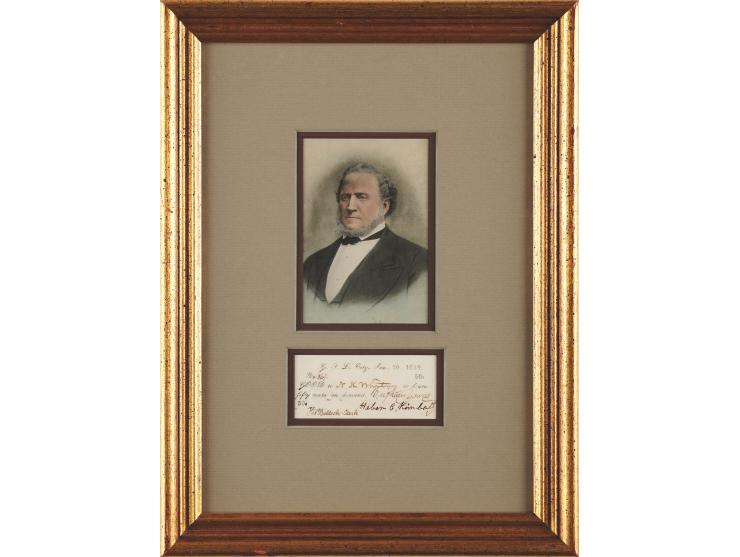
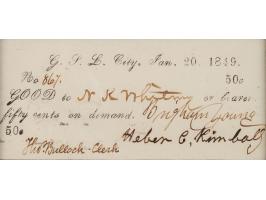
Rare partly-printed note of Mormon currency in the amount of fifty cents, 3.5 x 1.75, made out in another hand to N. K. Whitney, and signed in ink by three early Mormon leaders, "Brigham Young," "Heber C. Kimball," and "Tho. Bullock—Clerk." The note is number 867, issued at Great Salt Lake City on January 20, 1849. Handsomely double-matted and framed with a postcard portrait to an overall size of 10.5 x 14.25. In fine condition.
Following their arrival in the Salt Lake Valley in July 1847, Brigham Young and the Mormon pioneers quickly set about building the infrastructure of their new homeland. With no standardized national currency in circulation at the time, the growing settlement soon required a reliable medium of exchange. In 1848, the church established a mint in a small adobe building in Great Salt Lake City, initially producing coinage from gold dust brought from California. Due to losses associated with weighing the gold, Young authorized the printing of paper currency in early 1849.
Using a hand-press brought west by wagon—and later an improved press constructed by church architect Truman Angell—the first notes were issued on January 20, 1849, in denominations ranging from 50 cents to $9. These bills, the earliest known examples of Utah printing, were signed by Brigham Young along with prominent church leaders including Heber C. Kimball and Thomas Bullock; this particular bill is especially notable as it was issued to Newel K. Whitney, presiding bishop of the church. Redeemable in gold, most were eventually exchanged and destroyed, making surviving examples exceptionally scarce.
Opening: $1,000
Estimate: $10,000 - $15,000
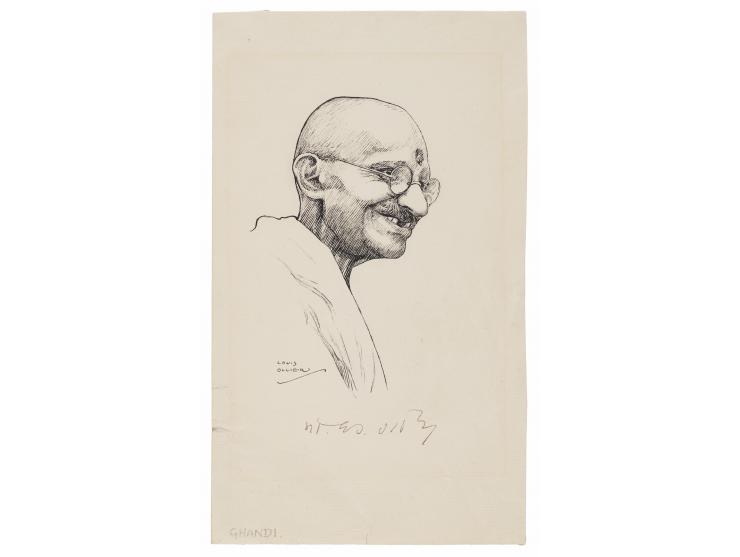
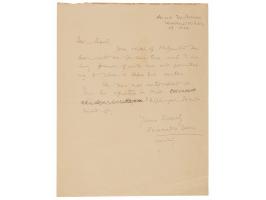
Attractive portrait sketch of Mohandas Gandhi by artist Louis Ollier, accomplished in ink on an off-white 5 x 8.5 sheet, signed neatly below in ink by the Mahatma, who has signed his name in Hindi. Includes a letter of transmittal from Gandhi’s secretary, Mahadev Desai, dated December 29, 1934, sent from “The Ashram,” in full: “Your sketch of Gandhi has been with me for some time and I am sorry. Pressure of work has not permitted me to place it before him earlier. He has now autographed it. It’s his signature in Hindi. I hope you do not mind it.” In fine condition, with a few short edge tears, and some light toning from prior display, all easily matted out.
Opening: $200
Estimate: $1,000 - $1,500
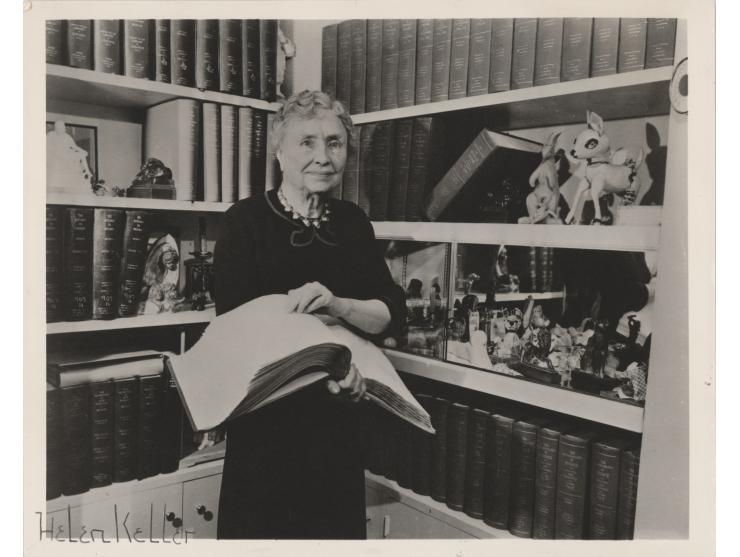
Vintage glossy 10 x 8 photo of Helen Keller holding a huge book of braille, neatly signed in the lower left in pencil. In fine condition.
Opening: $500
Estimate: $2,500 - $3,500
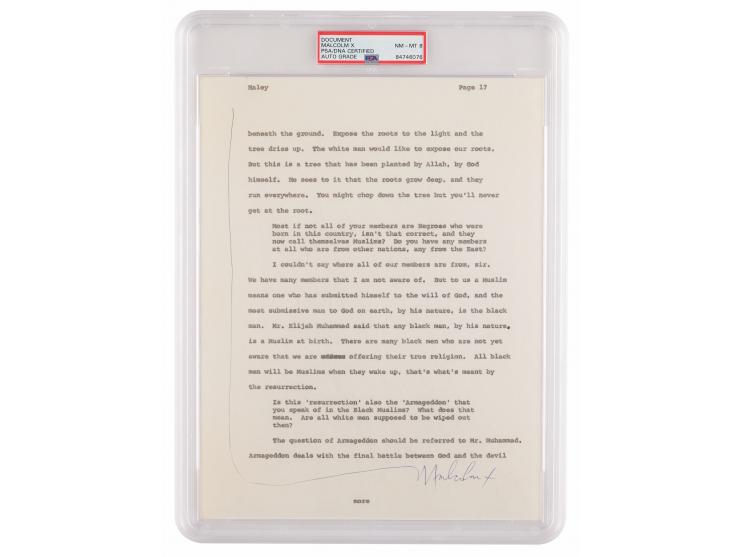
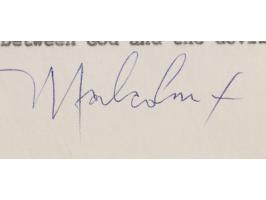
Page 17 from the original typescript of Alex Haley’s 1963 interview of Malcolm X for Playboy magazine, one page, 8.5 x 11, signed "Malcolm X" in the bottom margin (with a marginal line indicating his approval of the contents). In full: [Malcolm X] “…beneath the ground. Expose the roots to the light and the tree dries up. The white man would like to expose our roots. But this is a tree that has been planted by Allah, by God himself. He sees to it that the roots grow deep, and they run everywhere. You might chop down the tree but you'll never get at the root.
[Haley] Most if not all of your members are Negroes who were born in this country, isn't that correct, and they now call themselves Muslims? Do you have any members at all who are from other nations, any from the East?
[Malcolm X] I couldn't say where all of our members are from, sir. We have many members that I am not aware of. But to us a Muslim means one who has submitted himself to the will of God, and the most submissive man to God on earth, by his nature, is the black man. Mr. Elijah Muhammad said that any black man, by his nature, is a Muslim at birth. There are many black men who are not yet aware we are offering their true religion. All black men will be Muslims when they wake up, that's what's meant by the resurrection.
[Haley] Is this 'resurrection' also the 'Armageddon' that you speak of in the Black Muslims? What does that mean. Are all white men supposed to be wiped out then?
[Malcolm X] The question of Armageddon should be referred to Mr. Muhammad. Armageddon deals with the final battle between God and the devil…” In very fine condition. Encapsulated and graded by PSA/DNA as “NM - MT 8.”
Playboy's May 1963 interview with Malcolm X was one of the most famous of Haley’s career and gave most readers their first in-depth look at Malcolm X’s teachings and personality. Supporters and critics viewed the Muslim minister in very different terms. Admirers saw him as a courageous advocate for the rights of African-Americans and condemned crimes against black Americans; detractors accused him of preaching racism, black supremacy, and violence. Nevertheless, he has been described as one of the greatest and most influential African-American leaders in history. Within a year of granting this interview, with America still gripped by ever-growing racial tension, the once-combative black nationalist Malcolm X had repudiated almost every stance in the interview. He had broken with the Nation of Islam movement, fallen out with its leader, Elijah Muhammad, renounced black supremacy, and embraced racial equality and human rights. He was assassinated in Harlem in 1965.
Opening: $200
Estimate: $1,000 - $2,000
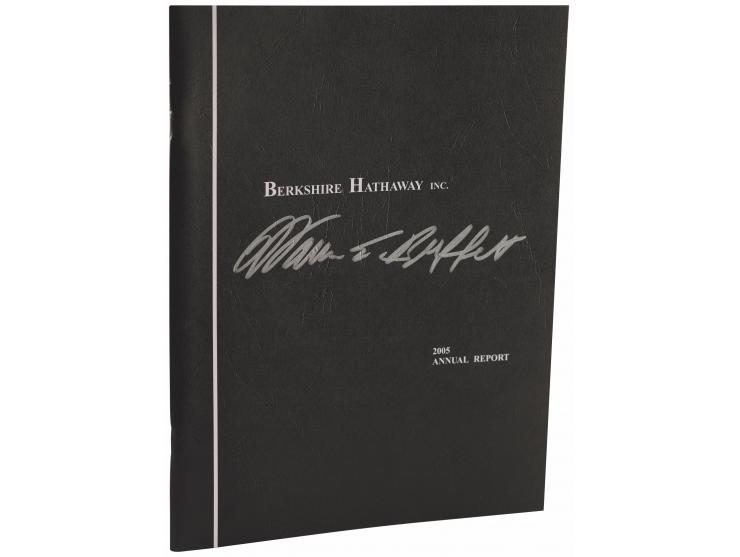
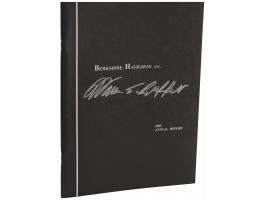
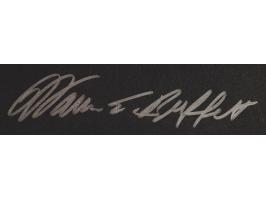
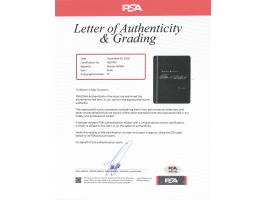
Rare softcover Berkshire Hathaway Inc. annual report from 2005, 80 pages, 8.25 x 10.75, signed on the front cover in attractive silver ink, "Warren E. Buffett." The report opens with one of Buffett's popular shareholder letters, offering his fascinating insights into the state of Berkshire and of the economy at large. In fine condition. Accompanied by a full letter of authenticity from PSA, which grades the autograph as a "10."
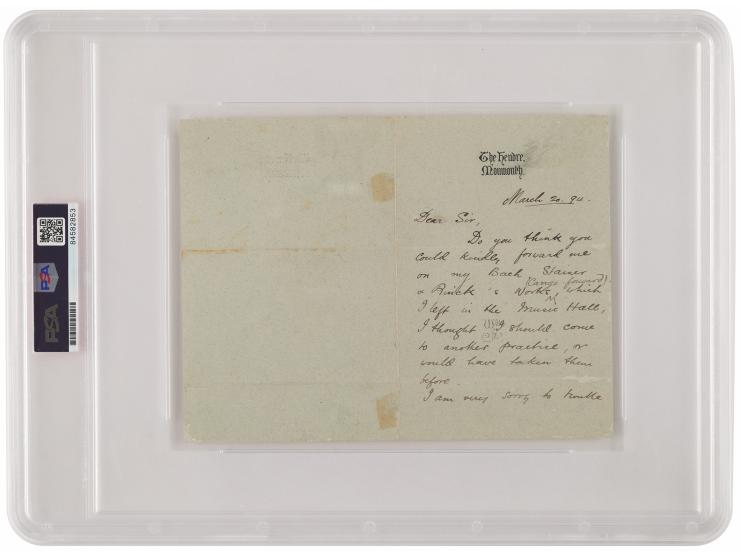
Opening: $200
Estimate: $1,000 - $2,000
Scarce ALS signed “C. S. Rolls,” one page both sides, 4 x 6, The Hendre letterhead, March 20, 1894. Handwritten letter to a gentleman, in part: "Do you think you could kindly forward me on my Bach Stainer & Rinck's Works, which I left in the Music Hall, I thought I should come to another practice, or would have taken them before." In fine condition. Encapsulated and graded by PSA/DNA as "GEM MT 10."
Opening: $200
Estimate: $2,500 - $3,500
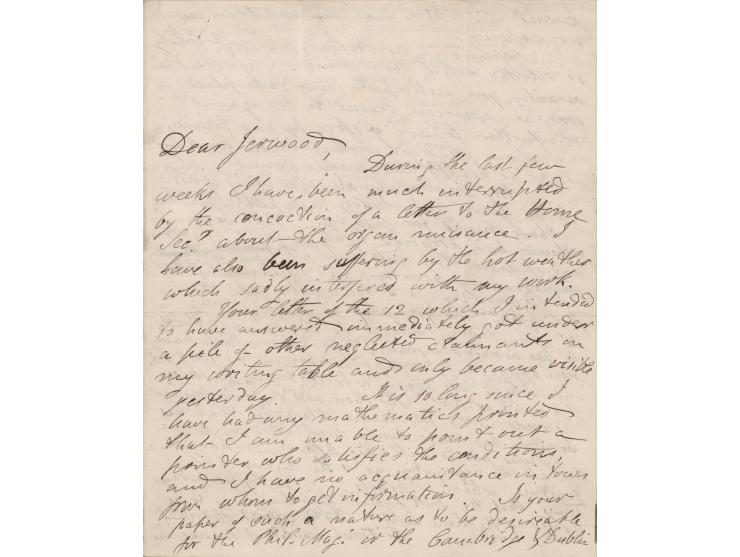
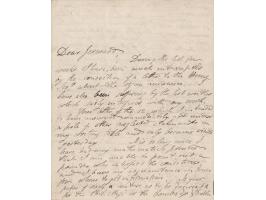
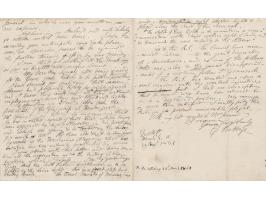
ALS signed “C. Babbage,” three pages on two adjoining sheets, 7.25 x 9, August 29, 1861. Handwritten letter to "Jerwood," mentioning his work on the Analytical Engine and signals for ship navigation, while complaining about the Royal Society. In part: "I am steadily working at the Anal. Eng. as far as health and means admit. My occulting signals after being ignored for two years seem likely to be put in practice. I have observed for some time that various schemers had proposed lights for night signals and I knew they could not use them with success without employing my occulting and blinking lights…The French Minister or Marine has made a contract for eight electric lights to be placed along the court of the channel. 'The object of these lights is to maintain a communication with ships within light of land, and to transmit the news rapidly to the interior.' As to the R.S., the council have recommended Sabine—to the great disgust of Murchison, and as one of the fellows tells me, also to the great disappointment of a certain other fellow, Dr. Granville. The R.S. has treated me upon several occasions with the greatest injustice: but I had no conception that it could ever have been reduced to such a degraded position." In fine condition.
Charles Babbage’s Analytical Engine, first described in the 1830s, was a groundbreaking mechanical computing machine and is often considered the first concept for a general-purpose computer. Unlike his earlier Difference Engine, which was built to perform specific calculations, the Analytical Engine was designed to execute a wide range of operations using punched cards for input. It featured key components found in modern computers, including a 'store' (memory) to hold numbers and a 'mill' (processor) to perform calculations. Although it was never completed during Babbage’s lifetime, the design introduced fundamental ideas such as programmability and conditional branching, laying the foundation for modern computing.
Opening: $500
Estimate: $3,000 - $5,000
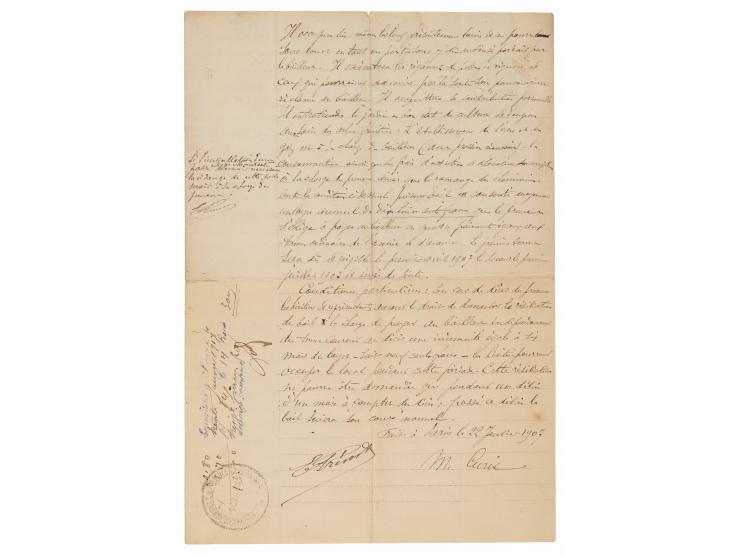
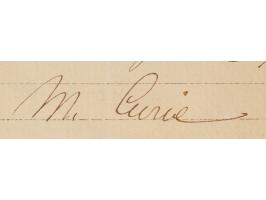
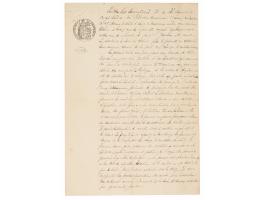
Manuscript DS in French, signed “M. Curie,” one page both sides, 6.75 x 9.75, January 22, 1907. Document pertaining to the lease of a property. In full (translated): "Between the undersigned, it has been agreed as follows:
Mr. Téron (name slightly uncertain due to handwriting), residing in Lezay, gives as a rental lease to Madame Curie a house situated at Lezay, Rue de l’Église No. 32, having also an entrance on the Chemin du Parc, with garden and courtyard.
The landlord leases the property in its entirety, by the present agreement, without any reservation on his part, together with its appurtenances and dependencies.
The present lease is made for a period of three, six, or nine entire and consecutive years, beginning on the first of April 1907, and may end on the first of April nineteen hundred and sixteen, at the option of the tenant and the landlord; on condition that the party wishing to terminate the lease at the end of one or another of these three-year periods shall notify the other party three months in advance by registered letter.
The landlord shall deliver to the tenant the house presently rented in good state of repair, and the tenant shall maintain it in the same condition during the entire duration of the lease.
The landlord shall maintain the buildings, roofs, and coverings in accordance with customary usage.
The tenant may not make any alterations or new constructions without the written consent of the landlord.
The tenant shall guarantee the rent by keeping sufficient movable goods and furniture of adequate value in the premises to ensure payment of the rent and the execution of the obligations and conditions of the lease.
The tenant must also insure his movable property against fire with an insurance company and must provide proof of this insurance to the landlord upon request.
The tenant will take possession of the rented premises in a good state of repair and will return them in the same condition at the end of the lease, except for normal wear and tear.
He shall bear the cost of major repairs if they become necessary during his occupancy, without claiming any compensation for the time the work might take, provided that such repairs do not exceed forty days.
He will occupy the premises being rented himself and will not be able to sublet them, in whole or in part, without the lessor’s written authorization. He will obey the local ordinances [réglement de police] in effect and those that may come into effect in the future, without being able to claim anything from the lessor. He will pay personal taxes. He will maintain the garden in a good state of cultivation and fertilization. He will take care of the fruit tree. The establishment of water and gas connections (with the necessary pressure) is at the lessor’s expense; consumption and the costs of maintenance and meter rental are at the lessee’s expense, as is cleaning the chimneys.
On the conditions above, this lease is agreed to for an annual rent of eighteen hundred francs, which the lessee agrees to pay to the lessor in four equal payments at the usual times of the year, in advance. The first payment will be due and payable on the first of April 1907, the second on the first of July 1907, and so on in the future.
Particular condition: In the event of the lessee’s death, his heirs and representatives will have the right to a cancellation of the lease in exchange for paying to the lessor, independent of the lease period at the time of death, an indemnity equal to six months of rent—that is, nine hundred francs. The heirs may occupy the premises during this period. This cancellation may be requested only within a term of one month after the death; after that term, the lease will continue its normal course." In fine condition.
After winning a Nobel Prize in Physics in 1903, Marie Curie became the first person to ever win the award twice when she received the Nobel Prize in Chemistry in December 1911. She received it ‘in recognition of her services to the advancement of chemistry by the discovery of the elements radium and polonium, by the isolation of radium, and the study of the nature and compounds of this remarkable element.’
Opening: $1,000
Estimate: $6,000 - $8,000
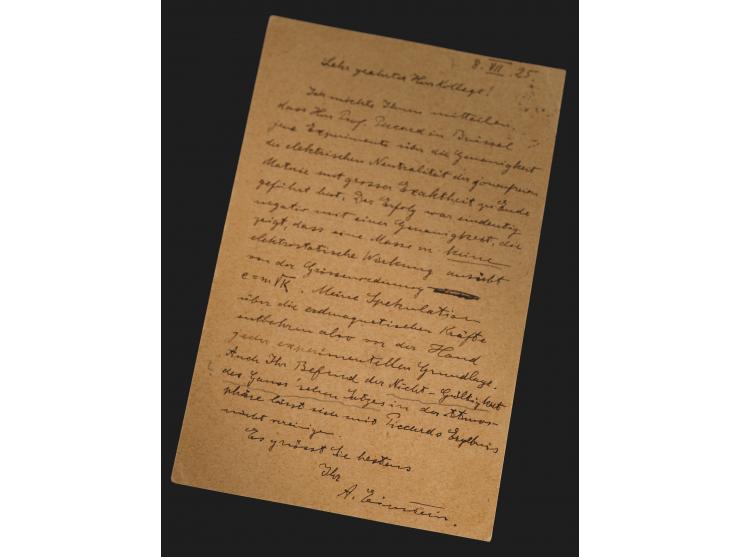
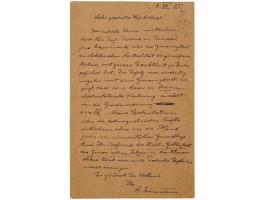
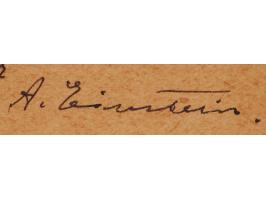
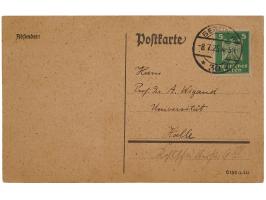
ALS in German, signed “A. Einstein,” one page, 3.5 x 5.5, July 8, 1925. Handwritten letter to Professor Albert Wigand at the University of Halle, in full (translated): "I would like to inform you that Prof. Piccard in Brussels has completed those experiments on the accuracy of the electrical neutrality of matter with great precision. The result was clearly negative with an accuracy that shows that mass exerts no electrostatic effect of the order of magnitude e=m√K. My speculation about geomagnetical forces therefore lacks any experimental basis for the time being. Your finding of the non-validity of Gauss's law in the atmosphere cannot be reconciled with Piccard's result either." Addressed on the reverse in Einstein's hand. In fine condition.
In 1925, Auguste Piccard—best known today for his later high-altitude balloon flights and deep-sea explorations—was deeply engaged in precision experimental physics. Along with his collaborator, E. Kessler, Piccard carried out a meticulous experiment in Brussels to test one of the fundamental assumptions of physics: the electrical neutrality of matter. Einstein notes that Piccard’s results were decisively negative, confirming with remarkable accuracy that matter exhibits no detectable electrostatic effect—thereby undermining Einstein’s own speculative ideas regarding geomagnetical forces. The letter captures Einstein engaging directly with contemporary experimental results, candidly reassessing his theoretical conjectures in light of new empirical evidence.
Opening: $200
Estimate: $2,000 - $3,000
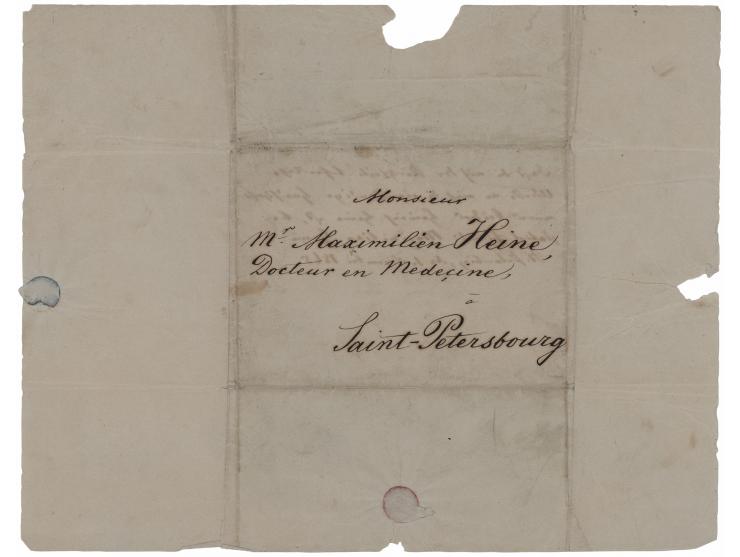
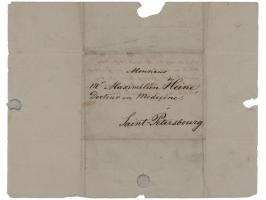
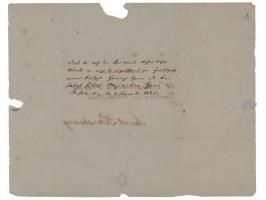
Hand-addressed mailing cover accomplished by Heinrich Heine, measuring 10.5 x 8.5 open, with a central panel of 5 x 3.75, addressed by Heine to his brother: "Monsieur Mr. Maximilien Heine, Docteur en Medecine, Saint-Petersbourg." On the reverse is a handwritten note by Maximilian Heine, dated November 1865, identifying the handwriting as that of his brother. In fine condition, with tears and seal-related loss to the wide borders.
Opening: $500
Estimate: $6,000 - $8,000
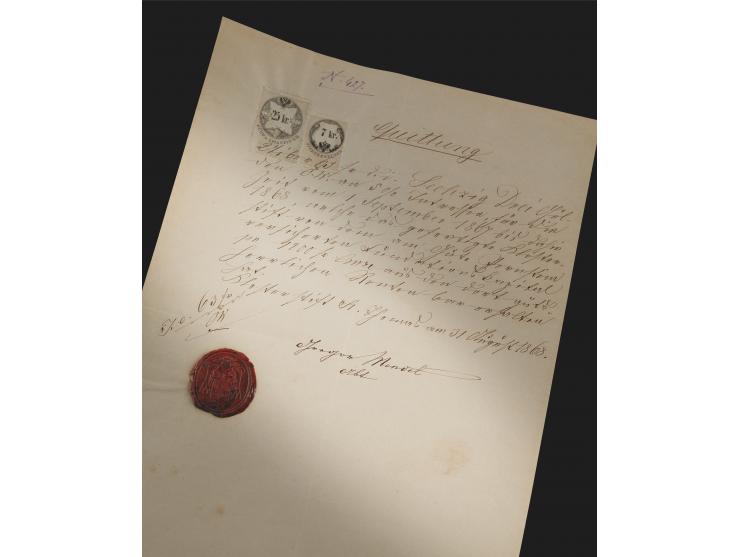
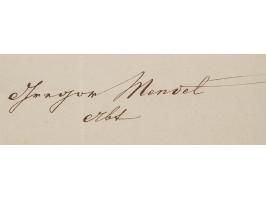
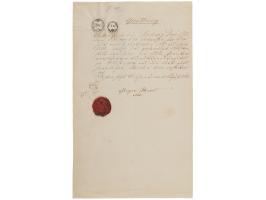
Rare manuscript DS in German, one page, 8.5 x 13.75, 1868. Receipt document concerning a financial transaction, issued from St. Thomas's Abbey in Brno. In full (translated): "For 63 florins, that is, sixty-three Austrian guldens, at 5 % interest, for the period from 1 September 1867 up to now in 1868, that the satisfied monastery has received in cash from the endowment capital of 1200 convention florins secured by the Pernstein manor and the manorial rights there." An official embossed red wax seal is affixed to the lower left, with two revenue stamps affixed near the top. In fine condition.
Mendel conducted his principal pea plant experiments between 1856 and 1863, developing the laws of inheritance through his observations. He coined the terms 'recessive' and 'dominant' to refer to the invisible 'factors' that influenced heredity (now known as genes), and his principal paper on the subject was published in 1866. In 1868, the year of this document, he was elevated to abbot of the monastery and his new responsibilities gave him little time to devote to scientific studies. He spent most of his time attempting to keep the monastery financially afloat and, following his death, the succeeding abbot burned many of the papers in Mendel's collection to mark an end to the financial troubles. Autographic material by the groundbreaking scientist is thus very difficult to come by and exceptionally desirable worldwide.
Opening: $200
Estimate: $2,000 - $3,000
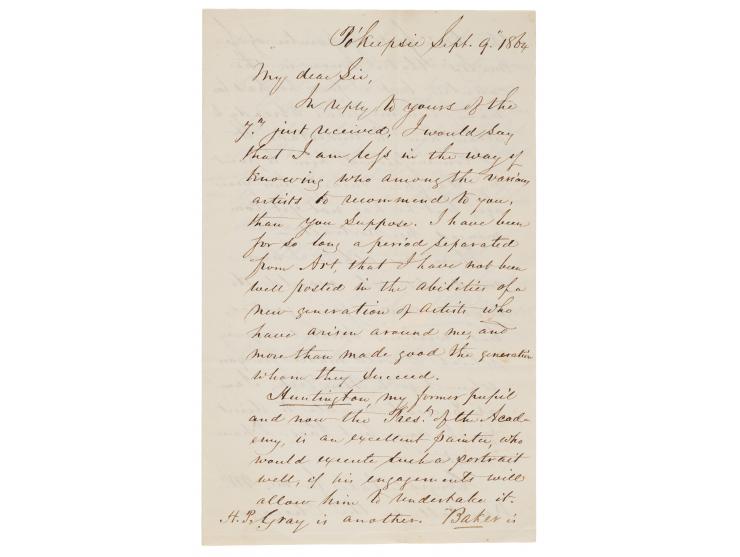
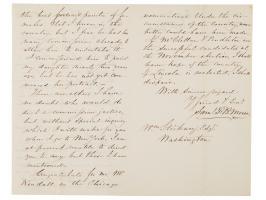
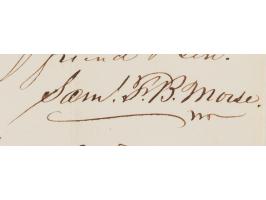
ALS signed “Sam'l F. B. Morse,” four pages on two adjoining sheets, 5 x 8, September 9, 1864. Handwritten letter to William Stickney, a co-founder of the Columbia Institution for the Deaf (now Gallaudet University). In part: "In reply to yours of the 7th just received, I would say that I am less in the way of knowing who among the various artists to recommend to you, than you suppose. I have been for so long a period separated from Art, that I have not been well posted in the abilities of a new generation of artists who have arisen around me, and more than made good the generation whom they succeed.
Huntington, my former pupil and now the Prest. of the Academy, is an excellent painter, who would execute such a portrait well, if his engagements will allow him to undertake it. H. P. Gray is another. Baker is the best portrait painter of the males that I know in the country, but I fear he has too many commissions already, to allow him to undertake it. I commissioned him to paint my daughter nearly two years ago, but he has not yet commenced her portrait.
There are others I have no doubt who would do such a commission justice, but without special inquiry which I will make for you when I go to New York, I am at present unable to direct you to any but those I have mentioned. Congratulate for me, Mr. Kendall, on the Chicago nominations. Under the circumstances of the country, none better could have been made. If McClellan & Pendleton are the successful candidates at the November election, I shall have hope of the country. If Lincoln is reelected, I shall despair." In fine condition.
An interesting letter in which Morse acknowledges his 'past life' as a successful painter, renowned for portraits of the likes of John Adams, James Monroe, and the Marquis de Lafayette. Here, he recommends three artists for a potential commission: Daniel Huntington and Henry Peters Gray, both of whom had studied under Morse; and George Baker, an excellent portrait painter and popular miniaturist.
He also opines on the forthcoming election, which saw the incumbent President Lincoln square off against the Democratic ticket of George B. McLellan and George H. Pendleton. In spite of his anti-Lincoln, pro-slavery views, Morse's invention—the telegraph—revolutionized military communication in the United States and played a leading role in the Union Army's organization and success in the Civil War.
Opening: $300
Estimate: $2,000 - $4,000
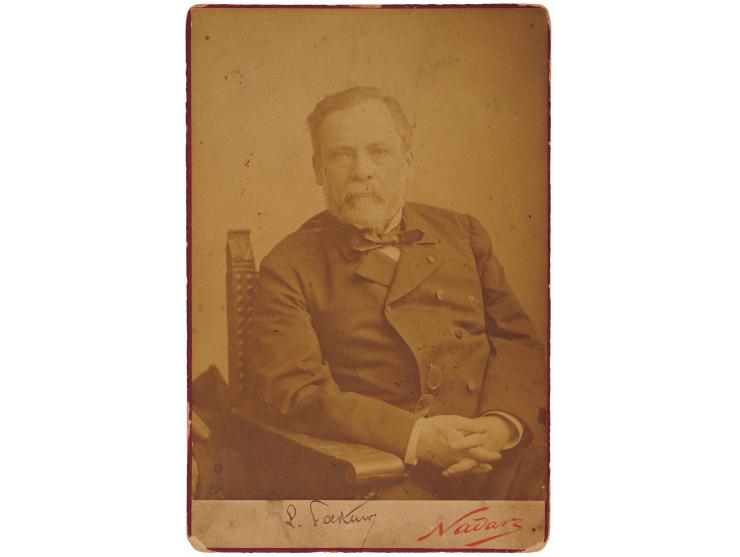
Scarce 4.25 x 6.5 cabinet photo of the celebrated scientist by Nadar of Paris, signed on the mount in ink, "L. Pasteur." In very good to fine condition, with small stains, light scuffing and soiling, and some minor edge chipping.
Opening: $200
Estimate: $1,000 - $1,500
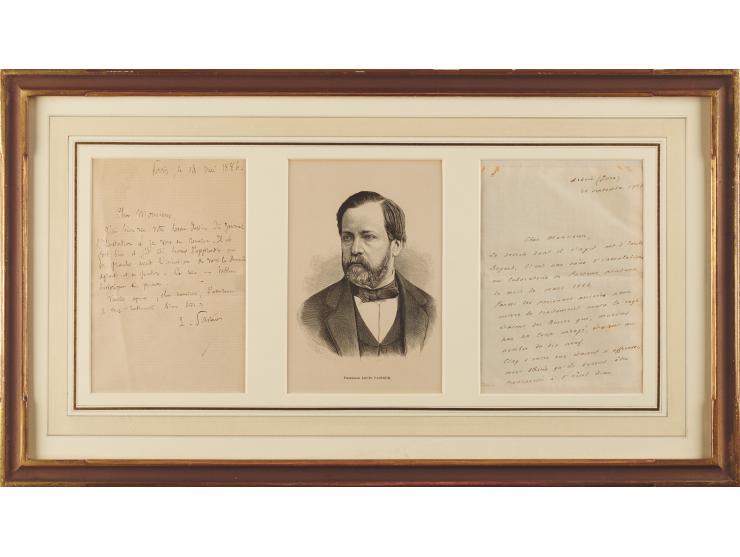
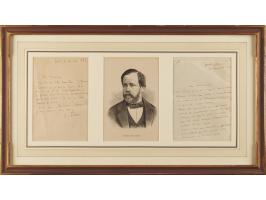
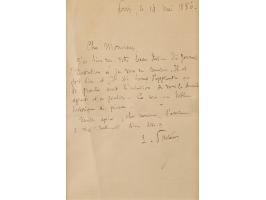
ALS in French, signed “L. Pasteur,” one page, 4.5 x 6.75, May 14, 1886. Handwritten letter expressing his appreciation for an illustration by A. Gerardin, which appeared in the French illustrated weekly newspaper L'Illustration in 1886 and showed some of the rabies patients under his care. Matted and framed with an engraved portrait and an explanatory letter by his son-in-law, René Vallery-Radot, to an overall size of 21.25 x 12. In fine condition.
Soon after beginning his experimental inoculation treatment for rabies, Louis Pasteur received hundreds of bite victims from across Europe and the United States, including severely injured Russian peasants attacked by a rabid wolf and English children bitten by a mad dog, all seeking his preventative care in Paris. Despite the grave nature of many wounds and intense public attention, Pasteur’s method had resulted in only two deaths at the time, one due to extreme injuries and another from receiving treatment too late.
Opening: $500
Estimate: $3,000 - $5,000
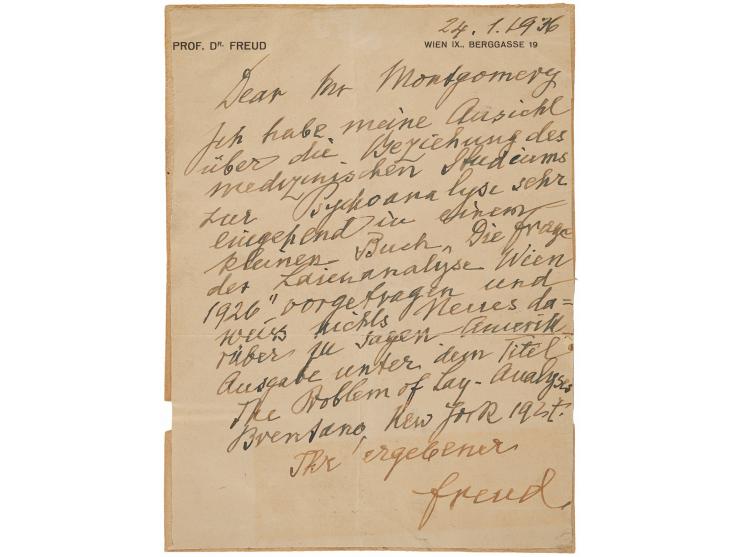
ALS in German, signed “Freud,” one page, 5.25 x 7.25, personal letterhead, January 24, 1936. Handwritten letter to "Mr. Montgomery," in part (translated): "I have expounded my view on the relationship of medical studies to psychoanalysis in great detail in a small book, 'The Question of Lay Analysis,' Vienna 1926, and have nothing new to add to it." Backed by two separated mounts and in good to very good condition, with trimmed edges, toning, and some splitting to the folds.
Sigmund Freud’s 1926 book The Question of Lay Analysis defends the right of non-physicians to practice psychoanalysis. Written in response to legal challenges against Theodor Reik, a non-medical analyst, Freud argues that psychoanalysis is primarily a psychological discipline rather than a branch of medicine. He maintains that proper training in psychoanalytic theory and technique—not a medical degree—is the essential qualification for practicing analysis.
Opening: $200
Estimate: $2,000 - $4,000
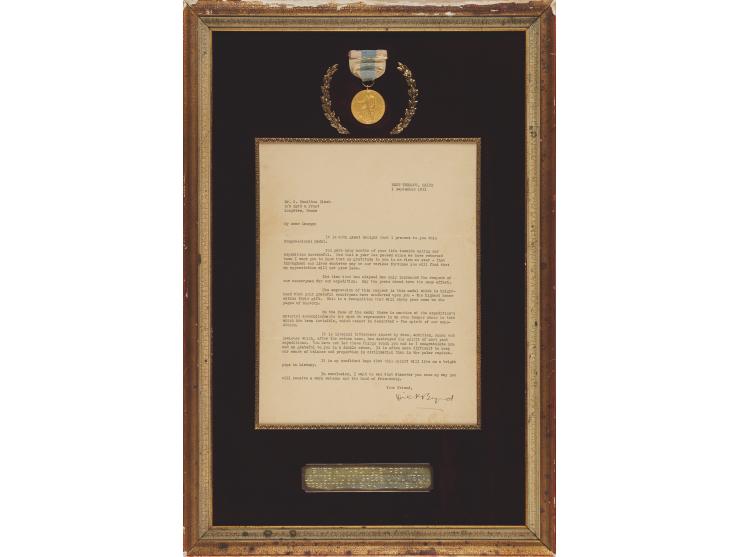
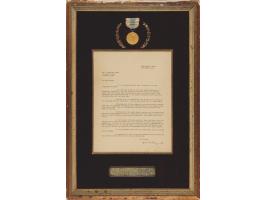
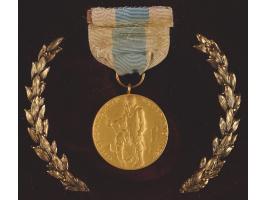
Exceptionally rare Congressional Gold Medal from the Byrd Antarctic Expedition presented to George Hamilton Black, a supply officer on Richard E. Byrd’s famed Antarctic Expedition of 1928–1930. The medal, 1.25˝ in diameter, bears an embossed front design of Admiral Byrd in fur-lined arctic clothing encircled with text: “Byrd Antarctic Expedition 1928-1930.” The edge is engraved “G. Hamilton Black,” and the medal is suspended from a white silk ribbon with a light blue center stripe. The reverse (hidden due to framing) features the sailing ship City of New York, surrounded by dedication text: ‘Presented to the Officers and Men of the Byrd Antarctic Expedition to Express the High Admiration In Which the Congress and the American People Hold Their Heroic and Undaunted Services in Connection With the Scientific Investigation Exploration of the Antarctic Continent.’
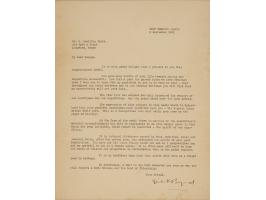
The medal is presented with its original transmittal TLS from Admiral Byrd, signed “Dick Byrd,” one page, 8.25 x 10.75, September 1, 1931. Addressed from West Tremont, Maine, the letter reads, in full: “It is with great delight that I present to you this Congressional Medal. You gave many months of your life towards making our expedition successful. Now that a year has passed since we have returned home I want you to know that my gratitude to you is as firm as ever — that throughout our lives whatever may be our various fortunes you will find that my appreciation will not grow less. The time that has elapsed has only increased the respect of our countrymen for our expedition. May the years ahead have the same effect.
The expression of this respect is this medal which is knighthood that your grateful countrymen have conferred upon you — the highest honor within their gift. This is a recognition that will carry your name on the pages of history. On the face of the medal there is mention of the expedition's material accomplishments but what it represents in an even deeper sense is that which has been invisible, which cannot be described — the spirit of our expedition.
It is internal bitterness caused by fame, ambition, money and jealousy which, after the return home, has destroyed the spirit of most past expeditions. You have not let these things touch you and so I congratulate you and am grateful to you in a double sense. It is often more difficult to keep our sense of balance and proportion in civilization than in the polar regions. It is my confident hope that this spirit will live as a bright page in history. In conclusion, I want to say that whenever you come my way you will receive a warm welcome and the hand of friendship.” Matted together with an engraved plate within its original frame to an overall size of 14 x 21. In overall very good to fine condition.
On May 23, 1930, President Herbert Hoover signed legislation enacted by the 71st Congress (1929–1931) authorizing the award of Congressional Gold, Silver, and Bronze Medals—among the highest honors bestowed by the United States Congress—to members of Rear Admiral Richard E. Byrd’s first Antarctic expedition. Byrd, already renowned for his pioneering Arctic flights, led the expedition to Antarctica in December 1928, where the team established their base—dubbed ‘Little America’—on the Ross Ice Shelf and from which Byrd made the historic first flight over the South Pole in November 1929.
Over the course of two years, the explorers endured the extreme conditions of the Antarctic while conducting extensive scientific work. Using aircraft for aerial surveys, the expedition mapped more than 150,000 square miles of previously uncharted territory and gathered valuable geological and meteorological data. The perilous nature of Byrd’s polar explorations and the scientific knowledge gained from them led Representative Clarence McLeod of Michigan to describe the achievement as among ‘the wonders of our age.’
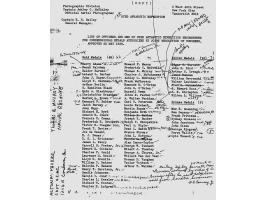
Following congressional authorization, the Navy Department organized a competition to design the medal. Francis H. Packer of New York was awarded the $1,000 prize when the Commission of Fine Arts selected his design from among 16 submissions. The medal measures 1.25 inches in diameter and was struck in gold, silver, and bronze. A total of 81 medals were produced at a cost of $6,560 — 65 in gold, seven in silver, and nine in bronze — and were awarded to members and key participants of the expedition. A modern printed copy of the original list of medal recipients is included, with Black’s name (“G. Hamilton Black”) present in the “Gold Medals” column.
Accompanied by various photographs, documents, and certificates related to Black’s career (one bearing a facsimile signature of President Lyndon B. Johnson), his vintage Amrita Grotto fez, and a presentation board containing an image of Black and an impressive set of 13 military pins and medals.
George Hamilton Black (1896–1965) was a merchant seaman and a decorated combat veteran of three wars whose career combined military service with polar exploration. A retired Army sergeant, he served in World War I, World War II, and the Korean War, earning numerous decorations for valor. During World War I, he fought with the Navy and received the Navy Cross for heroism in a sea battle off the coast of Ireland. Later, before the United States entered World War II, he served as a Canadian infantryman and was awarded the British Distinguished Service Cross for destroying a German machine-gun nest near Dieppe. His other honors included the Silver Star and Bronze Star.
Beyond his combat record, Black was closely associated with the famed explorer Rear Adm. Richard E. Byrd. He served as Byrd’s supply officer on two polar expeditions in the 1920s, joining the 1926 Arctic expedition during which Byrd and pilot Floyd Bennett attempted their flight over the North Pole. Black was stationed in an Arctic archipelago supporting the mission. Two years later, he accompanied Byrd to Antarctica, where he was temporarily stranded in a blizzard miles from the expedition’s base at Little America. Despite the extreme conditions and hardships faced by the party, the expedition succeeded, and after months in the polar wilderness the team safely returned home, marking a notable chapter in early American polar exploration.
Opening: $200
Estimate: $1,000 - $2,000
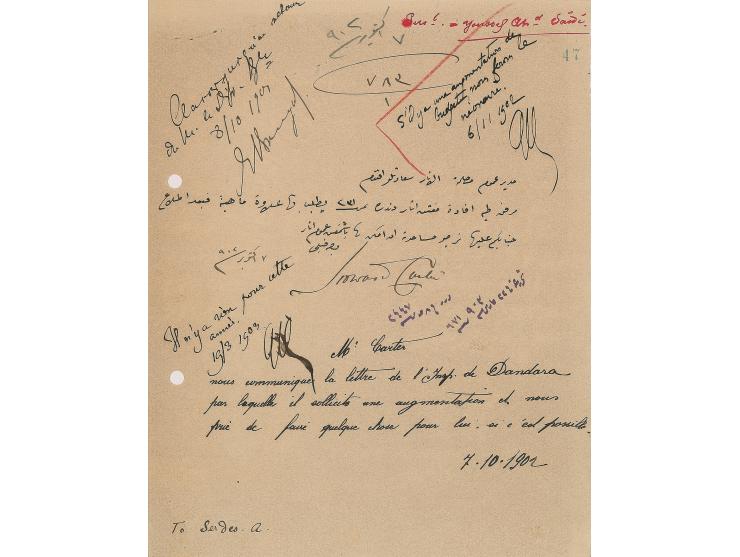
Manuscript DS, one page, 7 x 9, 1902. Document concerning a pay raise for a tomb guard, signed by Carter to approve the request. Also initialed twice by prominent Egyptologist Gaston Maspero. In fine condition, with pin holes to upper left corner and two file holes along the left edge.
During this period, Carter was serving as Chief Inspector of the Egyptian Antiquities Service and supervising a number of excavations at Thebes (now Luxor). A highly desirable, early document directly associated with his archaeological work.
Opening: $500
Estimate: $4,000 - $6,000
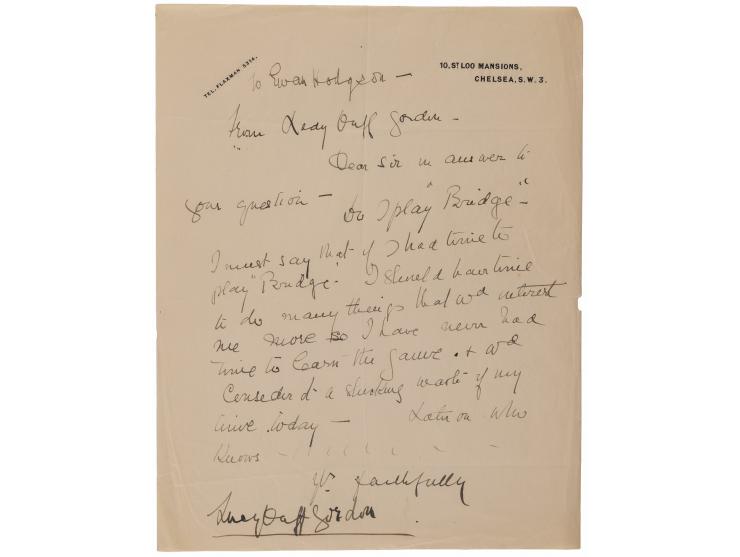
ALS signed “Lucy Duff-Gordon,” one page, 7.75 x 10, 10 St. Loo Mansions letterhead, no date. Handwritten letter, headed: "To Evan Hodgson—From Lady Duff Gordon," in full: "In answer to your question—Do I play 'Bridge'—I must say that if I had time to play 'Bridge,' I should have time to do many things that w'd interest me more so I have never had time to learn the game & w'd consider it a shocking waste of my time today—later on who knows." In fine condition.
Lucile, a prominent fashion designer, and her husband Cosmo Duff-Gordon were aristocrats who controversially fled to safety on Titanic's Lifeboat No. 1, occupied by a mere dozen people despite a capacity of forty. The wealthy couple soon became a popular tabloid topic with allegations that Cosmo had bribed the crew to row away faster, rather than returning to rescue others; the press ultimately dubbed it the 'Money Boat.' The only passengers to participate in the inquiry's hearings, it was deemed that the Duff-Gordons did not deter the crew from any attempt at rescue, but that the lifeboat might have been able to rescue others had it turned around. Lady Duff-Gordon would later say that her husband was brokenhearted over the negative coverage for the rest of his life.
Opening: $200
Estimate: $2,000 - $4,000
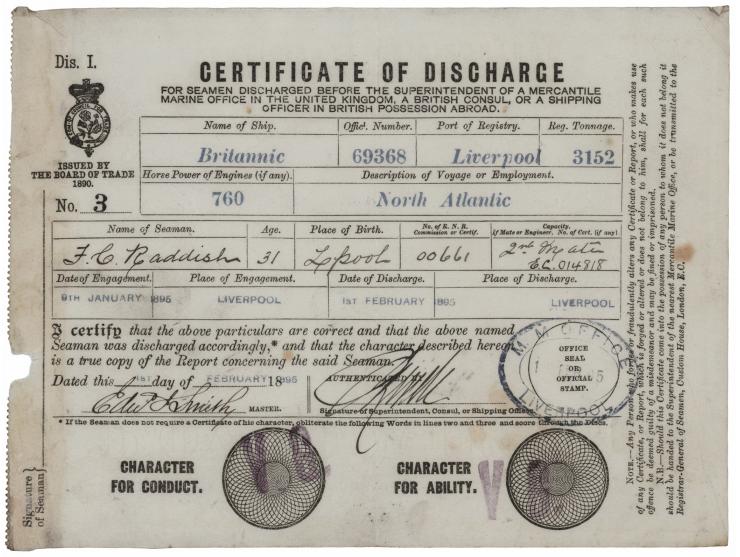
Partly-printed DS, signed “Edw'd J. Smith,” one page, 8 x 6, February 1, 1895. Certificate of discharge issued to F. C. Raddish, a second mate on board the Britannic. Printed near the bottom is a certification statement which reads, “I certify that the above particulars are correct and that the above named Seaman was discharged accordingly, and that the character described hereon is a true copy of the Report concerning the said Seaman.” Signed at the conclusion of the statement by Smith as the vessel’s master, and countersigned by a shipping representative. In fine condition, with faint toning along the left edge.
Smith joined the White Star Line in 1880 and assumed command of the Britannic, a post he held until May of 1893, when he left to briefly command the Adriatic. As he rose in seniority, Smith became a favorite of the wealthy financiers and notables who frequently traveled aboard his ships, acquiring the nickname the 'Millionaires' Captain.' From 1904 on, Smith commanded the White Star Line's newest vessels on their maiden voyages, including the R.M.S. Titanic.