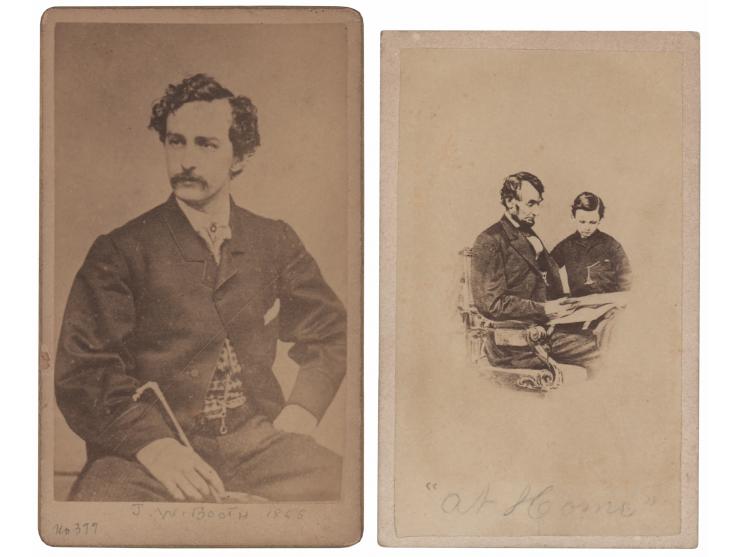
Lot 85
Abraham Lincoln and John Wilkes Booth
Opening: $200
Estimate: $400 - $600
Two uncommon carte-de-visite photos, including: a 2.5 x 4 portrait of Abraham Lincoln reading with his son Tad, after a photograph taken by Anthony Berger; and a 2.5 x 4 portrait of Lincoln assassin John Wilkes Booth, after a photograph taken by Alexander Gardner. In overall fine condition, with old pencil notations to the bottom of each photo.
On February 9, 1864, portrait painter Francis B. Carpenter arranged for President Lincoln to sit for a series of photographs at Matthew Brady’s Washington D.C. gallery. Carpenter, the President, and Lincoln’s youngest son Tad walked to Brady’s studio at 3 p.m.
Since Brady’s eyesight was beginning to fail, he asked his superintendent, Anthony Berger, to photograph Lincoln. Berger took at least seven poses of the President, both alone and with ten-year-old Tad. The images taken that day have formed the basis for Lincoln’s image on the penny and both the old and new $5 bills.
In this image, Lincoln holds 'a big photograph album which the photographer, posing the father and son, had hit upon as a good device to use in this way to bring the two sitters together.' Lincoln later feared that the public would view this pose as 'a species of false pretense' because most viewers would assume the book was a large clasped Bible. When they learned that it was a photograph album, they might think Lincoln was 'making believe read the Bible to Tad.' Just as Lincoln feared, after his death, some versions were carefully retouched to make the album appear like a large Bible.
In the second half of 1863, the twenty-five-year-old actor John Wilkes Booth visited Alexander Gardner's photographic studio in Washington, D.C. The young Scottish photographer had worked for Matthew Brady from 1856 to 1862, learning the photographer's art. After opening his own studio in Washington, D.C., in May 1863, Gardner photographed both President Abraham Lincoln and his future assassin, along with thousands of Civil War officers and enlisted men.