Lot 185
Charles Babbage
Opening: $200
Estimate: $2,500 - $3,500
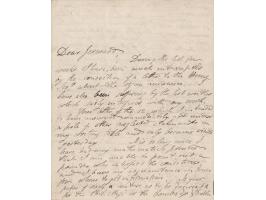
ALS signed “C. Babbage,” three pages on two adjoining sheets, 7.25 x 9, August 29, 1861. Handwritten letter to "Jerwood," mentioning his work on the Analytical Engine and signals for ship navigation, while complaining about the Royal Society. In part: "I am steadily working at the Anal. Eng. as far as health and means admit. My occulting signals after being ignored for two years seem likely to be put in practice. I have observed for some time that various schemers had proposed lights for night signals and I knew they could not use them with success without employing my occulting and blinking lights…The French Minister or Marine has made a contract for eight electric lights to be placed along the court of the channel. 'The object of these lights is to maintain a communication with ships within light of land, and to transmit the news rapidly to the interior.' As to the R.S., the council have recommended Sabine—to the great disgust of Murchison, and as one of the fellows tells me, also to the great disappointment of a certain other fellow, Dr. Granville. The R.S. has treated me upon several occasions with the greatest injustice: but I had no conception that it could ever have been reduced to such a degraded position." In fine condition.
Charles Babbage’s Analytical Engine, first described in the 1830s, was a groundbreaking mechanical computing machine and is often considered the first concept for a general-purpose computer. Unlike his earlier Difference Engine, which was built to perform specific calculations, the Analytical Engine was designed to execute a wide range of operations using punched cards for input. It featured key components found in modern computers, including a 'store' (memory) to hold numbers and a 'mill' (processor) to perform calculations. Although it was never completed during Babbage’s lifetime, the design introduced fundamental ideas such as programmability and conditional branching, laying the foundation for modern computing.